Jump to section
- Table of Contents
- What Web Scraping Services Australia Deliver
- DIY Scraping vs Managed Web Scraping Services
- Designing a Production Pipeline for Australian Sources
- Schema Design and Normalization
- When to Use CV and LLM Parsing
- Handling Rate Limits, Proxies, and Anti-Bot Defenses
- Proxy Selection and Rotation
- Rate Limit Management
- CAPTCHA Strategy
- Fingerprinting and Browser Hygiene
- Data Governance and Compliance for Australian Workloads
- Review Site Terms and Minimize Collection
- Documentation and Audit Trails
- Rate Limits and Respectful Collection
- Public Interest Versus Commercial Harvesting
- Compliance Checklist for Australian Web Scraping Projects
- Quality Controls, Delivery Formats, and Scheduling
- Delivery Options and Trade-Offs
- Scheduling and Cadence Decisions
- Final Tips
- Choosing a Web Scraping Partner in Australia
- What to Require From Proposals
- Frequently Asked Questions About Web Scraping Services in Australia
- How Do Managed Providers Handle Site Changes and Breakages Over Time
- What Makes a Managed Service Different from a Generic Scraping API
- How Are Multi-Geo and Multi-Language Requirements Met
- What Realistic Delivery Cadences Look Like for Common Workloads
- How Do Providers Prove Reliability So Vendors Are Comparable
Web scraping services in Australia offer managed, production-grade data operations that extend well beyond one-off scripts. For enterprise buyers, this means feasibility assessments, geo-targeted collection, ongoing monitoring, and compliance documentation come as standard rather than optional add-ons.
Table of Contents
Open Table of Contents
- What Web Scraping Services Australia Deliver
- DIY Scraping vs Managed Web Scraping Services
- Designing a Production Pipeline for Australian Sources
- Handling Rate Limits, Proxies, and Anti-Bot Defenses
- Data Governance and Compliance for Australian Workloads
- Quality Controls, Delivery Formats, and Scheduling
- Choosing a Web Scraping Partner in Australia
- Frequently Asked Questions About Web Scraping Services in Australia
- How Do Managed Providers Handle Site Changes and Breakages Over Time
- What Makes a Managed Service Different from a Generic Scraping API
- How Are Multi-Geo and Multi-Language Requirements Met
- What Realistic Delivery Cadences Look Like for Common Workloads
- How Do Providers Prove Reliability So Vendors Are Comparable
What Web Scraping Services Australia Deliver
A managed engagement in Australia typically begins with clear scoping and feasibility studies that map target sites and account for state-level variations in content and pricing.
- Scoping and feasibility work with sample extractions to prove coverage and establish realistic effort estimates.
- Schema design aligned with downstream warehouse and analytics requirements.
- Geo-targeted IP pools and localization to capture state-specific pricing, inventory, and promotional content.
- Continuous monitoring with automated retries and selector re-tuning when target sites undergo redesigns.
- Quality controls including schema validation, field-level diffs, freshness alerts, and exception reporting.
- Flexible delivery options such as CSV and JSON feeds, S3 drops, webhooks, and scheduled PDF compliance reports.
Managed services absorb operational risk so engineering teams can focus on product work rather than maintenance.
Real-world scenario: An ad verification bureau needs country- and state-level creative renderings delivered each morning. A managed provider supplies rotating Australian IPs, regional request patterns designed to avoid detection, and SLA-backed deliveries ensuring that stale or blocked requests never compromise compliance reporting.
DIY Scraping vs Managed Web Scraping Services
Choosing between building an in-house scraping operation and engaging a managed service comes down to where your team wants to invest time and accept risk. The table below outlines the key trade-offs.
| Dimension | In-House Scraping | Managed Web Scraping Service |
|---|---|---|
| Ownership | Full internal control | Vendor-run with SLAs |
| Setup Time | Weeks to months | Feasibility in days |
| Maintenance | High ongoing effort | Vendor handles re-tuning |
| Compliance | Internal burden | Vendor provides audit trails |
| Geo Coverage | Limited unless built | Australian IP rotation baseline |
| Risk | Higher blocking and failures | Proactive monitoring and alerts |
In practice, the decision often hinges on whether your team has the bandwidth to maintain infrastructure that demands constant attention as target sites evolve.
Practical tip: Start with a short feasibility study and a fixed schema to quantify the engineering time saved and the risk transferred before committing to a longer engagement.
The screenshot above shows ABS guidance on web scraping and CPI data usage, illustrating the legal context for statistical scraping in Australia.
This highlights that public-interest uses differ significantly from commercial harvesting and reinforces the need for documented use cases and audit trails.
Read also: Learn more about automated price monitoring and delivery options in our Price Monitoring guide.
Designing a Production Pipeline for Australian Sources
Building a reliable pipeline for Australian sources starts with aligning technical execution to business objectives. The infographic below outlines a five-step managed delivery lifecycle, illustrating how data collection and quality assurance feed into one another.
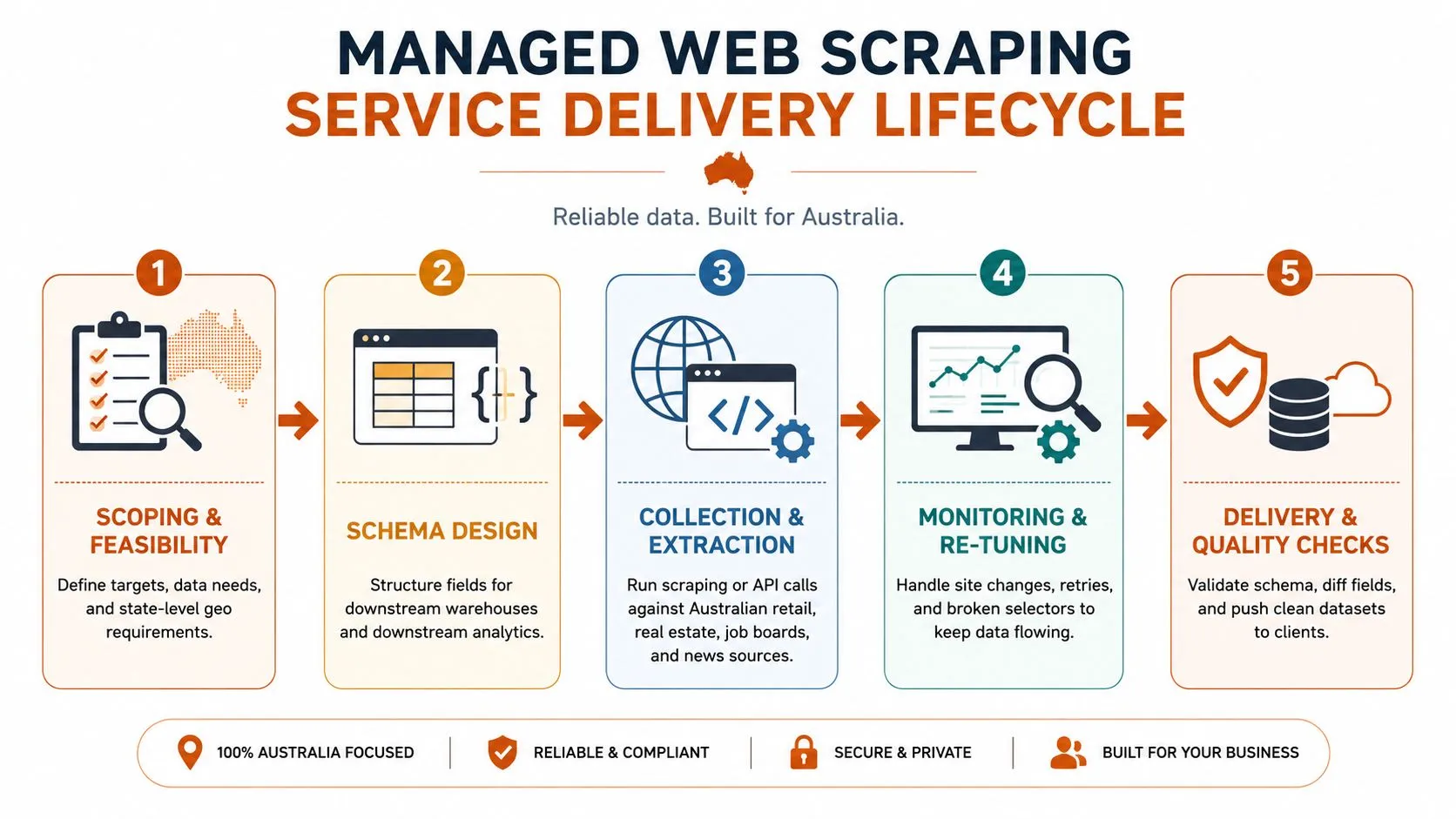
The flow moves from Scoping and Feasibility through Schema Design, Collection and Extraction, Monitoring and Re-tuning, and finally Delivery and Quality Checks. Mapping these phases out helps stakeholders pinpoint exactly where effort and risk concentrate.
Matching your collection method to target stability, freshness requirements, and budget is crucial. Official APIs work well when their rate limits and data coverage align with your cadence. Public scraping costs less for broad coverage but demands robust monitoring. Streams are the right call for high-frequency signals, such as marketplace price changes or SERP snapshots.
- Design schemas with downstream data warehouses in mind. Establish canonical IDs, timestamps, and provenance fields to maintain traceability.
- Capture both structured fields and visual attributes when tracking product pricing and stock levels.
- Plan for schema versioning to accommodate gradual shifts without breaking downstream consumers.
Handling Australian state differences requires multi-geo normalization. To reconcile listings from New South Wales, Victoria, and Western Australia, capture state codes, local SKU variants, promotion scopes, and delivery windows.
Schema Design and Normalization
Build schemas that allow analytics to treat New South Wales and Tasmanian results comparably, while preserving state-level nuance for compliance and stock checks.
Fine-tuning your collection tactics makes a significant difference at scale:
- Blend APIs, scraping, and streams based on the reliability and freshness each source offers.
- Rotate Australian IP addresses and embed polite request patterns to minimize blocking.
- Rely on browser-based extraction for heavy JavaScript sites, though HTML parsing is far more efficient for static pages.
Staying ahead of extraction failures requires active oversight:
- Monitor and re-tune proactively. Automated selector tests and diff alerts catch broken extractions early.
- Implement retries with exponential backoff to prevent noisy failures from cascading.
- Maintain small, curated test sets to validate visual extraction and OCR accuracy.
When to Use CV and LLM Parsing
Computer vision and LLM parsers become essential when target fields hide within images, inconsistent layouts, or vendor-provided PDFs. Use computer vision to extract labels and LLMs to classify ambiguous text, then validate those outputs against rule-based checks.
Consider a retail intelligence pipeline capturing daily prices, stock levels, and product images across major Australian ecommerce platforms. Combining structured price fields with image-derived attributes helps the system detect pricing errors and promotional creative discrepancies.
For a deeper dive into the architecture, read our guide on building scalable data pipelines with Scrapy.
Handling Rate Limits, Proxies, and Anti-Bot Defenses

Before writing a single line of collection code, spend time profiling the target site. Every platform defends itself differently. Retail search results pages tend to enforce strict per-IP rate limits, while classified ad sites often tolerate more bursty traffic. Understanding this upfront lets you choose the right proxy mix and pacing strategy instead of guessing and burning through IPs.
Residential proxies work best when a site runs aggressive bot detection — they look like ordinary household connections. Mobile proxies come in handy when content is tied to carrier IP ranges. Datacenter proxies are the cheapest option, but they fail quickly against any serious fingerprinting. If you’re collecting state-level pricing or inventory across Australia, rotating through Australian IPs is non-negotiable to avoid geo-blocks.
Proxy Selection and Rotation
- Segment your proxy pool by type so you can run A/B tests and measure what actually works.
- Use sticky sessions for authenticated flows — keeping the same IP across a session reduces fingerprint variance and lowers the chance of getting flagged.
- Track IP reputation actively. Retire addresses that start returning repeated challenges or blocks.
“Managed proxy logic and alerting prevented silent data corruption in production” — a lesson that comes up repeatedly in ad verification operations.
Rate Limit Management
Respectful request patterns go a long way. Build in exponential back-off, add randomized inter-request intervals, and use jittered retries so your traffic doesn’t look mechanical. Leaky-bucket or token-bucket algorithms help smooth out bursts when you’re running at scale.
Keep a close eye on HTTP response codes and challenge pages. When you see 403s or 429s climbing, that’s your signal to trigger dynamic back-off before things get worse.
- Log latency, 403/429 rates, and CAPTCHA frequencies across every proxy segment.
- Set up alerts for when the ratio of successful renders drops below an acceptable threshold — don’t wait for someone to notice missing data.
CAPTCHA Strategy
The best CAPTCHA is the one you never have to solve. Start by switching proxies or reducing your fingerprint footprint before reaching for a solving service. When you do use challenge-solving services, make sure it’s legal and compliant for your use case, and cache solved tokens carefully to avoid unnecessary costs.
Fingerprinting and Browser Hygiene
Fingerprint mitigation comes down to consistency. Your headers, timezone, fonts, and screen resolution need to tell the same story. Use real browser instances when rendering accuracy matters, and lean on headless approaches only when the content is static and simple.
Example case study: An ad verification bureau ran rotating Australian residential IPs alongside region-specific user agents and render validation hashes. This setup ensured that creatives matched what local users actually saw. When a region’s render hash deviated from the expected baseline, alerts fired immediately — catching discrepancies before they turned into false compliance reports.
Understanding how platforms defend themselves is only half the picture. It’s equally important to know how to secure apps without DevOps overhead when you’re building and maintaining these pipelines.
Read also: Check out our guide on static vs rotating proxies for implementation details.
Data Governance and Compliance for Australian Workloads
Scraping public web pages can be lawful, but the legality hinges on context, data type, and downstream use. Experienced providers build controls that let teams run recurring Australian workloads with predictable legal posture. This section summarizes practical controls, real examples, and a vendor checklist your legal team can use.
Review Site Terms and Minimize Collection
Always map publisher terms and robots.txt before designing collection logic. When possible, restrict fields to the minimum required and avoid harvesting personal data. This means capturing product titles and prices but excluding user emails or full comment bodies unless explicitly permitted.
Documentation and Audit Trails
Document every use case, intended recipient, retention period, and transformation step. Store immutable provenance metadata: source URL, capture timestamp, IP used, and schema version. These artifacts let compliance teams produce an audit package on demand.
- Keep signed feasibility notes that explain why each source is needed.
- Maintain access logs with role-based controls for data reviewers.
- Generate periodic compliance reports for auditors.
Key takeaway: Documented intent and traceable provenance reduce dispute risk.
Rate Limits and Respectful Collection
Apply conservative rate limits and geo-consistent IP pools for Australia to avoid disruptive traffic patterns. Use leaky-bucket throttling, randomized delays, and exponential backoff to demonstrate respectful behavior. For example, schedule heavy crawls overnight in the target timezone and cap concurrent connections per domain.
Public Interest Versus Commercial Harvesting
Statistical scraping under laws like the Census and Statistics Act 1905 differs from commercial harvesting of personal or copyrighted content. Treat ABS-style public-interest pulls as special cases and keep legal memos that reference applicable statutes. For commercial use, obtain permissions or fall back to licensed APIs where available.
For robust data governance and compliance, exploring tools like compliance automation software for CMMC is essential.
Compliance Checklist for Australian Web Scraping Projects
Before launching or outsourcing a recurring scraping workload in Australia, enterprise teams should confirm the following operational and governance controls. This checklist covers the core areas that legal and compliance reviewers typically scrutinize.
| Control Area | What to Confirm | Why It Matters |
|---|---|---|
| Legal Review | Terms, copyright, and jurisdiction notes | Avoid retroactive takedown claims |
| Minimization | Fields collected and retention periods | Limits privacy exposure |
| Provenance | Immutable capture metadata | Auditors need traceability |
| Rate Control | Per-domain limits and IP geography | Prevent service disruption |
| Reporting | Scheduled compliance artifacts | Simplifies vendor audits |
These controls form the backbone of a defensible scraping operation. Teams that treat them as living practices, rather than one-time checkboxes, tend to navigate audits and publisher inquiries with far less friction.
Read also: Learn more about ethical operational controls in our ethical data collection guide.
Quality Controls, Delivery Formats, and Scheduling

Quality doesn’t begin at the dashboard—it starts the moment extraction finishes. Validate schemas against expectations, diff fields between consecutive runs, and trigger freshness alerts when captures miss their SLAs. Small teams benefit enormously from automated schema checks that fail builds early and produce exception reports humans can actually read.
Delivery Options and Trade-Offs
Different teams need different outputs. Match the format to the consumer:
- CSV and JSON feeds serve analytics teams well. CSV works for quick spreadsheet work; JSON preserves nested product attributes that would flatten in a spreadsheet.
- Webhooks cut polling costs by pushing only changed records—ideal for event-driven workflows where you need to react, not repeatedly ask.
- S3 drops handle large batches reliably and slot directly into existing ETL jobs without extra orchestration.
- PDF compliance reports give non-technical reviewers and legal teams something they can annotate, with exceptions and remediation actions clearly highlighted.
Key insight: Automated PDF summaries slashed analyst triage time by 60% in a cooperative advertising workflow where exceptions still needed human sign-off.
Here’s a quick comparison:
| Use Case | Recommended Format | Why It Works |
|---|---|---|
| Ad verification daily snapshots | JSON + S3 | Full render metadata and images |
| Monthly compliance summaries | Human-readable highlights and annotations | |
| Real-time alerts | Webhook | Immediate downstream processing |
Scheduling and Cadence Decisions
Freshness costs money. Hourly captures keep pricing and SERP signals current but burn through budgets and invite rate-limit trouble. Daily runs hit the sweet spot for most retail intelligence—fresh enough to matter, cheap enough to sustain. Monthly PDFs work for compliance teams who review on fixed cycles.
A few scheduling principles I’ve learned the hard way:
- Align cadence with downstream review windows. If nobody looks at the data until Monday morning, hourly weekend captures are wasted compute.
- Use incremental runs with field-level diffs. Send only changed records instead of full dumps—your downstream systems will thank you.
- Schedule heavier crawls during off-peak hours in the target timezone. You’ll reduce publisher load and often get cleaner responses.
Example scenario: A cooperative advertising team receives monthly PDF dealer compliance reports with exceptions highlighted. Analysts open the PDF, review images of non-compliant listings, and approve remediation tickets—no JSON parsing required.
Final Tips
- Version your schemas and include provenance fields (source URL, capture timestamp, schema version). When something breaks six months from now, you’ll know exactly what changed.
- Emit quality metrics like 403/429 rates, missing-field ratios, and render-hash drift. These catch silent failures before they become data quality incidents.
- Automate remediation playbooks for common exceptions. The goal is to keep your Web Scraping Services Australia pipelines dependable without requiring a human to babysit every hiccup.
Choosing a Web Scraping Partner in Australia
Selecting a managed provider for web scraping services in Australia comes down to three things: operational reliability, legal posture, and measurable outputs. Everything else is secondary.
Start by asking for documented case studies with quantified delivery volumes. This lets you benchmark expectations before committing anything. Request schema version histories and concrete examples of how they handled site redesigns — you want to see their re-tuning workflows in action, not just hear about them. If visual attributes matter to your use case, demand image intelligence samples along with deduplication and format conversion reports.
What to Require From Proposals
- Feasibility study showing target coverage and edge cases with sample payloads
- Fixed schema agreement and migration plan for future fields
- SLAs tied to the business question — daily price freshness, render-hash stability, or whatever actually matters downstream
- Clear delivery formats and schedules: CSV/JSON, S3 drops, webhooks, and PDF compliance reports
Prioritize vendors that absorb maintenance burden with managed infrastructure, monitoring, retries, and automatic selector re-tuning.
Practical scoping tips help reduce risk and cost. Start small with a pilot that validates geo-specific captures across Australian states. Track 403/429 rates and missing-field ratios to assess provider performance during the pilot — these numbers tell you more than any sales deck.
Negotiate engagement models that include monthly recurring deliveries and campaign-based projects so you can scale without re-procurement. For real estate or location-heavy use cases, consult the BatchData guide to real estate data for selection criteria.
Read also: Learn more about outsourcing versus in-house effort in our Why Choose Web Scraping Services guide.
Frequently Asked Questions About Web Scraping Services in Australia
How Do Managed Providers Handle Site Changes and Breakages Over Time
Managed teams run continuous monitoring with automated selector tests and health checks. When a selector fails, automated retries and targeted re-tuning attempt recovery before an engineer ever needs to step in.
This approach keeps incident windows measurable and lets you budget downtime into a proper SLA.
What Makes a Managed Service Different from a Generic Scraping API
A managed service covers scoping, schema design, provenance logging, and re-tuning workflows. APIs typically return raw payloads, while managed providers deliver validated schema-aligned datasets with full audit trails and remediation playbooks.
Consider a retail client who received daily price tables alongside image hashes and change diffs rather than a raw HTML dump. That difference in output quality is what separates the two approaches.
How Are Multi-Geo and Multi-Language Requirements Met
Providers maintain segmented Australian IP pools and region-aware request patterns to capture state-level inventory and pricing accurately. Language normalization relies on locale fields, canonical state codes, and mapping tables to reconcile variations across New South Wales, Victoria, and Western Australia.
The result is datasets ready for ML models without any per-state preprocessing on your end.
What Realistic Delivery Cadences Look Like for Common Workloads
Ad verification often calls for daily or hourly snapshots with render hashes and screenshots. Retail price monitoring usually fits daily runs with incremental diffs, while hourly schedules are reserved for high-volatility categories.
Real estate and jobs feeds commonly run on daily or weekly cadences with full-field validation and de-duplication built in.
How Do Providers Prove Reliability So Vendors Are Comparable
Ask for feasibility studies, sample payloads, schema version history, and quantified metrics like 403/429 rates and missing-field ratios. Pilot captures across Australian states reveal geo-blocking risk and proxy effectiveness.
Compare vendors on measured delivery volumes and documented re-tuning examples rather than marketing claims.
Key Takeaway Choose a provider that delivers measurable SLAs, traceable provenance, and concrete pilot results so decision-makers can compare Web Scraping Services Australia offerings on equal terms.
For production-grade managed pipelines and pilot feasibility studies, contact WebscrapingHQ.
Want this done for you?
Send us the URLs. We'll quote it in 24 hours.
Paste the URL(s) you want scraped. We'll reply within 24 hours with a feasibility check and a ballpark quote.