Jump to section
- Whether a PubMed Scraper Is Legal by Jurisdiction
- United States Position
- European Union and United Kingdom Positions
- What Data a PubMed Scraper Actually Collects
- Terms of Service and NCBI Usage Policies
- Publisher and Downstream Obligations
- Pre-Launch Checklist
- Rate Limits and the Access Route to Choose
- Production Pattern
- Why Baseline Files Beat Repeated Crawling
- Load Sequence
- Risk Controls for a Compliant PubMed Pipeline
- Control Checklist
- Choose In-House Scraping or a Managed Service
- Verdict by Situation
- What to Require in Writing
Scraping PubMed citation metadata is generally lawful in most jurisdictions when it follows NCBI’s usage rules, but the result depends on the data collected, the method used, and the jurisdiction of the operator and relevant data subjects. Change any one of those three variables, and a routine extraction can become a copyright, contract, or privacy problem.
Why do teams ask whether a tool is legal instead of asking what the tool stores, how it connects, and where it operates? That narrower question hides the exposure. A PubMed scraper that pulls public citation metadata through NCBI’s official route occupies a very different position from one that copies abstracts at scale, harvests author contact details, or ignores documented request limits.
Whether a PubMed Scraper Is Legal by Jurisdiction
Public visibility doesn’t settle the legal analysis. A record can be readable by any browser while its abstract remains protected by copyright, its author fields contain personal data, and its retrieval remains governed by contract terms. Those layers overlap, and satisfying one doesn’t discharge the others.
The table below states a general position for planning purposes. It isn’t legal advice for a specific dataset, product, or country pair, and it can’t substitute for a review of the current statutes and licences that apply to your use case.
| Jurisdiction | Main legal sources | Main risk for a PubMed scraper | Practical position |
|---|---|---|---|
| United States | Computer Fraud and Abuse Act; copyright law; state contract law | Breach of NCBI or publisher terms; copyright claims over stored abstracts | Lower criminal risk for public metadata after hiQ v. LinkedIn; contract and copyright claims remain |
| European Union | GDPR; DSM Directive 2019/790; database rights under Directive 96/9/EC | Personal data in author and affiliation fields; substantial extraction from protected databases | Limit personal data to what’s needed; check rights reservations; apply the research exception only for qualifying research |
| United Kingdom | Copyright, Designs and Patents Act 1988 section 29A; UK GDPR; Data Protection Act 2018 | Commercial use falls outside the non-commercial research exception | Research use is clearer; commercial use needs a licence and rights review |
| Canada | PIPEDA; Copyright Act; contract law | Collection of personal information without a clear purpose or consent | Minimise personal fields; document the purpose; review copyright on stored abstracts |
| Australia | Privacy Act 1988; Copyright Act 1968; contract law | Reproduction of abstracts beyond permitted uses; personal information handling | Keep to metadata where possible; verify current text and data mining exceptions before storing abstracts at scale |
| India | Digital Personal Data Protection Act 2023; Copyright Act 1957; Information Technology Act 2000 | Processing of personal data under the DPDP Act; copyright in abstracts | Treat personal data as regulated; confirm obligations as implementing rules are issued |
| Other jurisdictions | Local data protection and copyright law | Unknown local rules on personal data and reproduction | Obtain local legal review before collection begins |
United States Position
The Computer Fraud and Abuse Act is often treated as the whole US analysis. It isn’t. The Ninth Circuit’s 2022 decision in hiQ v. LinkedIn narrowed access-based exposure for public pages, which lowers the criminal risk attached to retrieving public metadata. It didn’t create a general right to copy, store, or redistribute what you retrieve.
Contract and copyright claims remain available even where an access claim weakens. If NCBI terms, a publisher licence, or a downstream click-through agreement restricts bulk use, breach of those terms is a separate question from unauthorised access. Copyright in abstracts and full text raises a third question, because downloading a record for analysis and republishing its expressive text aren’t the same act.
European Union and United Kingdom Positions
In the EU, author names, affiliations, and contact details can bring a project within the GDPR, even when the underlying papers are public. You need a lawful basis, a defined purpose, minimisation, retention limits, and a process for data subject rights. A practical starting point is to work through GDPR obligations for web scraping projects before deciding which personal fields, if any, belong in the schema.
The EU’s DSM Directive 2019/790 provides text and data mining exceptions, including a route for research organisations and a broader route subject to rights reservations by rights holders. Database rights can also restrict extraction of a substantial part of a protected database. None of those provisions should be read as a blanket permission to reproduce abstracts or build commercial contact products from affiliation data.
The United Kingdom takes a narrower approach to text and data mining. Section 29A of the Copyright, Designs and Patents Act 1988 permits copies for computational analysis for non-commercial research, subject to lawful access and other conditions. A commercial analytics product therefore can’t assume that a research exception covers it merely because the technique resembles academic mining.
Formal caution: These positions are general, they change over time, and they don’t account for your exact fields, licences, or redistribution model. Obtain a formal opinion from counsel before any commercial use.
Canada, Australia, and India illustrate why a single global answer fails. The statutes differ, but the recurring risks are consistent. Personal information needs a purpose and proportionate handling, expressive text needs a copyright basis, and contractual restrictions need separate review. Cross-border storage adds another layer, because the operator’s location doesn’t necessarily determine every applicable law.
The sound conclusion isn’t that PubMed scraping is legal or illegal in the abstract. It’s that low-risk work is narrow, documented, and route-specific. Public metadata retrieved through NCBI’s official channels, for a defined purpose, with personal and expressive fields excluded or justified, is materially easier to defend than indiscriminate collection through web pages.
What Data a PubMed Scraper Actually Collects
Legal exposure changes with the fields in your schema. Four classes should be separated at design time, not after the first export has already mixed them into one table.
- Citation metadata: PMID, title, journal, publication dates, article identifiers, and MeSH terms. This is generally the lowest-risk class, although database and contractual restrictions still require review.
- Abstracts: Short expressive text that’s often copyrighted by publishers. Internal analysis, long-term storage, display, and redistribution present different risks and shouldn’t be treated as one permission.
- Full text: Material reached through PubMed Central or publisher links. Licences vary by article, so each licence needs checking before copying, mining, or republishing.
- Personal data: Author names, affiliations, and contact details. Publication doesn’t remove privacy duties, particularly where records are enriched, profiled, or used for outreach.
Scale makes indiscriminate collection harder to justify. The National Library of Medicine description of PubMed states that PubMed contains more than 40 million citations covering MEDLINE, life-science journals, and online books. Its OLDMEDLINE subset contains approximately 2,011,000 citations from international biomedical journals for 1946 to 1965, converted from print indexes into machine-readable form.
That history produces uneven records. Metadata completeness, publication dates, indexing practice, and duplicate or evolving records vary across eras and sources. Don’t assume every citation has identical fields, and don’t let a parser discard records that don’t match a modern journal template. Before bulk retrieval, it’s often cheaper to use search operators to find papers and confirm that the result set, fields, and exclusions match the stated research question.
Say a team collects abstracts for 10,000 papers to build a topic model. Its central questions concern copyright, text and data mining exceptions, retention, and whether model outputs reproduce protected text. If the same team instead extracts affiliations and email addresses to build a contact list, the project moves into privacy compliance, direct marketing rules, purpose limitation, and objection handling. The source hasn’t changed. The data class and purpose have.
Store only the fields the analysis needs, and record why each retained field is necessary.
That minimisation rule is both a legal control and an engineering control. Fewer fields mean fewer licences to track, fewer personal data obligations, smaller payloads, and a clearer audit trail when a record must be corrected or deleted.
Terms of Service and NCBI Usage Policies
Law and contract aren’t interchangeable. Retrieval can be lawful under a computer access statute while still breaching NCBI’s usage conditions. For a production pipeline, that distinction is practical rather than academic, because the first consequence of non-compliance is usually operational. Access can be throttled or blocked before any court considers the underlying law.
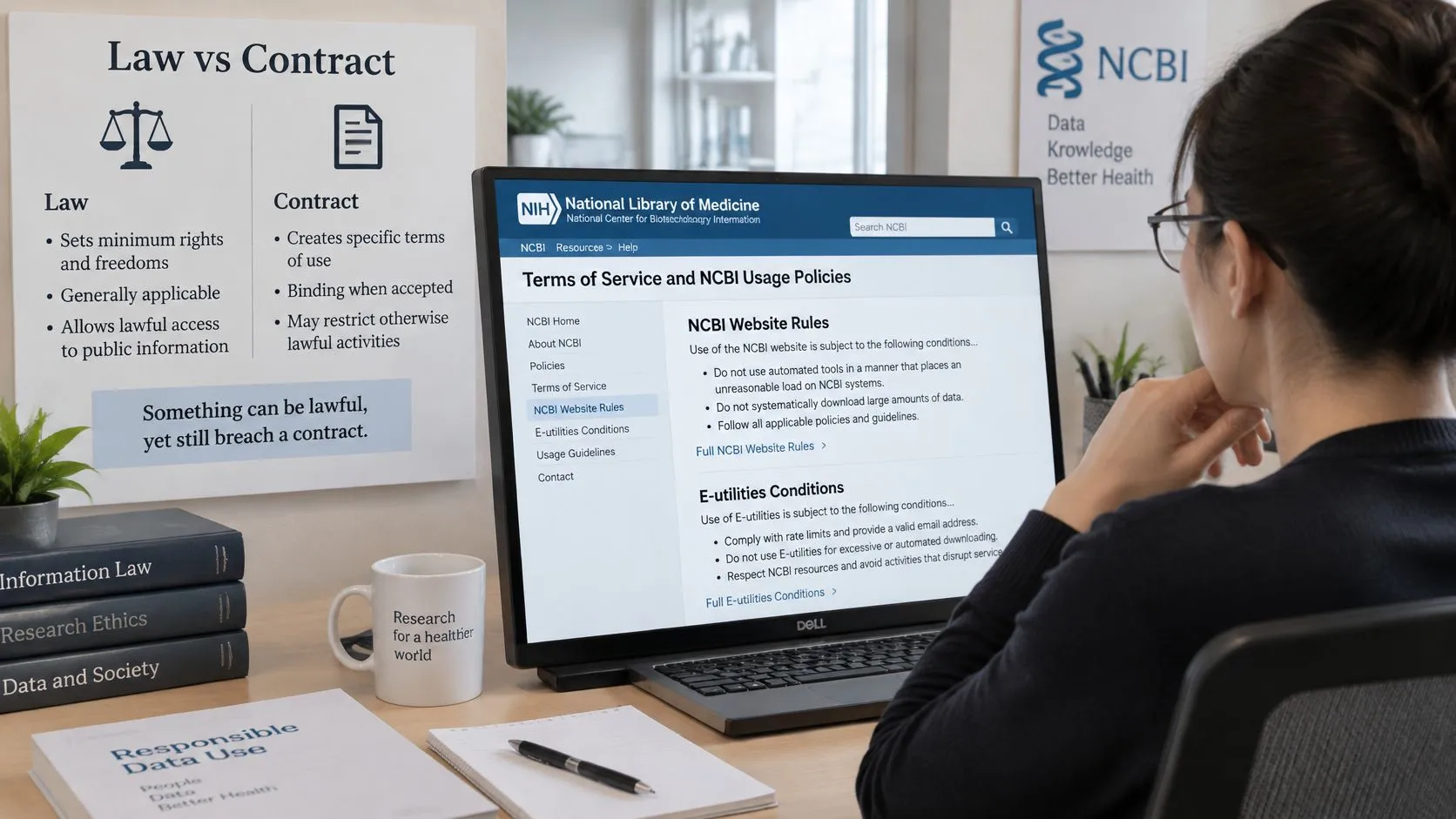
E-utilities requests should identify the application and provide a contact address through the tool and email parameters NCBI requests. That identification gives NCBI a route to contact an operator whose traffic causes problems. Anonymous high-volume traffic does the opposite. It removes the opportunity for correction and makes enforcement through throttling or an IP block more likely.
Respect the documented request ceilings, avoid redistribution that NCBI policies prohibit, and check whether robots.txt applies to any web path you fetch. We only scrape publicly available data and respect robots.txt where applicable, and that boundary should be encoded in project scoping rather than left to an individual developer’s judgment. The details of website terms of service for scrapers matter because browsewrap, clickwrap, API terms, and publisher licences create different evidentiary and contractual positions.
Publisher and Downstream Obligations
PubMed displaying a citation doesn’t grant rights in everything linked from that citation. A publisher website may impose terms on bulk retrieval, a paywall may restrict access to subscribers, and an article licence may permit reading without permitting redistribution or commercial mining. Follow each link as a new source with its own conditions, not as an extension of PubMed.
The mechanism of assent also matters. It helps to understand how clickwrap captures active consent when a publisher, repository, or API presents terms during registration or download. If your team accepted terms to obtain an API key, dataset, or full text collection, those terms may bind the organisation even if a later engineer retrieves the same material through a script.
Your own users create a further layer. If you publish a dataset, search product, or model, licence clauses and attribution duties may flow downstream. State what recipients may store, display, redistribute, and use commercially. Don’t pass on rights you don’t hold.
Pre-Launch Checklist
- Read the current terms: Review the current NCBI and PMC usage pages for every route and data class in scope.
- Record the review: Store the review date, reviewer, and terms version in project documentation.
- Map restrictions to controls: Convert each relevant restriction into a schema, rate, retention, or redistribution rule.
- Define the stop procedure: Decide in advance who can pause collection if NCBI or a publisher objects.
If an IP address is blocked or a publisher raises an objection, pause the job. Contact NCBI support with the tool and email details used in the requests, correct the settings, and document the change before resuming. Continuing from another address to evade a block converts an operational incident into evidence of deliberate non-compliance.
Rate Limits and the Access Route to Choose
The access route determines whether limits are documented and manageable or inferred from failures. For recurring work, NCBI’s E-utilities provide the defensible programmatic route, while the annual files provide the bulk route. HTML scraping offers neither a documented allowance nor a stable data contract.
| Access route | Documented limit | Failure signal | Recommended action |
|---|---|---|---|
| E-utilities without API key | 3 requests per second per IP address | HTTP 429 throttling | Global limiter set to 3 requests per second; backoff with jitter |
| E-utilities with API key | 10 requests per second | HTTP 429 when the threshold is exceeded | Global limiter set to 10 requests per second; monitor 429 rate |
| Bulk baseline and daily update files | No per-request ceiling documented; delivered as files | Missing, late or out-of-order files | Verify checksums; apply in numerical order; reconcile file counts |
| Scraping PubMed HTML pages | No allowance documented | Blocking, CAPTCHAs, selector breakage | Avoid as the primary route; use only for gaps the APIs do not cover |
| Large scheduled jobs | Weekends or 9:00 p.m. to 5:00 a.m. Eastern Time on weekdays (NCBI recommendation) | Slower responses during peak hours | Schedule backfills and bulk runs inside the off-peak window |
The NCBI support guidance on E-utilities limits documents 3 requests per second per IP address without an API key and up to 10 requests per second with a key. Exceeding the supported threshold can trigger throttling or HTTP 429 responses. At 10 requests per second, the theoretical ceiling is 864,000 requests per day, but that figure is a request ceiling, not a promised record throughput.
Real workflows chain calls. A team may search, request summaries, fetch full records, and retry failed batches. Payload size, network latency, and server throttling reduce sustained performance further. The general choice between web scraping and API access is therefore clearer here than on many sites, because NCBI documents both a programmatic interface and bulk files for the same corpus.
Production Pattern
- Register for an NCBI API key. Use the key consistently and protect it as an operational credential.
- Place a global rate limiter in front of every worker. Per-process limits fail when containers, queues, or scheduled jobs run concurrently from one IP address.
- Set bounded concurrency. A limiter controls request rate, but unbounded workers can still create retry storms and excessive local queues.
- Classify retries. Retry 429 and 5xx responses with exponential backoff and jitter. Treat other 4xx responses as permanent errors until the request is corrected.
- Persist query state. Use ESearch history with WebEnv and query key, or deterministic pagination with retstart, and checkpoint each batch so restarts don’t duplicate records.
- Schedule large jobs off peak. Run intensive work during weekends or 9:00 p.m. to 5:00 a.m. U.S. Eastern Time on weekdays.
The call sequence should remain explicit. ESearch counts and stores the result set, EFetch pulls batches, and each batch is logged with its query parameters, response code, record count, and checkpoint position. That log turns a failed run into a resumable operation rather than a reason to restart from zero.
Consider a hypothetical backfill of 500,000 records at one record per request. At 3 requests per second, it needs about 46 hours of continuous calls before retries, parsing, storage, and network overhead. Batch retrieval improves the record rate, but the example exposes the planning error in treating an API key and off-peak scheduling as optional extras.
HTML scraping is weaker for structural reasons. Layout changes break selectors, search pages aren’t designed as a complete export mechanism, and blocking becomes more likely at volume. Reserve browser retrieval for narrow manual verification or a documented gap. Don’t make it the system of record.
Why Baseline Files Beat Repeated Crawling
Repeated crawling sees only what a search page shows today. The official file route delivers a complete record set that can be rebuilt, reconciled, and audited. That difference matters when records are revised or deleted after your first extraction, because a fresh search result doesn’t reliably reveal what changed in records you already hold.
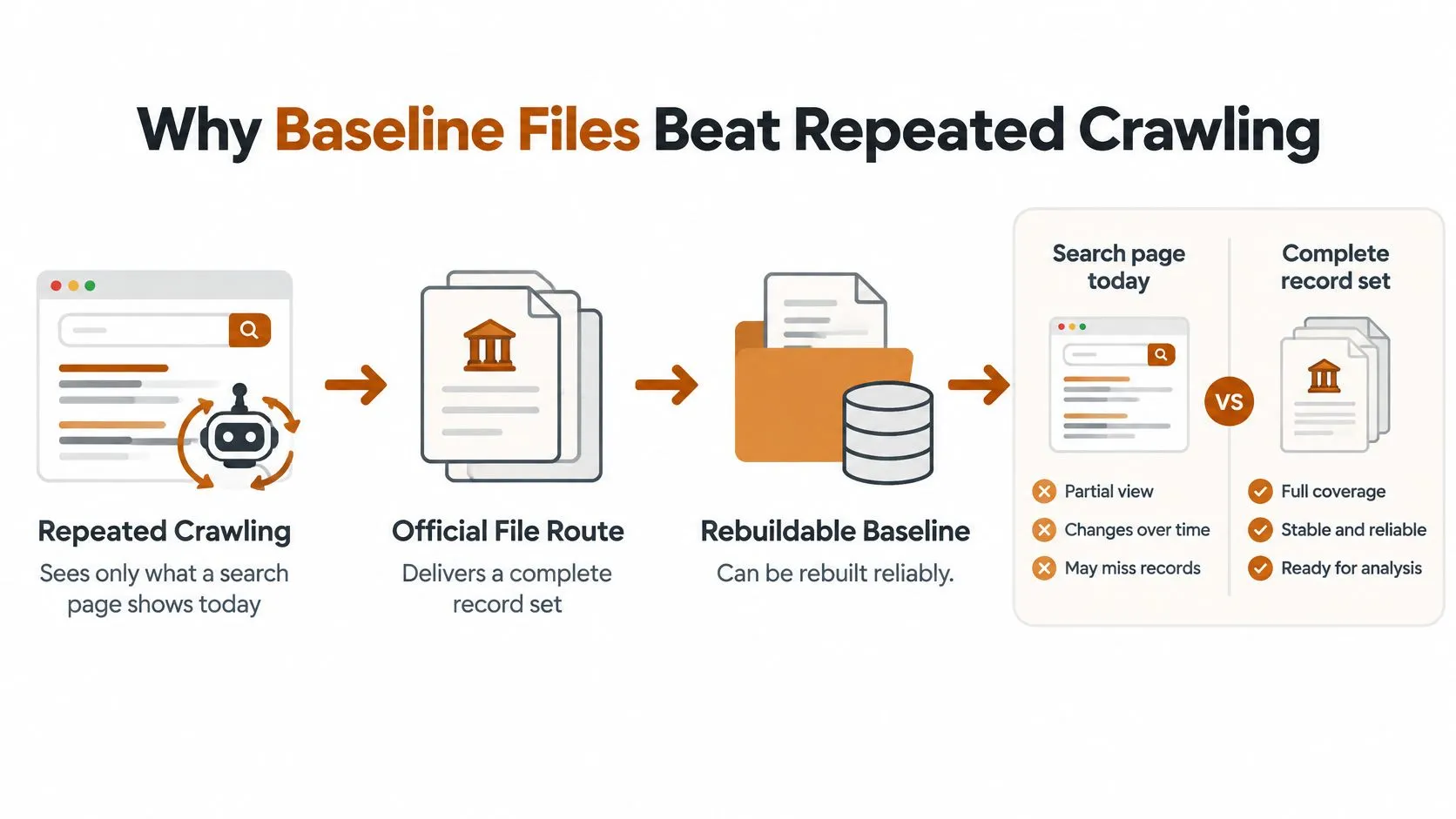
NLM’s architecture combines an annual XML baseline with daily update files. The PubMed DTD documentation describes a structure in which the baseline contains complete PubMed citation records in XML, while incremental files contain new, revised, and deleted citations. The DTD documents valid elements, attributes, and content models, giving the parser a contract against which incoming files can be validated.
Baseline plus delta ingestion reduces unnecessary bandwidth and processing. It also preserves change semantics. A revised citation replaces the prior version under a known identifier, and a deletion becomes an explicit event. A crawler that merely adds newly discovered pages can retain withdrawn or superseded material indefinitely.
Load Sequence
- Download the baseline and verify checksums. NLM distributes baseline data across multiple XML files and provides checksum files, so a corrupt or incomplete file can be stopped before it reaches the store.
- Validate against the PubMed DTD. Quarantine malformed files so schema failures surface as operational errors rather than silent gaps.
- Load keyed by PMID. Preserve the PubMed identifier as the stable primary key for updates, reconciliation, and lineage.
- Apply daily files in numerical order. A skipped day or out-of-order revision can corrupt the mirror without producing an obvious retrieval error.
- Handle revisions and deletions explicitly. Replace revised records and represent deletions as tombstones or delete events. Don’t ignore them because the local product has no delete workflow.
- Reconcile every run. Log file names, checksums, record counts, and processing status, then compare file counts with the release listing.
Updates should be idempotent. Replaying a file after a partial failure must produce the same final state, not duplicate authors, affiliations, chemicals, MeSH terms, or article identifiers. Those fields can be absent, repeated, or nested, so the parser needs versioned schemas and tests for optional structures rather than a flat mapping built from a few modern examples.
Retain raw XML alongside normalised tables. Raw retention lets engineers reparse history when a mapping defect is discovered, and record-level lineage lets analysts identify which file produced a disputed value. These controls align with disciplined batch data processing, where replay, quarantine, and reconciliation are designed into the job rather than improvised after a failure.
A mirror you cannot rebuild from named inputs is not a dataset of record. It’s an accumulated scrape.
The trade-off is clear. A baseline pipeline takes more effort to build than a page scraper, particularly around validation, storage, and deletion handling. In return, it’s cheaper to keep current, less dependent on interface changes, and substantially easier to audit. For systematic review platforms, biomedical analytics, and AI dataset construction, reproducibility usually outweighs the convenience of repeated crawling.
Risk Controls for a Compliant PubMed Pipeline
Risk in a mature PubMed pipeline is primarily a governance problem, not a selector problem. Tools retrieve records, but governance determines which records may be collected, how changes are detected, who can approve a new use, and how the organisation proves that today’s output matches its source inputs.
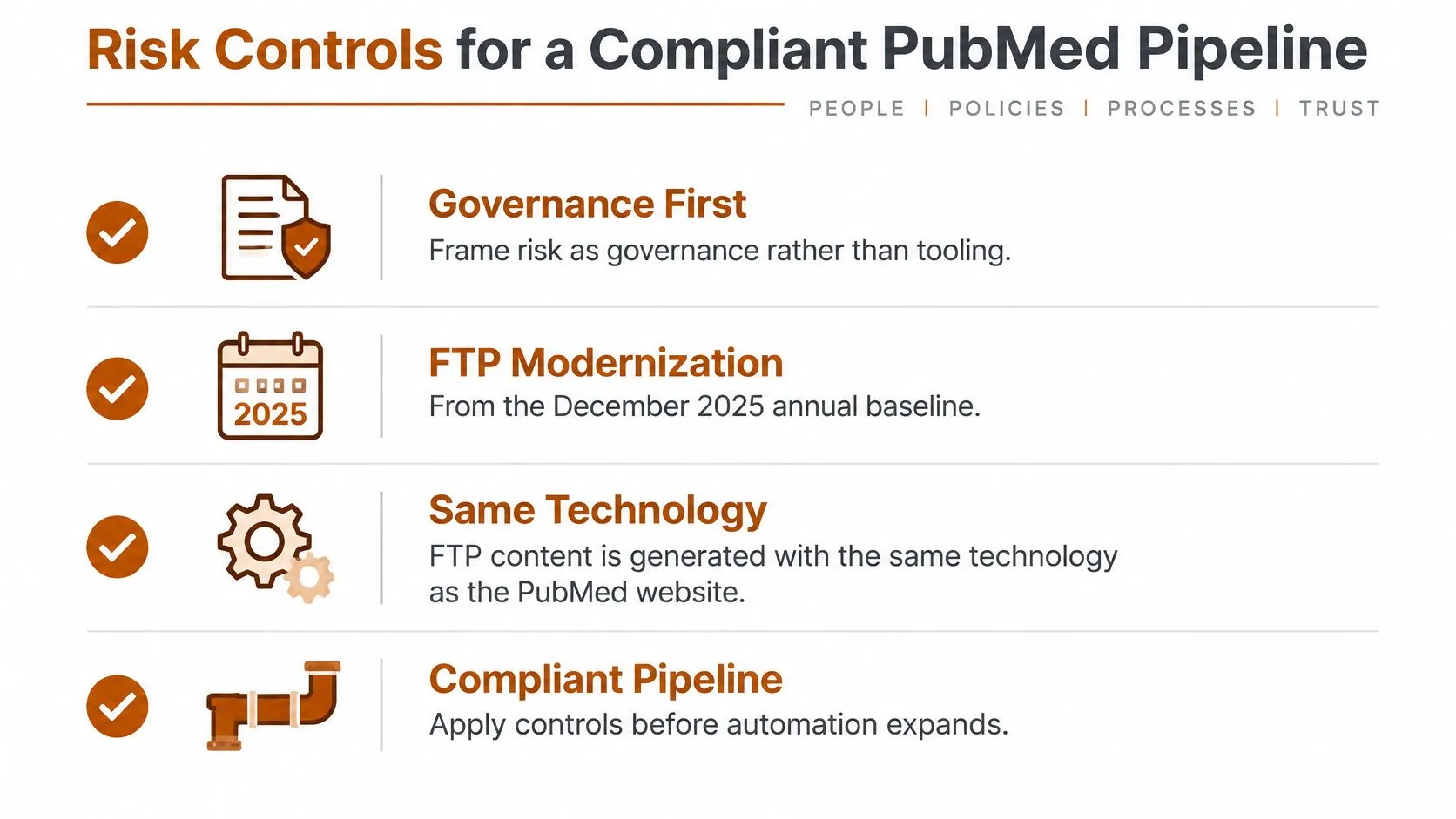
FTP modernisation illustrates the point. The NLM Technical Bulletin on PubMed FTP data states that NLM announced in June 2025 that, beginning with the December 2025 annual baseline, FTP content would be generated using the same technology as the PubMed website and E-utilities API. The stated goal was for FTP data to match the website and API, and NLM provided test update files so users could review them and test workflows before the transition.
That announcement shouldn’t be read as proof that every legacy assumption survived unchanged. Field semantics, ordering, optional elements, and delivery timing can differ even when the underlying records are intended to align. Run NLM test files through the production parser in a staging environment, compare outputs at record level, and investigate differences before cutover. Treat unexplained differences as release blockers, not cosmetic variance.
Control Checklist
- Maintain a golden-record test set. Select records covering old and new publications, repeated authors, missing abstracts, revisions, and deletions, then compare outputs before and after every format change.
- Run schema-diff tests after each release. Compare the incoming XML structure with the applicable DTD and your internal schema so new or relocated elements are reviewed deliberately.
- Set alert thresholds. Monitor record counts, deletion volumes, failed files, checksum failures, and unusual changes in key fields. Thresholds should trigger investigation before bad data reaches downstream users.
- Minimise and time-limit personal data. Exclude author contact fields unless the purpose requires them, restrict access, and set a retention period that forces deletion or renewed justification.
- Preserve raw XML and lineage. Every normalised record should trace to a source file, processing run, parser version, and transformation version.
- Define rollback in advance. A rollback must restore the previous baseline, the update files applied to it, and the schema version that interpreted them.
- Assign a legal review owner. A named owner should reassess the position whenever fields, users, jurisdictions, retention, or commercial purpose change.
Security controls belong in the same register as extraction controls. Access management, audit logs, encryption, vendor review, and incident procedures support meeting information security requirements where author data, credentials, or licensed full text are stored. A pipeline can respect NCBI rate limits and still fail governance if API keys are shared casually or raw files sit in an unrestricted bucket.
Using the official API reduces access risk. It doesn’t verify equivalence, licence compliance, privacy handling, or downstream accuracy for you.
That caveat is central. API, web, and bulk outputs can follow different delivery patterns and fail in different ways until alignment is verified in your environment. E-utilities also don’t decide whether an abstract may be redistributed, whether affiliation data may be used for outreach, or whether a research dataset can later become a commercial product. Those decisions require documented ownership.
Change management should include duplicate detection, update-order guarantees, reconciliation reports, and monitoring for changed field meanings. A field can retain its XML name while its population rule changes, which is why count checks alone are insufficient. Sample known records, compare field-level values, and retain the evidence from each migration test.
An auditor, research ethics committee, or enterprise customer will rarely ask to inspect your scraping library first. They’ll ask for the source terms review, data inventory, retention schedule, validation results, access controls, incident procedure, and rollback evidence. Build those documents while the pipeline is built. Retrofitting provenance after data has been distributed is slower and less credible.
Choose In-House Scraping or a Managed Service
The build or buy decision should turn on ownership, not on whether an engineer can make one successful E-utilities call. A prototype proves connectivity. Recurring production requires rate control, schema monitoring, reconciliation, legal review, and someone accountable when a scheduled run fails at night.
| Criterion | In-house scraper | Managed service |
|---|---|---|
| Code and API maintenance | Your engineers, including rate-limit and schema updates | Provider maintains pipelines and re-tunes them when sources change |
| Monitoring and alerts | Built and run by your team | Provider monitors, alerts and retries as part of operations |
| Legal and compliance review | Your team or counsel, document by document | Scoped before work starts; additional legal review flagged where needed |
| Delivery format | Whatever your team builds | Named formats such as CSV, JSON, S3 or webhook, as agreed |
| Cost model | Engineering time plus infrastructure, rising with volume | Scoped engagement priced after the scoping step |
| Best fit | One-off exports or teams with existing E-utilities expertise | Recurring, multi-source or compliance-sensitive workloads |
Verdict by Situation
- Build in-house for a bounded export: A one-off, well-defined metadata pull can be economical when your team already understands E-utilities, can implement global rate limiting, and doesn’t need long-term update handling.
- Build in-house when the pipeline is core infrastructure: A systematic review platform or biomedical data product may justify owning baseline ingestion, provided the team also owns alerts, DTD changes, reconciliation, and rollback.
- Choose a managed service for recurring or multi-source work: The operational burden grows when PubMed is combined with publisher pages, trial registries, or other sources with different limits and licences.
- Choose a managed service when engineering time is scarce: Paying for operations can be more rational than assigning scarce engineers to retry logic, file reconciliation, and source change monitoring.
- Choose managed support for compliance-sensitive delivery: External operations don’t transfer legal responsibility, but documented scoping and handling can reduce execution risk.
The broader case for choosing managed web scraping services rests on maintenance and accountability. Even so, a provider should never be hired on a general promise to handle compliance. Require the commitments in writing before collection begins.
What to Require in Writing
- Scoping before extraction: The provider reviews data classes, source route, jurisdictions, intended use, and redistribution before work starts.
- Named delivery format: The agreement states schema, file format, delivery location, schedule, and acceptance checks.
- Monitoring and retries: Operations include alert ownership, bounded retries, checkpointing, and incident reporting.
- Documented data handling: Retention, access, deletion, subcontractors, and raw data storage are specified rather than assumed.
- Escalation for legal uncertainty: Projects that need additional legal review are flagged before delivery, not after data has been collected.
We scope each engagement to the client’s compliance posture and have delivered recurring work in healthcare, finance, EU data, and ad verification. We only scrape publicly available data, respect robots.txt where applicable, and advise clients up front when a project needs additional legal review. Those constraints can narrow a proposed collection, but they also prevent a technically successful run from creating an unusable dataset.
Delivery should match the receiving system rather than force a new ingestion process. We deliver in the client’s preferred format, including PDF reports, CSV or JSONLines feeds, S3 or GCS drops, or webhooks and custom APIs signed with HMAC with retries on failure. For a PubMed pipeline, the important point isn’t the file extension. It’s that schema version, batch identity, record counts, and deletion events travel with the data.
Take one concrete step this week. Write down the exact data types, estimated volume, jurisdictions, update frequency, retention period, and intended use. Mark every abstract, full text, and personal field separately. Bring that inventory to a scoping conversation and compare the proposed route with the controls your organisation can operate. Counsel must still confirm the legal conclusions, particularly before commercial use.
If your team needs a recurring PubMed pipeline built around documented access routes, defined fields, monitored delivery, and clear escalation where legal review is required, visit WebscrapingHQ to discuss the scope. Bring your data inventory, jurisdictions, volume, and update frequency, and we’ll help you assess whether in-house operation or managed delivery is the defensible route.
Want this done for you?
Send us the URLs. We'll quote it in 24 hours.
Paste the URL(s) you want scraped. We'll reply within 24 hours with a feasibility check and a ballpark quote.