Jump to section
- What Breaks First When You Build a Yad2 Scraper
- A marketplace is not one page template
- A proxy can’t repair a weak crawl design
- Choosing Between Residential Datacenter and ISP Proxies
- Match the proxy to the crawl stage
- Keep the decision measurable
- Compliance and Discovery Before You Send a Request
- Map public pages before defining crawl targets
- Record the scope as an operational rule
- Rotation Sticky Sessions and Request Budget
- Pace requests deliberately
- Tune from the failure pattern
- Building a Two-Stage Incremental Crawl
- Stage one finds candidates
- Stage two validates and updates records
- Cost Scale and When to Outsource the Pipeline
- Define alerts around data quality
- Keep the business logic close to the data
- Launch Checklist and Common Failure Modes
You’ve collected a set of Yad2 listing URLs, run a quick script against them, and watched the first requests succeed. Then the crawl slows, responses change, or fields that looked consistent in one category arrive missing in another. Replacing the proxy may restore access briefly, but it won’t fix a crawler that ignores site rules, mistakes reposts for new supply, or treats every category as if it shared one schema.
A dependable Yad2 scraper is a pipeline, not a proxy setting. Compliance and discovery, request pacing, identity tracking, and field validation all determine whether the data is useful after collection. That matters on a marketplace that had grown to roughly 16 million monthly visits by 2014, with more than 10,000 advertisements uploaded daily and over half its traffic arriving through mobile devices, according to Reuters’ reporting on Yad2’s sale. Those are historical measures, not a current traffic forecast, but they establish the scale and variety that a crawler must be designed to handle.
What Breaks First When You Build a Yad2 Scraper
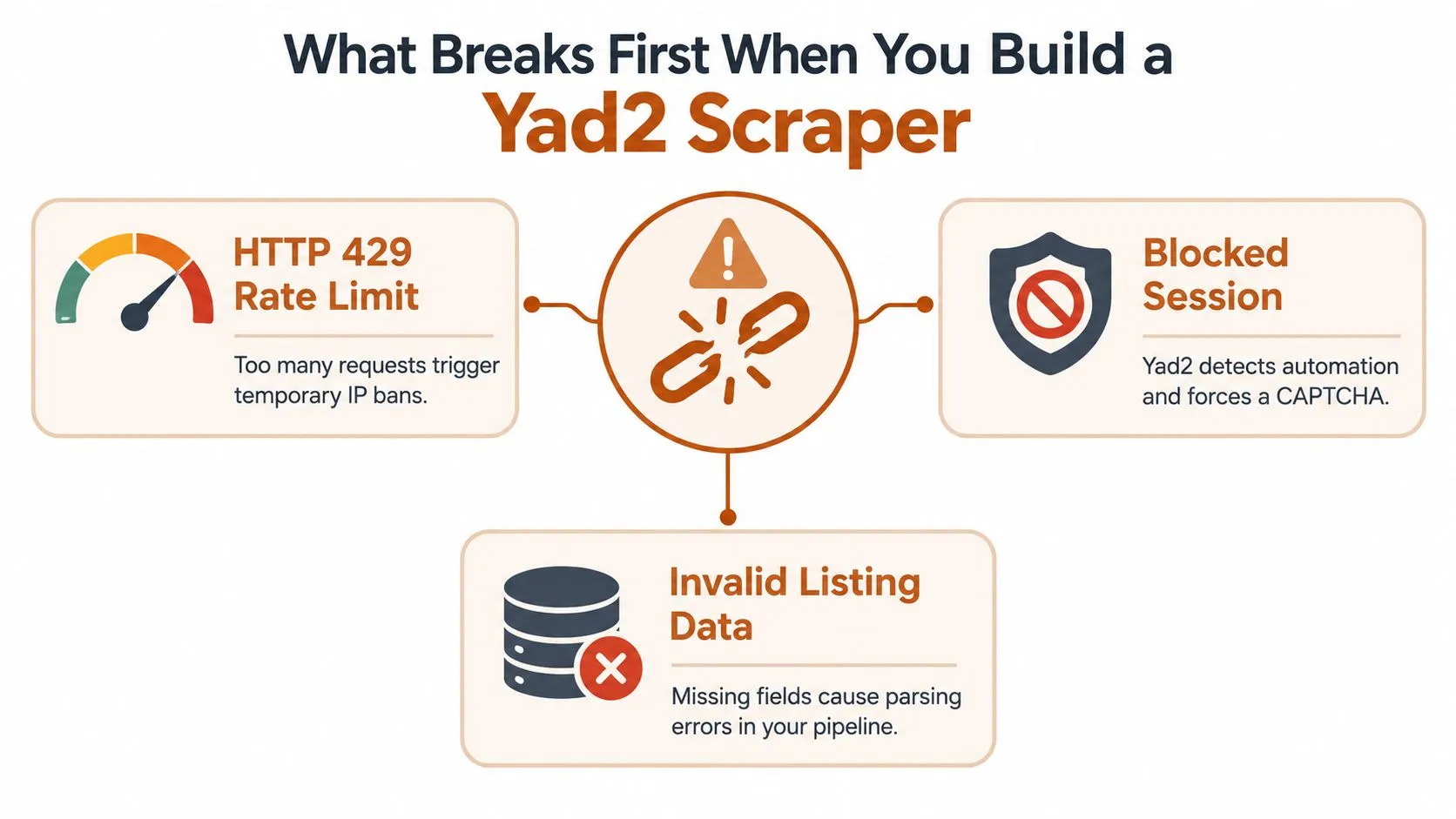
The first crawl often looks healthy. Search pages load, listing cards contain prices, and the script begins saving records. A little later, responses slow or fail, a session starts behaving differently, or the parser returns blank fields for vehicle listings even though it worked on apartments. Those failures aren’t interchangeable: a blocked request needs a different response from a changed page template or a malformed record.
A marketplace is not one page template
Yad2 spans property, vehicles, jobs, and second-hand goods. Their listings don’t necessarily expose the same fields or update in the same way. A real-estate parser may expect rooms and floor area, while a vehicle parser needs attributes such as make, model, year, and mileage. A shared extraction routine that assumes every field is present will produce records that look complete in storage but aren’t valid for analysis.
Mobile matters, too. Reuters reported that more than half of Yad2’s traffic came through mobile devices in 2014. That doesn’t mean every scraper must use a browser, but it does mean a desktop-only assumption can miss important differences in navigation or rendering. Test representative category and detail pages before you lock in a parser or transport method.
A proxy can’t repair a weak crawl design
Anti-automation controls may not activate on the first suspicious request. A short test can succeed, then a longer run can degrade after the site has seen repeated traffic. This is why a successful request rate during a small trial isn’t proof that your production pace is safe.
The common mistake is to treat every failure as an IP problem. A proxy can change the request’s network route; it can’t make an excluded path permissible, restore an identity lost through reposting, or validate an extracted asking price. For a useful framework on handling extraction failures beyond connectivity, see this guide to common web-scraping errors and their solutions. Teams also benefit from defining the storage, transformation, and monitoring layers before increasing collection volume, as described in digna’s ETL pipeline architecture guide.
Practical rule: Treat access, identity, and data quality as separate failure classes. Track them separately so a proxy change doesn’t conceal a broken parser.
Choosing Between Residential Datacenter and ISP Proxies
Proxy families trade off cost, speed, and the network identity presented to the site. None guarantees access, and no proxy type excuses excessive or out-of-scope requests. Choose based on the work each stage performs, then test against permitted pages and your actual request budget.
| Proxy Type | Detection Risk | Typical Cost | Best Fit |
|---|---|---|---|
| Residential | Often lower than datacenter, but not a guarantee | Usually higher | Detail pages where continuity and a residential network identity matter |
| Datacenter | Often higher because network ranges can be recognizable | Usually lower | Controlled discovery tests and low-sensitivity public pages |
| ISP | A middle ground between residential identity and datacenter speed | Usually mid-range | Workloads that need a stable address and responsive connections |
Match the proxy to the crawl stage
Index pages are for discovering listing identifiers. If they’re publicly reachable and permitted by the site’s rules, a team may test a lower-cost proxy class there and keep concurrency conservative. Detail pages hold the fields that often justify the collection effort, so teams may prefer a more trusted route when their tests show that a cheaper pool produces inconsistent access.
That’s a trade-off, not a universal prescription. Residential proxies typically cost more, and switching to them can’t fix a request pattern that’s too aggressive. Datacenter proxies can be fast and economical, but their network reputation may make them a poor fit when a target scrutinizes traffic. ISP proxies can balance performance and network identity, but availability and price vary by provider.
The proxy decision is inseparable from request volume. A costlier pool used for every discovery request may waste budget; a cheaper pool that repeatedly fails on detail pages can raise the cost per valid record. Estimate cost against valid, deduplicated records, not successful page loads.
For a broader procurement framework, compare providers using the criteria in this guide to proxy servers for web scraping. Test the same permitted URL patterns across candidate proxy types, then compare response consistency, latency, and usable field completeness. Don’t assume that results from one category will transfer to another.
Keep the decision measurable
Before production, record why each proxy class is assigned to a stage and what would trigger a change. If access degrades, check status codes, session behavior, and page structure before rotating providers. That diagnosis prevents a familiar failure: paying for a more expensive network while the actual problem is an endpoint that should not have been crawled or a parser that no longer matches the page.
Compliance and Discovery Before You Send a Request
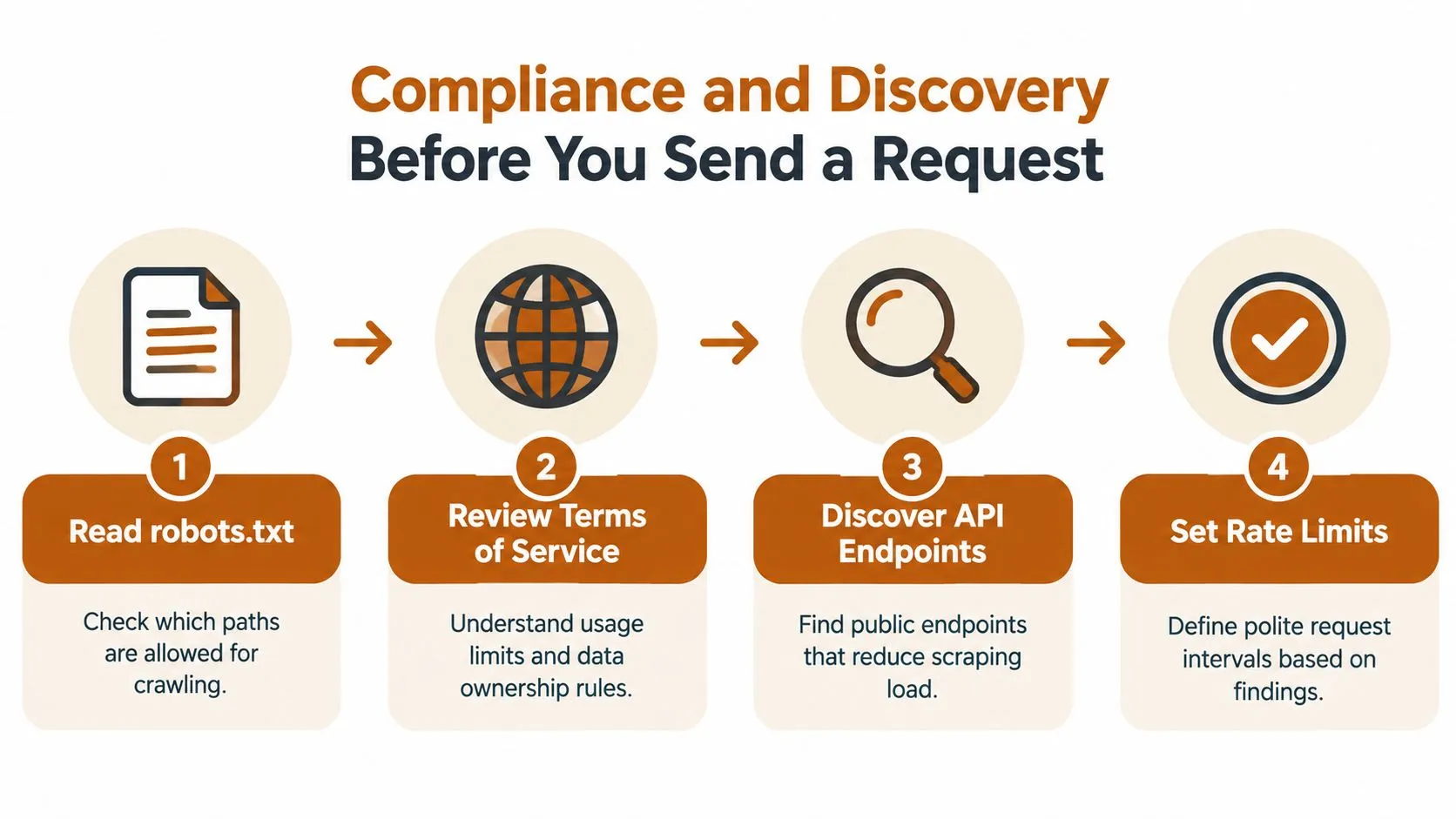
Start with the crawl boundary, not the proxy order. Read Yad2’s published robots.txt and exclude disallowed paths from the crawl plan. The published file specifically disallows administrative, advertising, AJAX, city-lookup, and API paths, including /admin/, /ads/, /ajax/, /ajax/CityAjax/, and /api/.
A permitted proxy does not make a disallowed path acceptable. Review the site’s terms and your intended use as well, and seek legal advice when your planned collection raises questions about access rights, personal data, or redistribution. This guide to web-scraping legal risks and mitigation is a useful starting point for a compliance review, not a substitute for advice specific to your situation.
Map public pages before defining crawl targets
Find the publicly reachable category and detail-page patterns you intend to use. Test each pattern manually, confirm what information is exposed on the page, and note how category templates differ. Don’t treat an endpoint as fair game merely because a browser can reach it; the published exclusion list remains a boundary for your crawler.
For permitted collection, make index pages discovery surfaces. Extract listing identifiers from those pages, compare them with stored state, and fetch a detail page only when it’s new or merits rechecking. This listing-ID-first design reduces redundant requests and makes the request budget more effective.
Record the scope as an operational rule
Keep an explicit allowlist of page patterns and an exclusion list derived from the published rules. When a page redirects, returns an unexpected status, or presents a new path, stop and review it rather than broadening the crawl automatically. A compliance change should be reflected in the crawl plan before the next run.
The work also lowers operating cost: every request you don’t need to send is one you don’t need to route, retry, or parse. Keep the discovery notes with the pipeline configuration so future maintainers can see which pages are in scope and why. Don’t probe private or prohibited endpoints in search of a shortcut.
Rotation Sticky Sessions and Request Budget
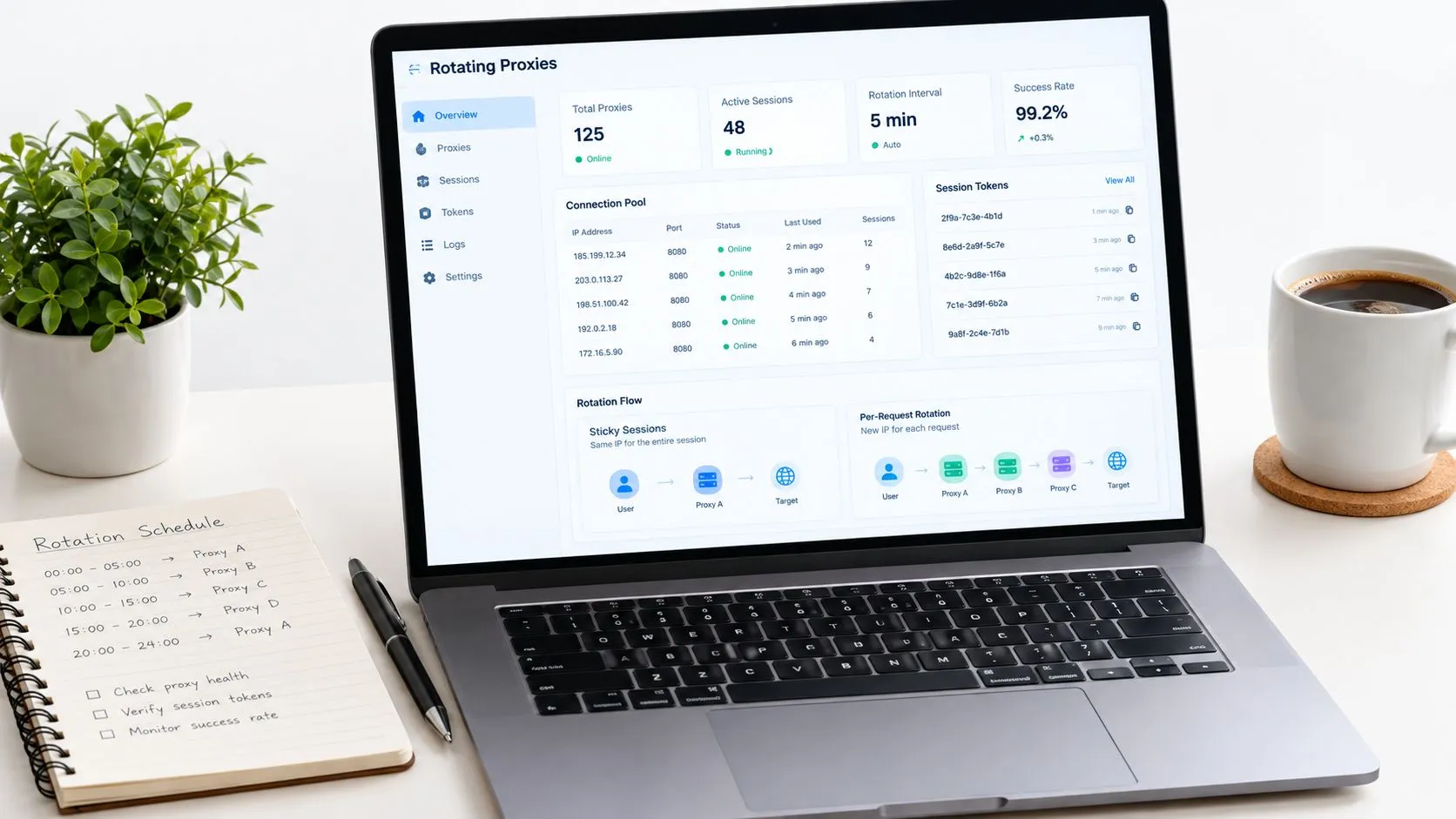
A rotating proxy pool changes the route between requests; a sticky session keeps the same exit for a defined sequence. The useful choice depends on the workflow. If you fetch a search page, follow its listing links, and need consistent session behavior across those steps, a sticky session can reduce needless variation. For independent index-page checks, per-request rotation may be workable, provided it doesn’t make the request pattern bursty or difficult to diagnose.
Neither approach creates a safe request rate. Anti-automation controls can respond only after a delayed threshold, so early success doesn’t tell you how a longer run will behave. Don’t use the fastest rate that works during a brief test as your production setting.
Pace requests deliberately
Set bounded concurrency, randomized intervals, exponential backoff, and a strict per-host request budget. Backoff should reduce pressure after transient errors, not turn repeated denials into an endless retry loop. Set a retry limit and stop when the same request keeps failing; inspect the path, response, and crawl scope before resuming.
A useful run log records the target URL, response status, proxy class, session identifier, retry count, and elapsed time. That gives the team enough context to distinguish an access problem from a source outage or a parser regression. Don’t log credentials or sensitive session material in a shared data store.
A calm crawl that produces clean records is more useful than a fast crawl that spends the rest of the day retrying.
Tune from the failure pattern
When a run starts well and later degrades, reduce concurrency first and examine how failures cluster. If failures follow a particular category, check its URL pattern and page behavior. If they follow a session, test whether session continuity is required. If the site is returning errors across the run, pause rather than rotating through exits at increasing speed.
Treat each proxy class as one controlled variable. Changing proxy type, interval, concurrency, and parser logic at the same time makes the cause of improvement or failure hard to identify. Keep test runs small, scoped, and compliant, then carry forward only settings that produce consistent valid records.
Building a Two-Stage Incremental Crawl
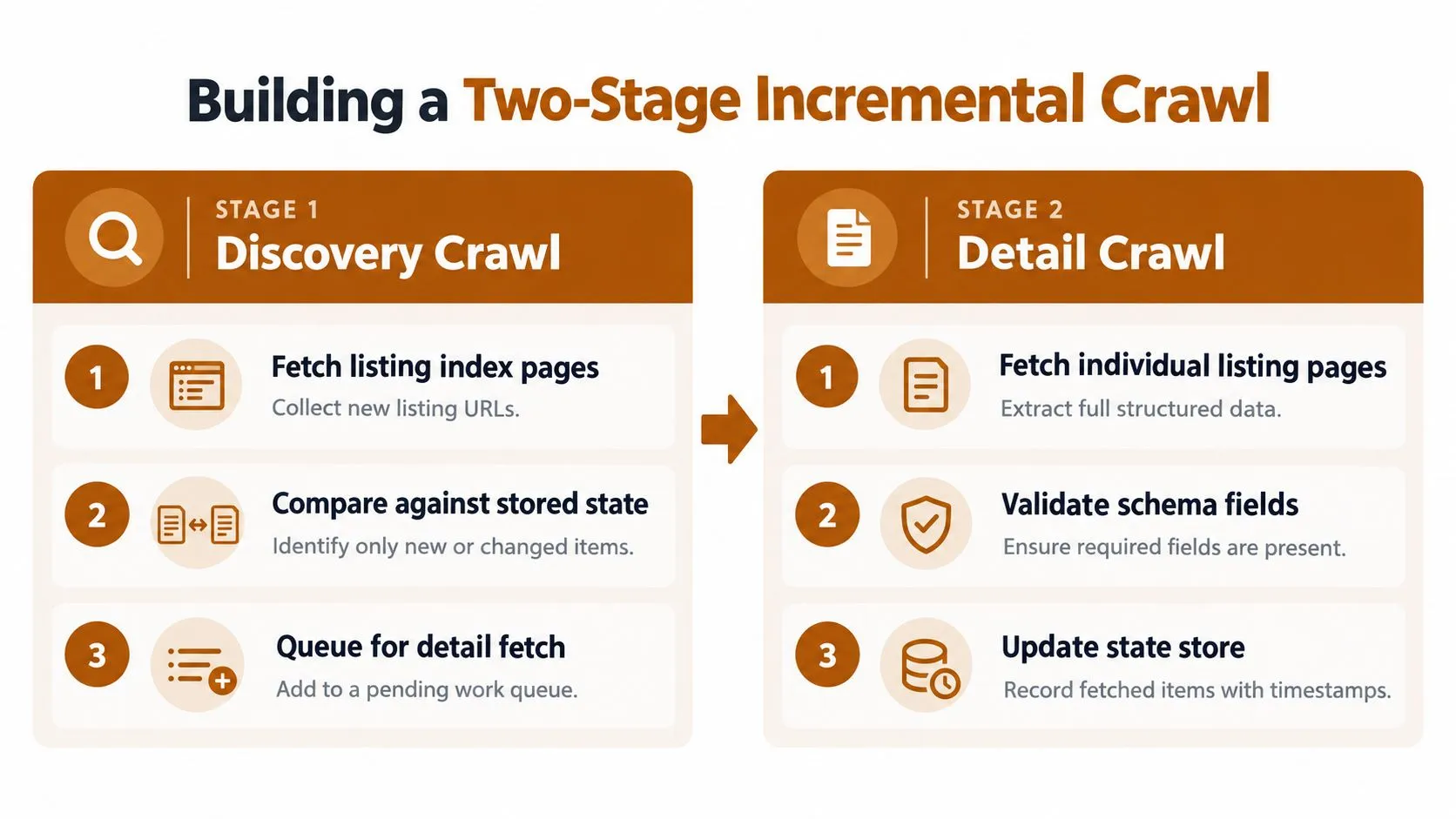
A useful incremental crawl separates discovery from detail extraction. The discovery stage checks search-result pages for identifiers that are new or need attention. The detail stage fetches individual listing pages and updates structured records. This prevents a scheduled run from needlessly re-downloading every detail page just to find out whether anything changed.
Stage one finds candidates
Store state under a normalized listing ID when one is available. If not, use a canonical URL and define how URL changes affect identity. Poll permitted index pages, extract identifiers, and compare them with the state table. Queue a detail page when a listing is new, its last-seen timestamp changes, or another condition in your update policy indicates a recheck.
Persist the canonical URL, listing ID, first-seen timestamp, HTTP status, content hash, and parser version. These fields help the team distinguish a changed record from a failed fetch or an extraction produced by a different parser version. A crawl log without identity and parser metadata is difficult to audit when results change.
Stage two validates and updates records
For each queued listing, keep both the raw source values and parsed values. Preserve the original Hebrew text for addresses and location labels alongside normalized values; convert prices to integer minor units plus currency while retaining the raw price string. Store the publication date and asking price as listing attributes, not proof of a completed transaction.
Consider a real-estate listing that remains at the same URL but changes its asking price. A naive daily refresh may append a new row and report new supply. A stateful crawl instead compares the current content hash with the stored one, updates the existing listing’s history, and records the price change as an event. If the listing disappears and later returns under a different identifier, identity resolution should consider seller and normalized listing attributes rather than assuming it’s unrelated.
Yad2 records can include location, floor area, room count, floor, publication date, and asking price, and a Bank of Israel research dataset reports coverage of advertisements since January 2014 (research dataset and documentation). That makes historical research possible, but the records are advertisements, not transaction data. Listing type can also affect the observed sample: one published study analyzed more than 15,000 Yad2 listings from 2014–2016 and found paid listings sold for 3.5%–3.8% more than free listings, a reason to retain listing type and avoid presenting asking prices as unbiased market values.
For implementation structure and orchestration patterns, see this guide to building scalable data pipelines with Scrapy. The essential test is whether each record can be traced back to its source and its extraction history.
Cost Scale and When to Outsource the Pipeline
Set a cost ceiling per valid record before production. Include proxy traffic, retries, parsing, storage, monitoring, and the engineering time spent repairing changes. A low price per request can still produce a high cost per usable record if the crawler collects duplicates, misses required fields, or spends its budget on repeated failures.
The right build-versus-buy decision depends less on raw volume than on how much operational work the data demands. A team with a narrow, stable research question may keep a carefully scoped crawler in-house. A pipeline that supports a recurring business process needs monitoring, retries, schema maintenance, and an owner who can respond when the source changes.
Define alerts around data quality
Alert on field completeness and schema conformity, not only on job success. A run can finish without errors and still return blank prices, malformed dates, or a sudden change in category fields. Track duplicate rate, disappearance rate, validation failures, and valid deduplicated records per permitted request so the team sees whether the feed remains useful.
At one listing per day, a lightweight in-house process may be easier to maintain than an elaborate managed setup. As daily volume grows, the costs of retries, review, and schema changes become more important. At ten thousand or a hundred thousand listings per day, estimate infrastructure and maintenance from a measured pilot rather than assuming that the same design scales linearly. These are planning scenarios, not guaranteed capacity thresholds.
A managed partner can make sense when engineers spend more time maintaining access and parsers than using the data. Compare candidates on schema versioning, monitoring, multi-geo coverage, delivery formats, and how they handle site changes. For teams building an internal maintenance function, hire developers from Latin America is one staffing route to consider alongside managed operations.
Keep the business logic close to the data
Even when a provider runs the extraction, your team should own the definitions that determine whether a listing is a duplicate, which fields are mandatory, and how a price change is interpreted. Outsourcing collection doesn’t outsource accountability for downstream analysis.
If the team is weighing those options, this guide to outsourcing web scraping can help structure the evaluation. Ask for a sample of the actual fields your workflow needs, and verify how the provider reports missing data and source changes. A clean delivery contract should state what counts as a valid record, how updates are represented, and what happens when a page no longer matches the agreed schema.
Launch Checklist and Common Failure Modes
Before you schedule the first production run, verify the whole collection path rather than only testing a proxy connection.
- Scope: Confirm every target pattern against the published crawl rules, and keep disallowed paths excluded.
- Identity: Check that listing IDs or canonical URLs map repeat observations to the same record, including after a repost.
- Pacing: Set bounded concurrency, randomized intervals, backoff, and a per-host request budget.
- Validation: Require field-level checks for prices, category-specific attributes, and listing status.
- Monitoring: Alert on field completeness, schema conformity, duplicate rate, and valid deduplicated records per permitted request.
Treat robots.txt drift as a reason to review scope, not to crawl more aggressively. Treat declining proxy performance as a signal to inspect the request pattern and route, not an invitation to rotate without limits. When reposting weakens identity resolution, preserve observation history and review the matching rules. When schema conformity falls, pause downstream use until the parser and sample records have been checked.
The operational metric is valid, deduplicated records per permitted request, not pages fetched. If the runbook can’t explain where a record came from, how it was validated, and what happens when it changes, the pipeline isn’t ready to launch.
WebscrapingHQ provides managed web data operations and custom scraping pipelines, including proxy management, monitoring, schema versioning, and structured delivery for recurring data needs. If your team needs a Yad2 feed but would rather focus engineering time on analysis than crawl maintenance, visit WebscrapingHQ to discuss the scope and requirements.
Want this done for you?
Send us the URLs. We'll quote it in 24 hours.
Paste the URL(s) you want scraped. We'll reply within 24 hours with a feasibility check and a ballpark quote.