
Jump to section
- Why Real Estate Data Extraction Has Become Infrastructure
- The recurring workload is the product
- Scoping Targets and Proving Feasibility Before You Build
- A feasibility filter that saves engineering time
- Estimate the operational shape, not just the crawl
- Inspecting HTML and Building Resilient Selector Strategies
- Build selectors around evidence
- Version the extraction contract
- Modeling Property Data and Handling Document Accuracy
- Preserve evidence through layered processing
- Accuracy is field-specific
- Running Production Operations With Proxies Monitoring and Retries
- Design the run as a queue, not a loop
- Monitor freshness, not just availability
- Choosing Your Path and Deploying With Confidence
- Deployment checklist
2.4 million U.S. deed records are digitized every day, according to an industry summary of real estate data scraping. That volume changes the engineering question. Real estate data extraction services aren’t just collecting listings for a spreadsheet. They’re operating a continuously changing data system that must keep pace with portals, public records, ownership changes, valuations, documents, and market signals.
Market Research Future estimated the broader data-extraction market at USD 5.287 billion in 2024, with a projection of USD 28.48 billion by 2035 and a 16.54% CAGR, as reported in this overview of data extraction services. Real estate sits inside that wider category, but its requirements are unusually demanding. A property record can change, disappear, reappear under a new listing, or acquire new documents while the underlying entity remains the same.
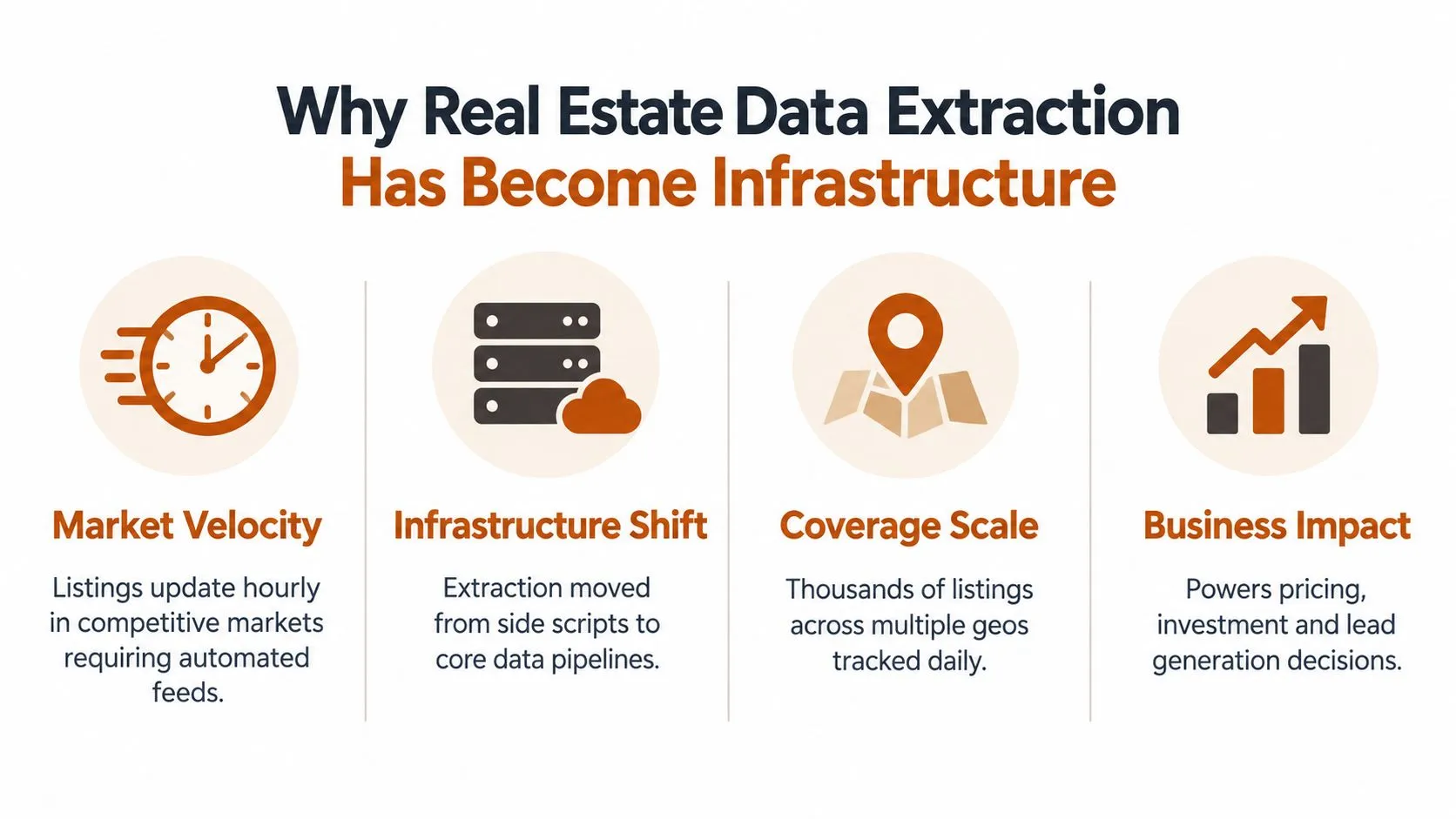
Why Real Estate Data Extraction Has Become Infrastructure
A one-off scraper answers a narrow question: what did a page contain when the script requested it? A production data operation answers a harder one: what changed, when did it change, can the system prove what it saw, and can downstream users trust the result?
The distinction matters for ordinary workloads. Brokers may need listing refreshes and agent enrichment. Investors may monitor price movement, ownership records, valuation inputs, and transaction histories. Analytics teams may combine portal data with parcel records, public filings, and regional market signals. Each workflow depends on timely, normalized data, not an occasional export that someone manually cleans.
The digitization benchmark illustrates the pressure. At 2.4 million digitized deed records per day, the U.S. example alone represents roughly 876 million records in a year, based on the calculation provided by ExtractHelp. That isn’t a workload a research assistant can reliably reconcile through ad hoc downloads. It requires ingestion, storage, transformation, matching, validation, and delivery controls.
The recurring workload is the product
Real estate extraction becomes infrastructure when the business depends on recurring outputs:
- Listing refreshes: Capture new, updated, removed, and relisted properties rather than treating every crawl as a new dataset.
- Change monitoring: Detect price, status, availability, address, and agent changes at the field level.
- Ownership intelligence: Reconcile deeds, parcel records, ownership changes, and transaction histories.
- Document feeds: Convert certificates, rent rolls, operating statements, leases, and compliance files into usable fields.
- Operational delivery: Push validated records to an API, database, S3 bucket, webhook, or review queue.
The economics follow from this recurrence. The RealtyAPI analysis describes a long-run double-digit growth trajectory for the broader extraction market, which supports the shift from manual research to automated, structured feeds. The value isn’t raw page count. It’s reducing the cost and delay of keeping business systems current.
Teams researching a new market can browse data sources to compare available property data inputs before designing a collection plan. They should still validate source rights, field definitions, freshness, and regional coverage independently.
Production standard: A scraper that runs successfully today is a prototype. A pipeline that detects source changes, preserves raw evidence, validates fields, and delivers on an agreed cadence is infrastructure.
A practical comparison of how structured collection supports local competitive analysis appears in this guide to real estate data scraping and local market domination. The operational difference is straightforward. Ad hoc scraping maximizes immediate coverage. Production extraction optimizes repeatability, freshness, traceability, and recovery.
Scoping Targets and Proving Feasibility Before You Build
The most expensive scraping mistake usually happens before the first selector is written. A stakeholder asks for “all property data,” an engineer starts with a prominent portal, and the team discovers later that “all” means several source types, multiple geographies, document attachments, historical changes, and a delivery schedule the original design can’t support.
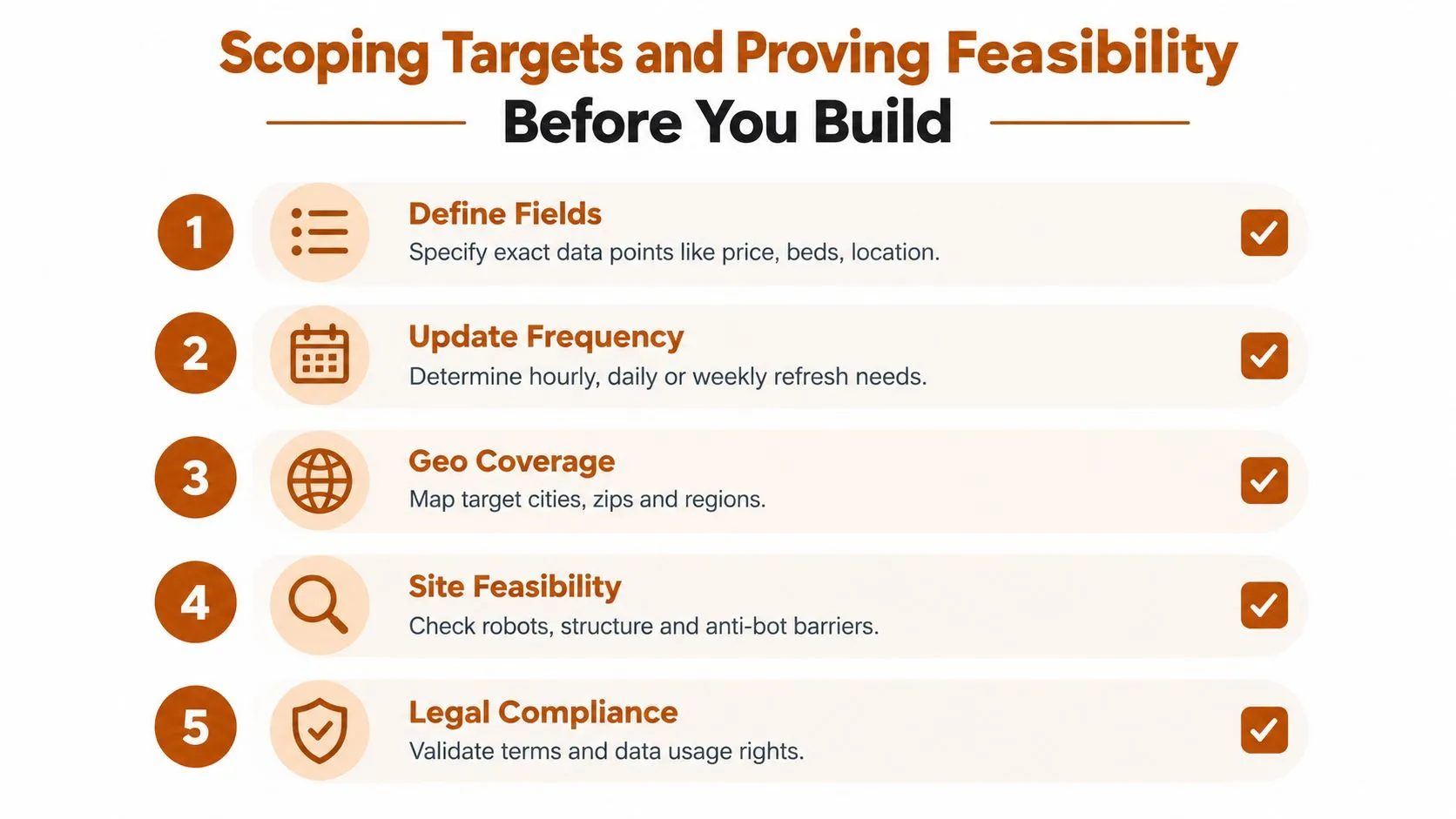
Start with a field contract. Define the exact output, including canonical address components, listing identifier, price, currency, property type, bedrooms, bathrooms, area, status, agent details, coordinates where permitted, source URL, observed timestamp, and change state. For document workflows, specify fields such as lease dates, rent values, escalation terms, tenant names, encumbrances, survey numbers, and consideration amounts only when those fields are required.
A feasibility filter that saves engineering time
Use a source register before implementation. Each row should represent one portal, registry, document repository, or supplied file channel.
- Define the business field set. Separate required fields from useful enrichment. A missing optional amenity shouldn’t block a record, while a missing price or legal identifier may make it unusable.
- Set the freshness expectation. A listing-monitoring workflow may need frequent observation, while a historical ownership dataset may tolerate a slower schedule. The cadence must follow the decision being made, not the crawler’s convenience.
- Map geographic boundaries. Record countries, states, cities, postal codes, languages, currencies, and local address conventions. “United States coverage” can conceal substantial variation across portals and public-record systems.
- Inspect the source behavior. Check server-rendered HTML, embedded JSON, GraphQL responses, client-side rendering, lazy loading, pagination, login requirements, rate limits, robots directives, and anti-bot behavior.
- Confirm lawful use. Review terms, licensing, privacy obligations, public-record restrictions, and the intended downstream use before collection begins.
The last two checks are connected but aren’t interchangeable. A page can be technically accessible and still be unsuitable for a planned commercial use. Conversely, a source with difficult rendering may still be viable through a licensed API, supplied export, or negotiated feed.
Estimate the operational shape, not just the crawl
Cost planning should include request volume, browser rendering, proxy usage, document download, OCR, storage, review, retries, and quality checks. Refresh schedules also need prioritization. High-churn listing sources may deserve more frequent observation than stable reference records, while document-heavy underwriting may justify narrower coverage with stronger validation.
Write assumptions into the project brief. Include source scope, fields, cadence, expected availability, duplicate rules, acceptable nulls, confidence thresholds, escalation ownership, and delivery format. Then run a sample extraction across representative pages and documents, including edge cases. A clean sample from one listing page proves very little. A useful feasibility test includes pagination, sold or withdrawn records, multilingual pages, malformed addresses, missing values, changed layouts, and scanned PDFs.
Practical rule: Don’t approve a build because the first page parses. Approve it when the source, fields, cadence, legal basis, failure modes, and acceptance tests are explicit.
This filter also clarifies whether a direct crawler is appropriate. If the source provides a stable, authorized API, use it where the license and schema fit. If the source changes frequently or combines listings with documents, a managed extraction workflow may be more economical than maintaining brittle browser automation internally.
Inspecting HTML and Building Resilient Selector Strategies
Selector work starts with observation, not preference. Open representative listing cards, detail pages, search results, pagination states, and error responses in browser developer tools. Compare the visible DOM with the network payloads. Many portals render useful values from embedded JSON or API responses, while others expose only fragments in the initial HTML and fill the rest after JavaScript execution.
For listing cards, prefer semantic relationships over generated class names. A selector anchored to a stable property-card element and its labeled price, address, or status field is easier to maintain than a long path through nested containers. CSS selectors are concise and usually sufficient for stable structural relationships. XPath helps when the relationship depends on text labels or sibling structure. Neither solves volatility by itself.
Build selectors around evidence
A resilient extraction layer commonly uses several fallback paths:
- Primary structured path: Read embedded JSON-LD, application state, or a documented response when it contains the required field.
- Semantic DOM path: Locate a stable card or detail-page region, then extract a labeled value inside that region.
- Text normalization path: Parse currency, area, and status from visible text only after removing locale-specific formatting.
- Visual or model-assisted path: Use computer vision or LLM-assisted parsing for fields that exist visually but lack dependable structural anchors.
- Failure path: Return a typed null or review event. Don’t substitute a nearby value.
Price parsing deserves special care. Currency symbols, decimal separators, localized number formats, rental periods, “from” values, and hidden promotional text can all produce plausible but wrong outputs. Keep both the raw text and normalized value, along with currency, period, source URL, and observation time.
Lazy loading and infinite scroll require a different test strategy from ordinary pagination. Verify that the crawler can detect the end of a result set, avoid re-requesting the same cursor, and capture content after the page has completed its relevant network activity. A browser that waits for a fixed duration is fragile. Prefer a condition tied to a selector, response, DOM mutation, or stable item count, with a bounded timeout.

Version the extraction contract
Store selector definitions and parser behavior as versioned code. Add fixtures from real source responses, then run regression tests whenever a selector changes. Useful tests check required fields, type validity, currency interpretation, address completeness, duplicate rates, and unexpected null spikes.
A page can return HTTP success while the extraction is functionally broken. Monitor the proportion of records with missing prices, repeated default values, empty result sets, and unusually short descriptions. Compare extracted structures against prior runs and alert on schema drift.
For broader scraping patterns, this overview of an Ahrefs scraper is useful for understanding how collection logic can be separated from downstream parsing and delivery. The same principle applies here. Keep source acquisition, field parsing, normalization, and validation separate so a portal redesign doesn’t force a rewrite of the entire data product.
Selector principle: Prefer stable meaning over temporary appearance. A generated class may survive for months, but a field label, structured property name, or consistent card boundary usually gives you a better recovery path.
Modeling Property Data and Handling Document Accuracy
A property pipeline should model more than a flat listing row. Listings, parcels, owners, agents, transactions, documents, and observations are different entities with different lifecycles. Treating them as one table encourages address-only merges, overwrites historical values, and loses the evidence needed to explain where a field came from.
Use stable source identifiers when available, but don’t rely on them exclusively. Entity resolution may combine normalized address components, parcel identifiers, coordinates, listing identifiers, owner names, and temporal evidence. An address alone isn’t a safe merge key. Unit numbers, spelling variants, redevelopment, multilingual formats, and duplicate listings can all create false matches.
Preserve evidence through layered processing
A reliable architecture separates ingress, staging, normalization, entity resolution, and serving. Raw payloads should remain unchanged, while transforms are versioned so the team can reprocess historical inputs after a mapping or parser change. Queues between stages prevent one volatile source from blocking unrelated work.
| Pipeline Layer | Purpose | Failure It Prevents |
|---|---|---|
| Ingress | Accept HTML, JSON, PDFs, images, and API responses with source metadata | Losing provenance or rejecting mixed inputs |
| Staging | Store raw payloads unchanged with observation details | Irrecoverable errors after parser changes |
| Normalization | Convert names, addresses, currencies, dates, and units into canonical forms | Inconsistent downstream comparisons |
| Entity resolution | Link listings, parcels, owners, transactions, and documents | False merges caused by address-only matching |
| Serving | Publish validated records to applications, warehouses, and review queues | Letting application code interpret raw upstream payloads |
The design guidance in this property data collection architecture specifically calls for these separated layers, versioned transforms, queues, idempotent consumers, and dead-letter handling. Those controls matter because extraction failures are normal. The system must isolate them instead of turning one malformed response into a feed-wide outage.
Accuracy is field-specific
Document extraction exposes why record-level accuracy is a weak success metric. A cited benchmark says that 95% accuracy on an encumbrance certificate can still mean roughly 1 to 2 incorrect fields per document, as explained in this property document extraction analysis. A wrong survey number or consideration amount can invalidate a title review even when most fields are correct.
Use confidence scoring by field type. OCR text, layout recognition, computer vision, and language-model parsing can work together, but the output should identify uncertainty rather than conceal it. Low-confidence legal identifiers, financial values, lease clauses, and ownership fields should enter a human review queue with the source page or image attached.
Manual entry also needs control. The same source notes that manual error rates can reach up to 4% without verification, so human review should be designed as a verification step, not an untracked fallback. Reviewers need clear rules for ambiguous scans, bilingual content, state-level formats, and conflicting values across documents.
Accuracy rule: A smaller set of defensible fields is often more useful than broad coverage filled with values no analyst can audit.
Lease workflows and underwriting make this distinction especially important. Rent rolls, T12s, operating statements, compliance PDFs, and images may arrive beside ordinary listings. A practical schema stores the extracted value, confidence, source location, parser version, review status, and original artifact. That turns an opaque prediction into a traceable business record.
For the distinction between raw acquisition and structured output, this guide to data parsing provides useful foundational context. In production, parsing is only one layer. Governance, provenance, confidence, and reprocessing determine whether the result can support a financial or compliance decision.
Running Production Operations With Proxies Monitoring and Retries
A real estate feed fails in ordinary ways. A portal changes a class name, a search endpoint returns an interstitial, a browser session expires, a registry serves a malformed PDF, or a source starts returning an empty result set without an obvious error. Proxies can help with access distribution, but they aren’t a substitute for observability or responsible request behavior.
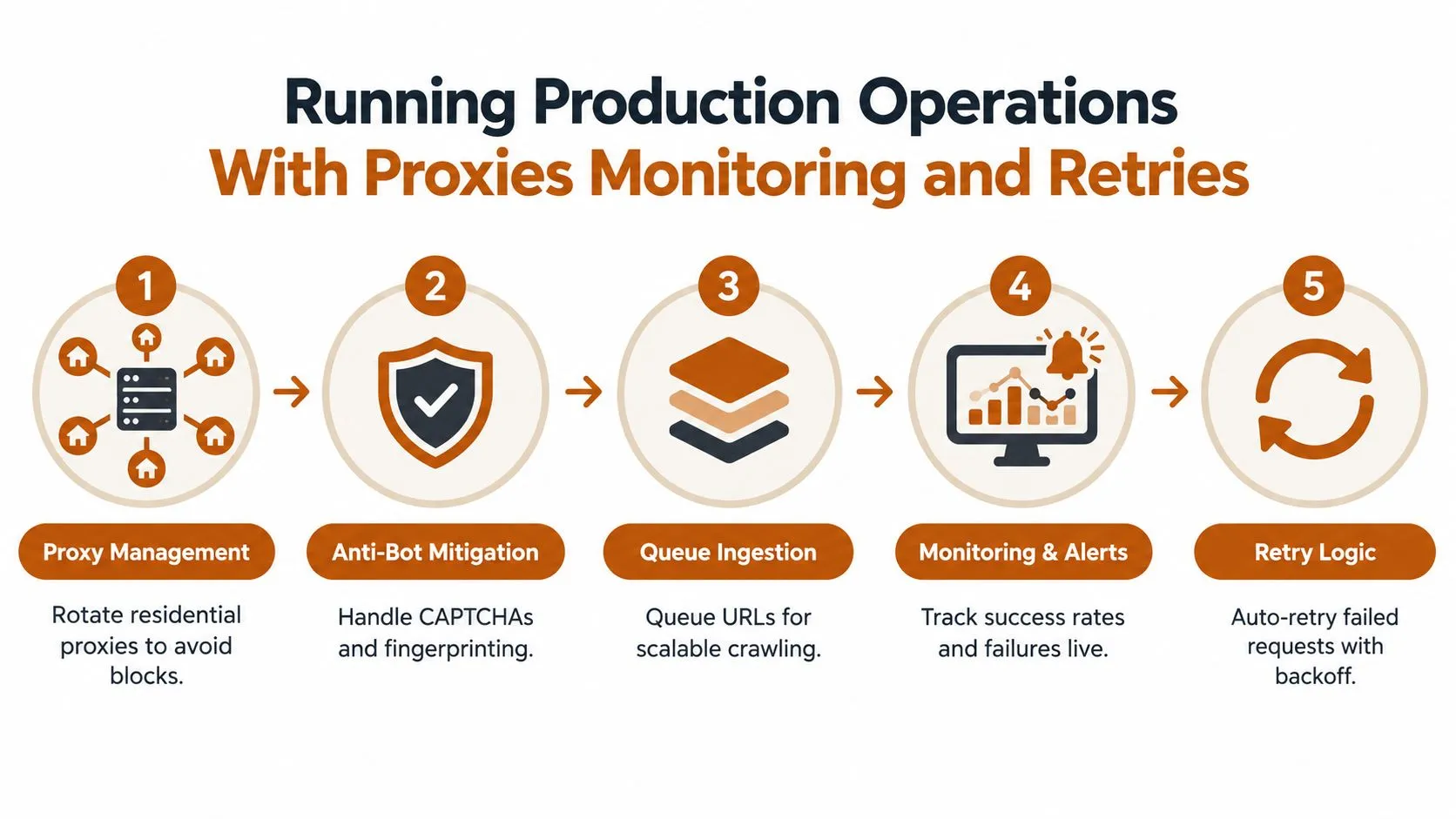
Proxy selection should follow source requirements and authorized use. Keep proxy pools separate by geography and workflow, rotate only when appropriate, and track response quality by source, region, session, and request type. Random rotation can make a site less stable if the workflow needs session continuity. It can also make debugging difficult because the same request behaves differently across endpoints.
Design the run as a queue, not a loop
A production crawler should enqueue work items with source, URL or query, geography, priority, attempt count, and schema version. Workers consume those items idempotently, which means a retry won’t create a duplicate listing or duplicate document record. Successful work emits normalized events, while malformed or repeatedly failing items move to a dead-letter queue for diagnosis.
Use bounded retries with backoff. Retry transient timeouts and temporary server failures, but don’t blindly repeat validation failures, access denials, or a confirmed source-layout change. A retry policy should distinguish transport errors, anti-bot responses, parsing failures, empty-result anomalies, and downstream delivery errors.
The guide to static and rotating proxies explains the operational trade-off between stable identity and rotating access. In real estate operations, the right choice depends on whether the source expects a persistent session, whether the task is geographically constrained, and whether the provider has a compliant access path.
Monitor freshness, not just availability
A crawler can report a healthy request-success rate while delivering stale or incomplete data. Monitor:
- Freshness: Time since each source, geography, and record family was last observed.
- Completeness: Presence of required fields, attachments, and expected result groups.
- Change volume: Sudden drops or spikes in new, removed, changed, or relisted records.
- Duplicate behavior: Repeated entities across portals, URLs, and observation windows.
- Schema drift: New labels, missing fields, altered response structures, and changed pagination.
- Delivery health: Queue age, dead-letter count, consumer lag, and destination acknowledgements.
Relisting detection needs temporal logic. Compare a property’s normalized identity, source history, status sequence, price history, and observed gaps. Don’t treat a new URL as a new property automatically. Conversely, don’t merge records solely because the address looks similar.
Global work adds another layer. UK, U.S., Spanish, German, Dutch, UAE, and Indian sources can differ in language, currency, address order, legal terminology, and layout. The market guide to real estate data providers highlights the importance of live web data, public-record APIs, ownership intelligence, regional analytics, and relisting detection in fast-moving markets. A practical SLA should define source-specific refresh cadence, expected latency, completeness thresholds, alert response, and escalation procedures.
Operations standard: Every source needs an owner, a freshness expectation, a parser version, a failure queue, and an alert that reaches someone who can act.
Choosing Your Path and Deploying With Confidence
Build internally when the source set is narrow, the schema is stable, the team can own browser automation and data governance, and the business accepts ongoing maintenance. Choose a managed service when sources change frequently, coverage spans languages or geographies, document review matters, or internal engineers would spend more time repairing collectors than improving the product.
The decision shouldn’t be based on raw record volume alone. Ask who will investigate a sudden null spike, update a parser after a redesign, review low-confidence document fields, reconcile duplicate properties, and prove what the pipeline delivered on a given date. If those responsibilities have no named owner, the system isn’t ready for recurring production use.
Deployment checklist
- Acceptance sample: Approve representative listing, detail, public-record, and document examples.
- Schema contract: Define required fields, types, null rules, provenance, confidence, and versioning.
- Quality gates: Reject or quarantine records that fail critical-field, duplicate, or anomaly checks.
- Delivery path: Choose CSV, JSON, API, webhooks, S3, dashboards, or a combination that downstream systems can consume.
- Operational agreement: Document refresh cadence, retry behavior, alert thresholds, review queues, and escalation ownership.
- Handover test: Verify that CRM, warehouse, underwriting, compliance, or analytics workflows can process the delivered data without manual reshaping.
Teams evaluating automation around transaction and property workflows may also find this RPA in real estate guide useful. RPA can coordinate repetitive application actions, but it doesn’t replace a governed extraction layer that validates property fields and preserves source evidence.
A pilot should begin with a bounded set of sources and high-value fields. Measure whether the pipeline remains fresh, whether critical fields pass review, whether duplicates are explainable, and whether failures recover without engineer intervention. The right outcome isn’t maximum coverage on launch day. It’s a dependable operating model that can expand without weakening trust.
For teams comparing internal ownership with external maintenance, this explanation of why businesses choose web scraping services frames the central trade-off clearly. The provider assumes responsibility for the moving parts, while the buyer retains control over the schema, acceptance criteria, and business use.
WebscrapingHQ provides managed real estate data extraction services covering source scoping, custom collectors, normalization, monitoring, retries, multi-language delivery, and outputs such as CSV, JSON, webhooks, and S3 drops. Define a pilot with your target portals, required document fields, geography, and freshness SLA, then visit WebscrapingHQ to discuss a pipeline built for reliable recurring delivery.
Want this done for you?
Send us the URLs. We'll quote it in 24 hours.
Paste the URL(s) you want scraped. We'll reply within 24 hours with a feasibility check and a ballpark quote.