
Jump to section
- Why Most Viator Scraper Guides Get the Starting Point Wrong
- Decide what you’re buying
- Understanding the Viator Marketplace Before You Scrape It
- Map entities before collecting fields
- The API-First Architecture for a Viator Data Pipeline
- Designing a Normalized Schema That Survives Production
- Core fields in a production Viator dataset
- Resolve ambiguity deliberately
- Rate Limits, Retries, and Capacity Planning
- API Access Versus Scraping Versus Licensed Data
- Measuring Demand Beyond Ratings and Review Counts
- Operating a Viator Pipeline Without Surprises
- Require an operational handoff
- Test failures before increasing volume
Most Viator scraper advice starts with the wrong question: how do you extract the website? Start by asking which access route authorizes the dataset you need. For an enterprise buyer, a fast extractor is worthless if legal can’t approve its use, analysts can’t trace its provenance, or operations can’t maintain its delivery schedule.
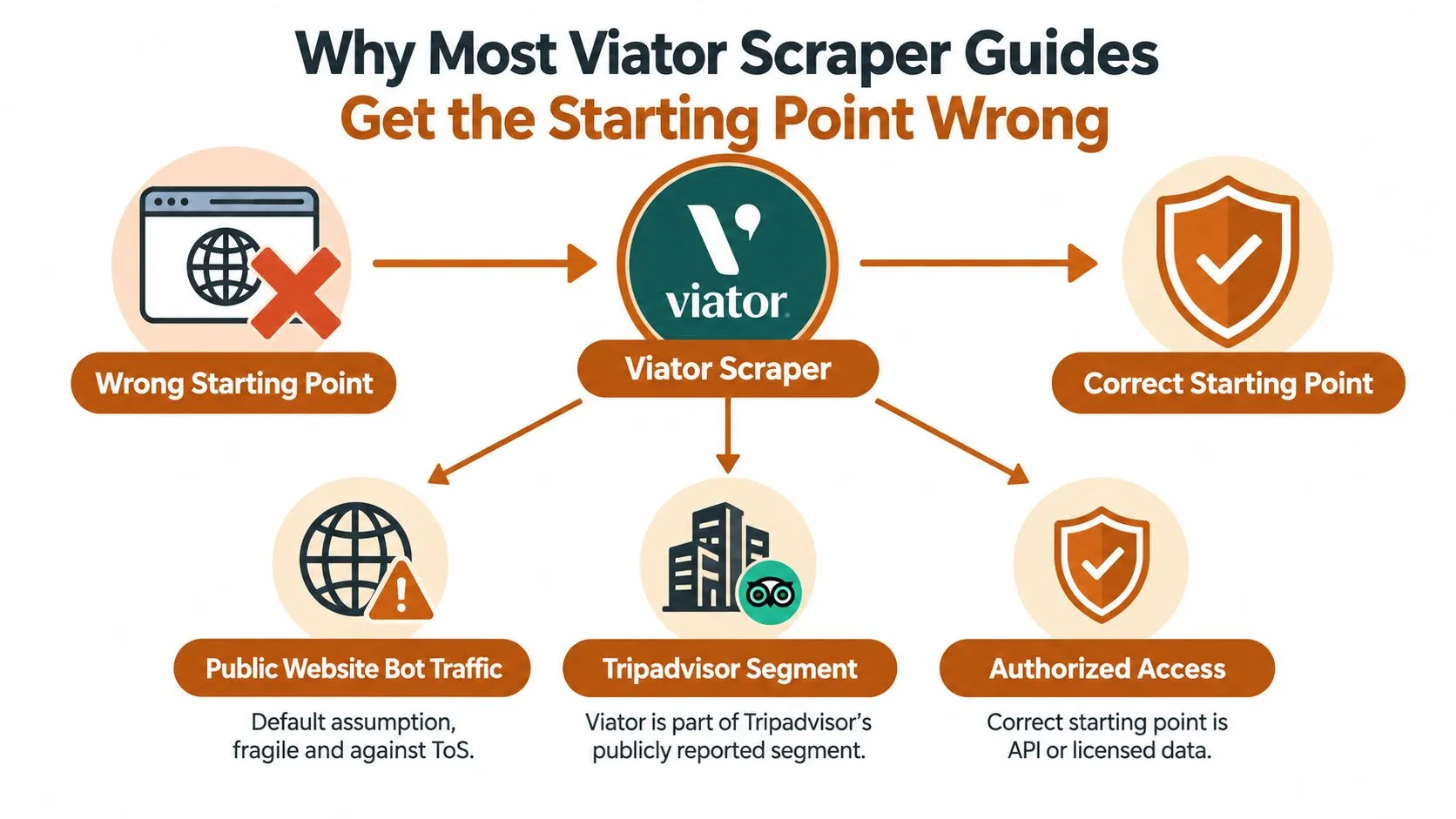
Why Most Viator Scraper Guides Get the Starting Point Wrong
A public listing isn’t an invitation to automate collection. Viator’s Terms of Use expressly restrict automated access, copying, indexing, and scraping without written permission. That restriction should determine your architecture before anyone selects a browser automation framework.
The popular approach reverses that order. Engineers build a collector, demonstrate an export, and then ask whether the organization can use the output. My recommendation is to reject that sequence. Approve the access method and intended use before funding extraction development.
Decide what you’re buying
An enterprise data project should begin with an access assessment, not a scraping demonstration. Ask the prospective delivery team to establish:
- Business purpose: Specify whether the output supports internal research, customer-facing discovery, supplier analysis, or another approved use.
- Access authority: Identify the agreement or permission covering collection and the responsible account owner.
- Permitted output: Define which fields may be retained, transformed, shared, or published.
- Operational evidence: Require traceable source records, capture dates, and a documented escalation process.
The distinction matters because retrieving a field and having permission to use it are separate questions. A successful HTTP response answers neither the licensing question nor the retention question.
Procurement rule: Don’t accept a sample export as proof that a recurring data service is authorized or production-ready.
Treat authorized API access as the default, licensed data as an alternative, and page collection as a governed fallback. That doesn’t mean every project belongs on the same connector. It means the team must justify a fallback against the actual research requirement, rather than choosing website automation because it makes an impressive demo.
The first deliverable should therefore be a source-and-rights assessment. Code comes after the buyer accepts it.
Understanding the Viator Marketplace Before You Scrape It
Model the marketplace before sizing the pipeline. In the third quarter of 2024, Viator reported more than 350,000 bookable experiences, over 55,000 operators, and more than 4,000 demand partners, alongside $270 million in revenue and nearly $1.1 billion in gross booking value, according to PhocusWire’s coverage of Tripadvisor’s quarterly results.
Those figures describe different entities and financial measures. An experience is a product, an operator supplies experiences, and a demand partner participates in distribution. Gross booking value measures booking activity, while revenue and adjusted EBITDA describe different aspects of business performance. Don’t use those measures interchangeably when defining your market model.
Map entities before collecting fields
| Marketplace concept | Recommended modeling treatment |
|---|---|
| Experience | Product record with a persistent identifier |
| Operator | Supplier entity linked to relevant products |
| Destination | Geographic dimension with normalized identifiers |
| Attraction | Separate discovery and location relationship |
| Demand partner | Distribution entity, not a supplier alias |
| Observation | Dated record of an experience’s visible state |
An operator-level comparison should aggregate products through a supplier relationship. A destination comparison needs consistent geographic boundaries. Without those distinctions, an analyst can mistake a broad catalog for a broad supplier base or confuse distribution coverage with supply.
Use consumer journeys to test the model’s usefulness. A resource for travelers looking to find Japan travel deals provides context for framing questions about destination coverage, product comparability, and booking choices. It isn’t evidence of marketplace demand, and it shouldn’t be treated as such.
The same modeling discipline applies across travel categories. A guide to Priceline scraping is a useful companion when scoping a wider travel-data project, but don’t assume different marketplaces share identical entities.
Preserve dated observations, not just the latest product record. Otherwise, analysts can inspect today’s catalog but can’t reconstruct what buyers encountered previously.
The API-First Architecture for a Viator Data Pipeline
Start with the partner API or do not start at all. Treat page collection as a governed fallback for named gaps, never as a quiet substitute for eligibility, certification, declared endpoint usage, or content-indexing limits. Confirm account status and access level through Viator’s partner integration guidance before the design hardens.
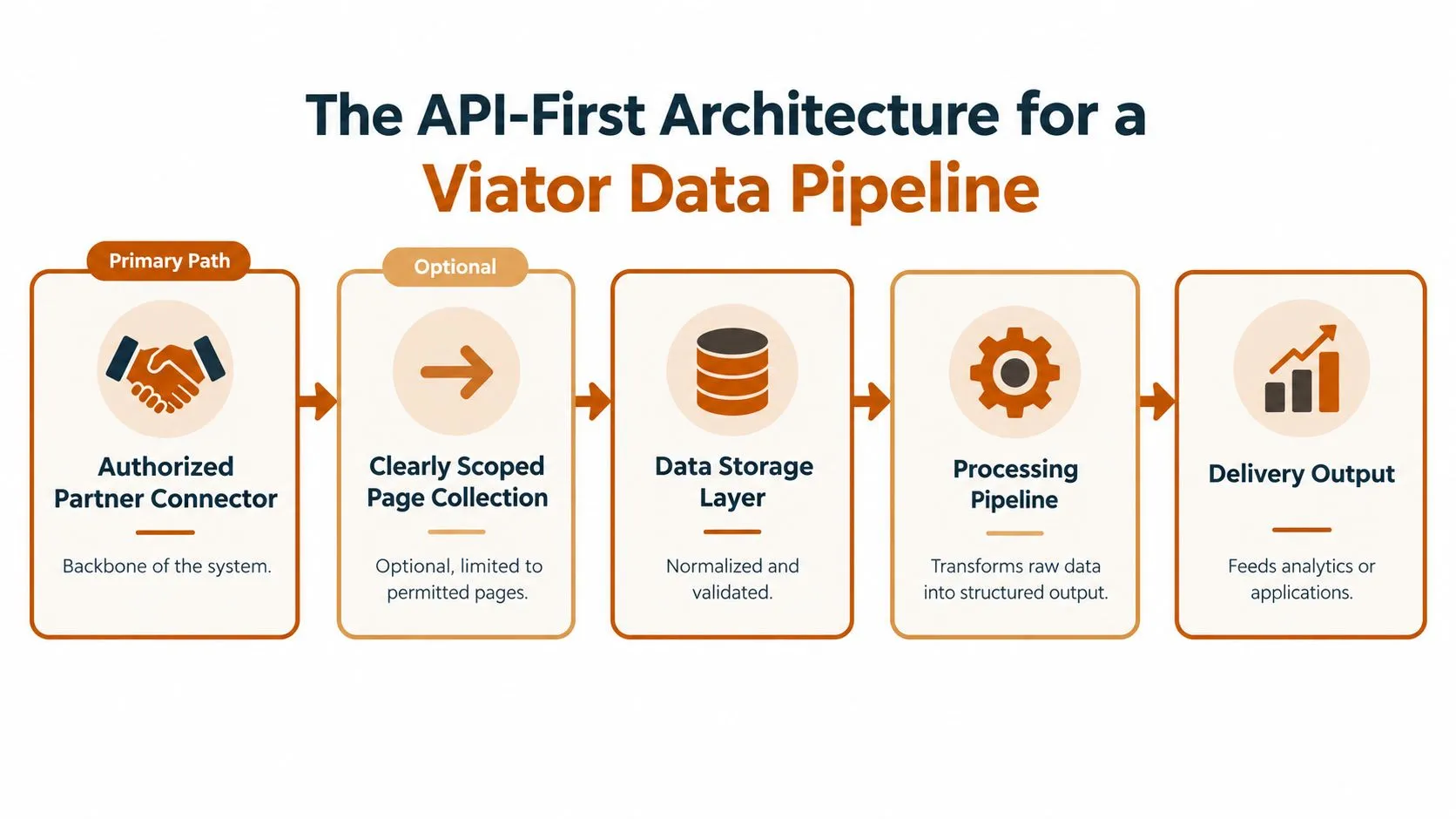
The pipeline should read like a chain of custody. Discovery scopes the population through destination, attraction, coordinate, and attraction-identifier workflows. Enrichment then pulls only the product fields your credentials permit. The ingestion ledger records query intent, pagination state, completed writes, and failed units. Validation checks identifiers, required fields, types, and business constraints before anything reaches delivery. The delivery layer publishes approved records without exposing credentials or restricted source content.
Keep discovery filters and enrichment logic separate. When market scope changes, you should adjust the query definition rather than rebuild the ingestion path.
The connector owns authentication, approved endpoint selection, request construction, and response classification. The ledger owns resumability. Validation owns the release boundary. Delivery owns publication. If one team improvises across those boundaries, outages turn into silent data corruption.
A worker dies after request 19 of 40. If another worker can read the ledger, see request 20 pending, replay exactly that unit, and write once under a stable product identifier, the design passes. If recovery means rerunning the whole crawl, rebuild it. Commit a pagination checkpoint only after its records are durable, keep state tied to the exact discovery query with filters and locale, and make retries idempotent.
The optional collector enters through the same validation boundary under separate provenance. Keep page-derived values out of API-derived records, and never let API approval imply website collection rights.
The request function is replaceable. The controlled path from approved source to reproducible dataset is the asset.
Designing a Normalized Schema That Survives Production
A product title and a price don’t constitute an analysis-ready record. Define a canonical schema with explicit types, nullable fields, ownership rules, and provenance. Missing, unavailable, and unauthorized-to-store should remain distinguishable states.
Keep product identity separate from observations. Store monetary values as decimal amounts with currency codes, and represent timestamps consistently. If analysts need converted prices, retain the displayed amount alongside the conversion result, reference currency, conversion timestamp, and approved exchange-rate source.
Core fields in a production Viator dataset
| Field | Purpose | Source |
|---|---|---|
product_id | Stable product identity | Authorized product response |
destination_id, attraction_id | Geographic and discovery relationships | Approved discovery metadata |
title, language | Localized product description | Authorized content response |
supplier_id, supplier_name | Operator linkage | Supplier metadata, where available |
price_amount, currency | Preserve the quoted monetary value | Approved pricing response |
travel_date, availability_observed_at | Distinguish travel date from capture time | Availability response and ingestion clock |
review_count, rating | Record permitted review signals | Authorized product content |
source_endpoint, captured_at | Trace record provenance | Connector instrumentation |
rights_reference, schema_version | Support permitted use and reproducibility | Internal governance registry |
Resolve ambiguity deliberately
Supplier deduplication needs a maintained crosswalk, not aggressive name matching. Preserve the original identity and your canonical mapping so analysts can inspect uncertain matches. Don’t merge suppliers merely because their names resemble each other.
Keep review objects outside the main product row when their structure or permissions require separate handling. The product record should reference related review data rather than repeatedly embedding a large, changing payload.
Downstream compatibility deserves an explicit mapping exercise. Use the Explola tour import guide as a reference when preparing questions about a destination system’s import requirements, not as a substitute for your canonical model.
When assessing managed online scraping services, request sample records with field definitions and null-handling rules. Schema versioning is a delivery contract, not an internal developer preference.
Rate Limits, Retries, and Capacity Planning
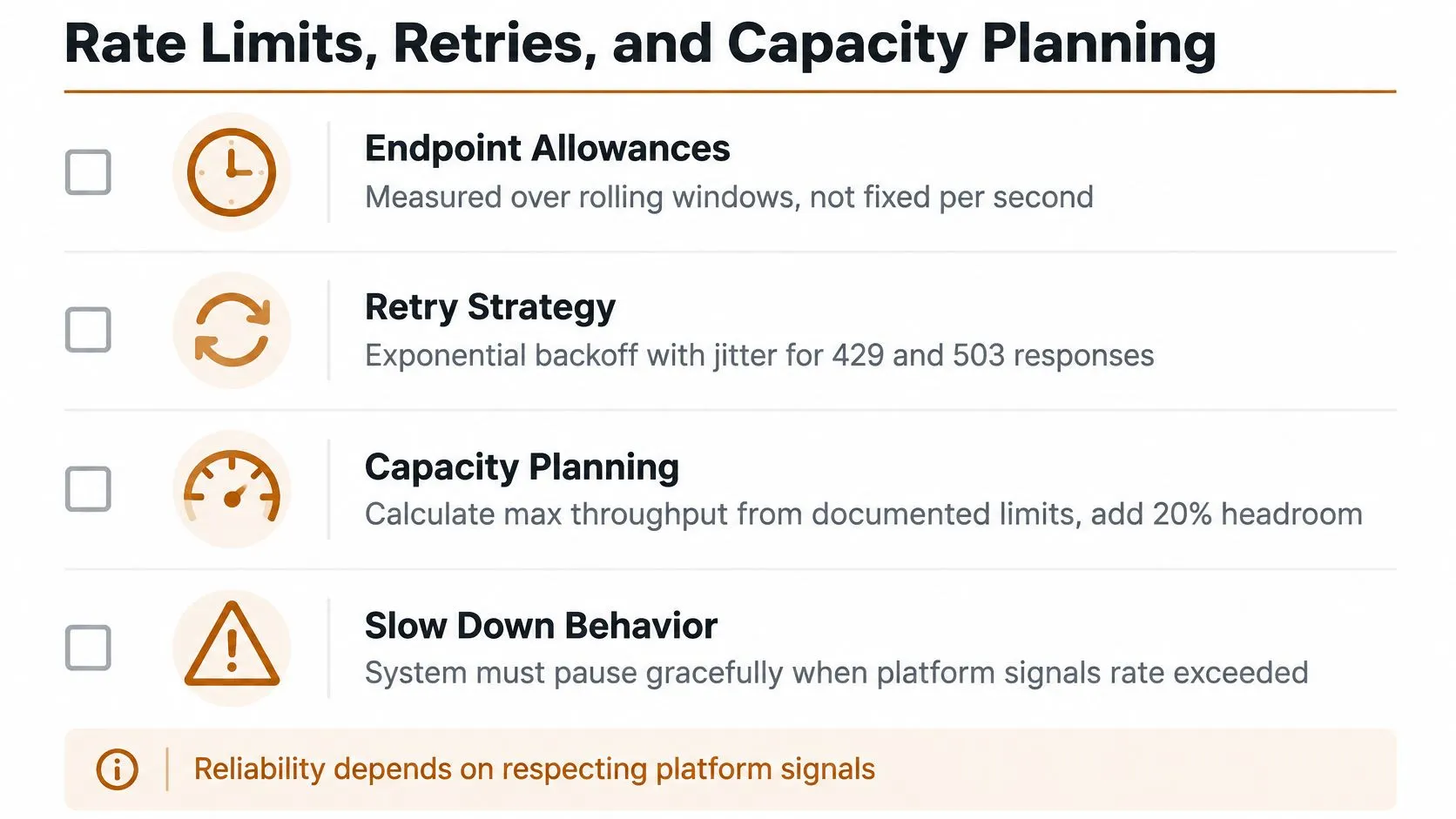
A 100,000-product catalog is a useful stress test for throttle design. At 50 items per search page, discovery alone requires at least 2,000 page requests. Viator’s Partner API technical documentation describes endpoint allowances over rolling 10-second windows, account-level controls, an originating-IP traffic cap, and HTTP 429 responses carrying a dynamic Retry-After value; a published affiliate specification lists 150 requests per window, or 15 requests per second on average, though account and endpoint policies can differ. At that average ceiling, those 2,000 requests have a theoretical floor of roughly 133 seconds before latency, filtering, retries, and detail enrichment enter the calculation.
Treat that number as the floor it is. If your capacity plan only works at the published ceiling, you have a hope, not a plan.
Budget each job type separately. Discovery, product enrichment, availability checks, and review pulls have different request shapes and different freshness requirements. For reviews specifically, Viator’s refresh guidance recommends fetching them only when the product-content response shows the total review count has changed. That signal saves real capacity over a catalog this size.
The limiter itself is the easy part. A token-bucket or leaky-bucket mechanism works, provided its configuration respects rolling-window behavior and it stays coordinated with the ingestion ledger so throttled jobs resume cleanly. The harder discipline is coordination: hold one shared account-level budget alongside endpoint-specific limits, because independent worker throttles do nothing to control aggregate traffic. Read Retry-After dynamically and apply bounded jitter, so a delayed backlog releases gradually instead of firing in a synchronized burst. Keep headroom for recovery traffic and urgent updates rather than filling every request slot.
A rate-limit response should delay unfinished work; completed work stays in the ledger.
The recovery patterns in distributed scraping fault tolerance apply to authorized API ingestion as much as to page collection. Judge the pipeline on completed, validated deliveries against the required cadence. Raw request throughput stays an internal implementation detail.
API Access Versus Scraping Versus Licensed Data
My recommendation is blunt: make the partner API the default, treat governed page collection as a scoped exception, and buy licensed data only when the contract gives you coverage your own pipeline cannot. Price each route by the cost of keeping an approved feed accurate after month three; the first export is a weak proxy.
Start with a concrete procurement test. Ask each route to prove it can deliver the exact fields, destinations, cadence, display rights, and deletion duties your product needs. If a vendor or team cannot put that in writing, the option is already weak.
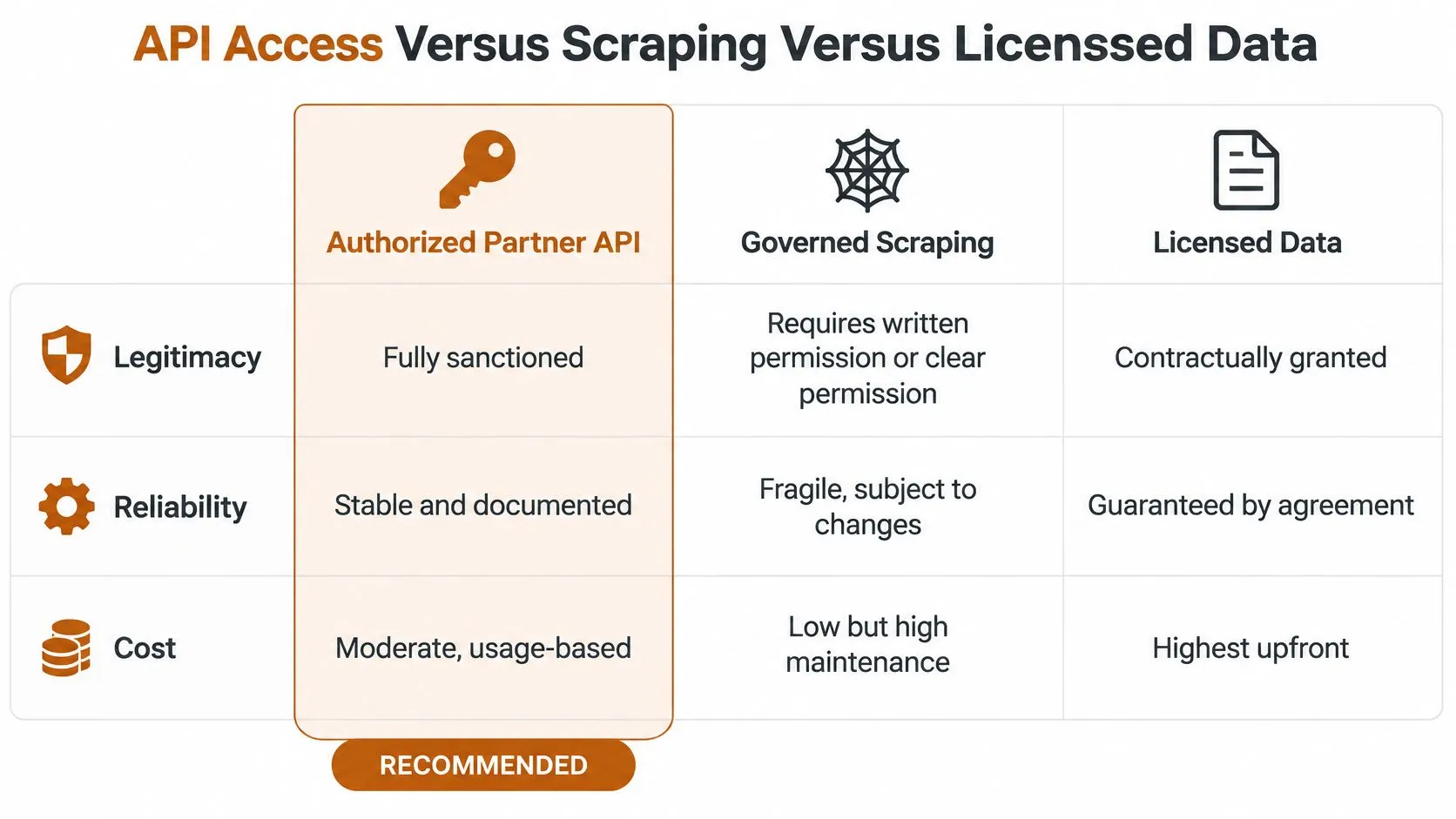
Use this as the decision grid:
| Route | Where it earns its place | What must be explicit before signoff |
|---|---|---|
| Authorized partner API | Approved discovery, product, availability, or review workflows | Account eligibility, endpoint scope, retention, attribution, display obligations |
| Governed page collection | A narrow, permitted research gap outside API coverage | Written scope, collection boundaries, permitted fields, owner for breakage |
| Licensed dataset | Contracted historical or market coverage | Provenance, freshness, redistribution, derived-work rights, exclusions |
The access label settles very little. API access can still carry endpoint limits, retention rules, or eligibility gates. Page collection can hide review burden, consent questions, and maintenance cost. A licensed feed can exclude resale, public display, or model training. For general context I point stakeholders to this API versus scraping comparison, then require a Viator-specific service schedule tied to fields and cadence.
Legal review should press four pressure points. Review text needs separate rules for storage, analysis, display, and republication. Derived outputs need clarity on aggregates, scores, and model-ready datasets. Conflicting values need a source-precedence rule. Exit needs delete-or-disable duties that survive contract end.
Keep the permission record, agreement version, field-level rights map, and lineage for mixed-source records. Choose API unless the gap is narrow, documented, and worth governing.
Measuring Demand Beyond Ratings and Review Counts
A high rating beside a large review count can still hide a weak product: it may be old, heavily discounted, or easier to find than to book. Treat ratings as satisfaction evidence and search position as distribution evidence. Demand needs dated movement.
Viator’s own categories make the point. In the 2025 Viator Travel Trends Report, booking growth, volume, gross booking value and review quality are separated, with more than 40% year-over-year growth for thermal spas and hot springs and above 4.8-star averages for craft, cooking and dance experiences. Those numbers answer different questions, so never average them into one demand score.
I would ship a labeled proxy. Start with three observations captured on a schedule: first-seen and last-seen dates for the same product URL; review deltas between snapshots rather than lifetime totals; availability and option status tied to travel dates. Then add two context fields: rank under a fixed query, locale and device class; price, cancellation and language changes that can explain a jump before demand does.
Category normalization is the common failure. Compare like with like across countries, keep Viator’s original taxonomy beside your mapping, and mark broad groups as lower confidence when they collide with narrow subcategories. Historical booking context, such as Viator’s 2024 year-in-review analysis, can frame seasonality, origins and booking windows, but current observations still decide whether interest is rising now.
If the API exposes the same fields, use it. Reserve governed collection for gaps that are narrow, written down and owned. Publish the components next to any composite inside a documented market trend analysis framework, and state plainly what the feed cannot prove: actual bookings, revenue and share.
Operating a Viator Pipeline Without Surprises
Production approval should depend on an operational acceptance review, not a successful demonstration. The buyer needs named owners, measurable delivery expectations, and a recovery process that has been exercised against interrupted work.
Create a runbook that connects source access, ingestion health, validation, and downstream publication. Set alert thresholds from the approved baseline and business requirements rather than choosing arbitrary tolerances that nobody can defend.
Require an operational handoff
- Capture schedule: Assign refresh priorities by field volatility and analytical need. Product descriptions and date-specific availability shouldn’t automatically share a schedule.
- Quality controls: Check missing identifiers, duplicate records, malformed currencies, stale observations, unexpected nulls, and unexplained catalog changes.
- Drift detection: Monitor response structures, endpoint errors, and permitted page layouts. Quarantine suspect output instead of publishing plausible-looking blanks.
- Delivery controls: Define completion criteria, late-feed notifications, replay behavior, and handling for partial datasets.
- Governance evidence: Maintain an accessible record of approved purposes, permissions, retention rules, and source lineage.
Test failures before increasing volume
Exercise worker interruption, delayed responses, malformed records, expired credentials, and downstream delivery failures. Confirm that operators can identify the affected scope and recover it without rebuilding the entire dataset.
Distinguish a collection failure from a genuine marketplace change. A sudden loss of availability may reflect inventory movement, but it may also indicate access failure or parsing drift. Analysts shouldn’t have to infer which occurred from an empty dashboard.
For permitted website collection, access challenges require an agreed escalation path. A CAPTCHA or block is a reason to pause and review authorization, not an instruction to bypass controls. A managed provider should own investigation and communication while keeping the buyer’s approved scope intact.
Scale only after the pipeline can explain its output and recover its failures. Begin with the required dataset, secure the appropriate access, validate representative records, and establish monitoring before expanding coverage. That sequence gives the buyer something more useful than a scraper: a maintainable data operation.
WebscrapingHQ provides managed web data operations and custom extraction pipelines, including scoping, schema design, monitoring, and scheduled structured delivery. Visit WebscrapingHQ to discuss your Viator dataset, approved access route, required fields, and delivery cadence before committing to implementation.
Want this done for you?
Send us the URLs. We'll quote it in 24 hours.
Paste the URL(s) you want scraped. We'll reply within 24 hours with a feasibility check and a ballpark quote.