Jump to section
- Why a 4chan Scraper Is Harder Than It Looks
- A snapshot isn’t a monitoring system
- How AI Augments Modern Web Scraping
- Give each layer a bounded responsibility
- Core Techniques Computer Vision and NLP Bring
- Match the technique to the evidence
- LLM-Based Parsing Versus Traditional Extraction
- Traditional Parsing Versus LLM-Based Parsing
- Make uncertainty an accepted output
- Real-World Use Cases for 4chan Scraper Pipelines
- An analyst studying discussion over time
- A safety team prioritizing review
- Common Misconceptions About Scraping Ephemeral Boards
- Absence needs an explanation
- Representativeness is a design question
- Designing a Defensible Scraping Pipeline
- Turn the design into operational checks
- Make the delivery auditable
- What to Take Away and What to Do Next
- Define a pilot with explicit acceptance criteria
You’ve downloaded a board, extracted the post text, and opened a clean-looking dataset. Then a colleague asks whether it includes discussions that disappeared before your script ran. Your scraper returned successfully, but you can’t yet explain what it missed. That’s the starting point for building a useful 4chan scraper: defining what your data represents before deciding how to analyze it.
Why a 4chan Scraper Is Harder Than It Looks
A board page can look like an ordinary extraction target. You identify the thread containers, collect their text, and save the results. The problem is that a successful download only describes what was accessible at that moment, not everything participants posted during your observation period.
4chan’s ephemeral design makes that distinction consequential. Threads can leave the live catalog, and recovering their final contents may require an archive. In a published measurement study, researchers retrieved the catalog every five minutes, compared successive observations, and recovered purged threads from an archive rather than treating the live catalog as a historical record (4chan measurement study).
A snapshot isn’t a monitoring system
Think of the catalog as a departure board at a station. Photographing it tells you which departures were displayed, but it doesn’t reconstruct the whole day’s service. Repeating the photograph helps, although you still need to document the intervals between observations and any interruptions.
A scraper therefore needs an explicit collection model:
- Observation scope: Specify the boards, content types, and collection window you intend to cover.
- Change tracking: Distinguish newly observed material from content you’ve already retrieved.
- Recovery boundaries: Record whether unavailable discussions can be recovered and which remain unresolved.
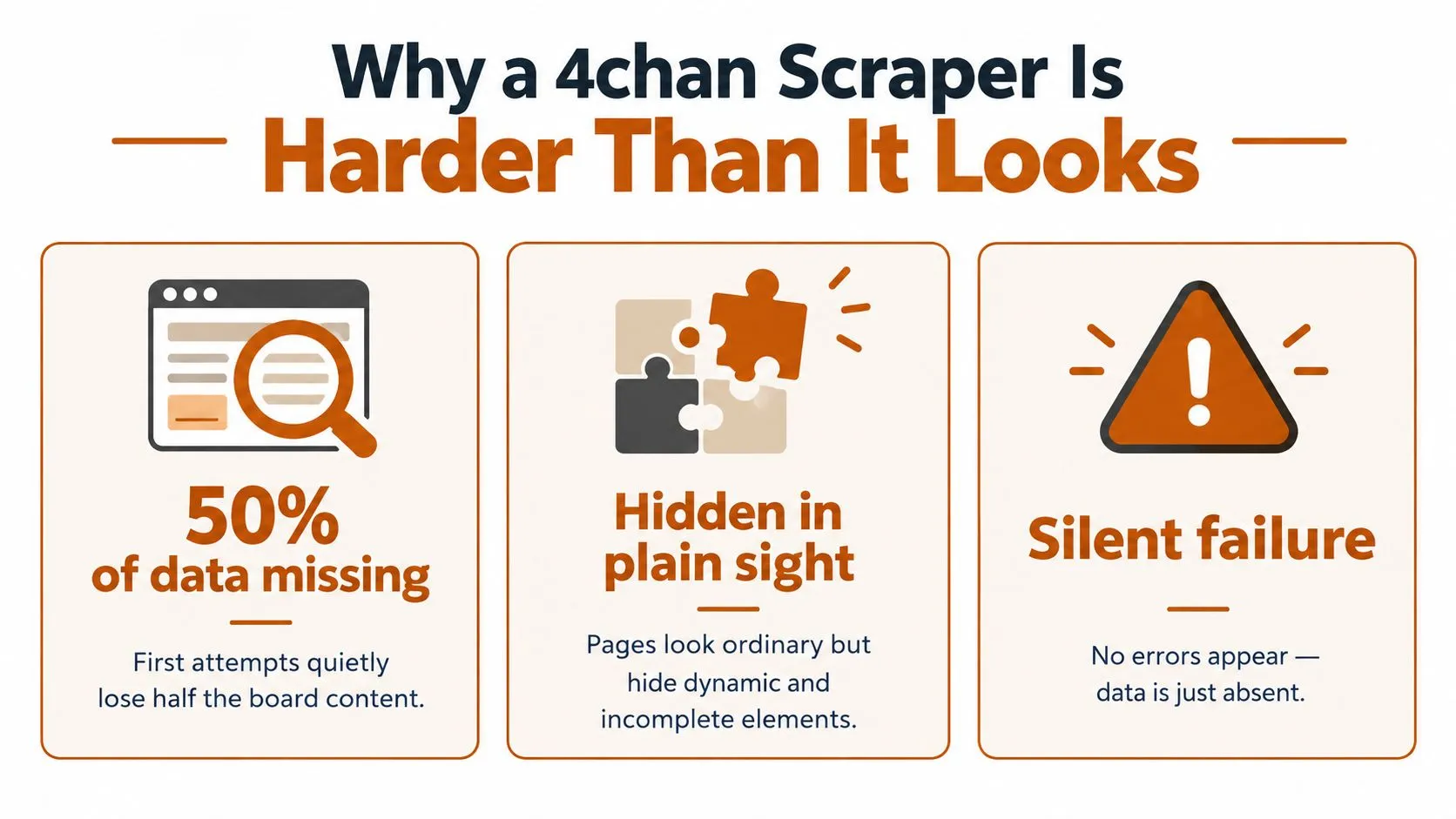
Treat the infographic’s missing-data percentage as illustrative, not as a measured loss rate. Actual completeness depends on your collection design and available recovery sources.
The most important failure may not produce an exception. Your program can parse every response correctly while never requesting a discussion that vanished between observations. Transport success, extraction success, and research validity are different tests. Computer vision and language models become useful only after you’ve separated those responsibilities.
How AI Augments Modern Web Scraping
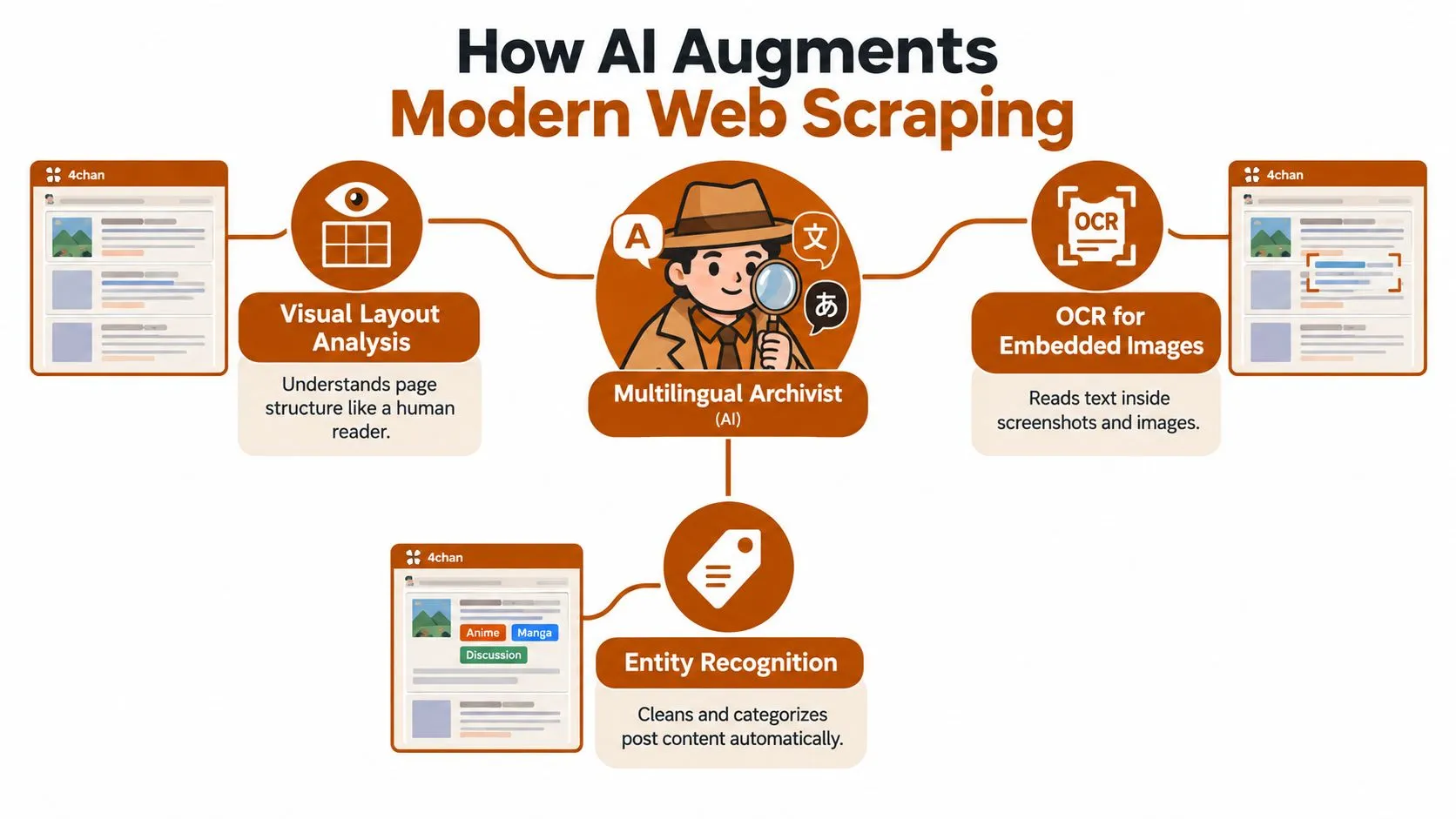
An AI-augmented scraper is best understood as an archive operation with specialized staff. A collector retrieves material, an archivist organizes it, and a multilingual reviewer interprets difficult passages. Giving the reviewer more language skills doesn’t repair a missing box of records.
For a 4chan scraper, I’d preserve that division in the architecture. Keep retrieval deterministic, store source material before interpretation, and send only suitable records to AI processing. The platform’s structured API makes this separation especially important: there’s little value in asking a model to infer a field that the source already supplies explicitly.
Give each layer a bounded responsibility
The collection layer should deliver source records without interpreting their meaning. A normalization layer then converts those records into agreed field types. Only afterward should an enrichment layer attempt tasks such as topic labeling, language identification, or extracting text from an attached screenshot.
Consider a hypothetical post containing commentary and an image of a document. The collector stores the post and its permitted attachment reference. An image-processing worker attempts transcription, while a language-processing worker proposes a topic label. Neither worker should overwrite the original content.
- Deterministic processing: Use ordinary code for identifiers, timestamp conversion, required-field checks, and known mappings.
- Selective enrichment: Invoke models where interpretation is necessary, rather than sending every field through them.
- Review routing: Send ambiguous results to a review queue or leave them unclassified.
This separation also clarifies service requirements. When evaluating AI data extraction services, ask whether the provider separates captured evidence from generated interpretation and can deliver both.
Practical rule: AI should add an inspectable interpretation to a record, not silently replace the record.
For model inputs, treat forum text as untrusted material. A post may contain instructions addressed to an automated reader. Your enrichment worker should analyze that content as data, without following embedded requests, accessing unrelated systems, or changing the collection workflow.
Core Techniques Computer Vision and NLP Bring
Suppose a collected post links a screenshot containing a product name, a paragraph of commentary, and a photographed table. Those elements need different extraction methods. A single instruction to understand the image leaves too much ambiguity about what the pipeline should return.
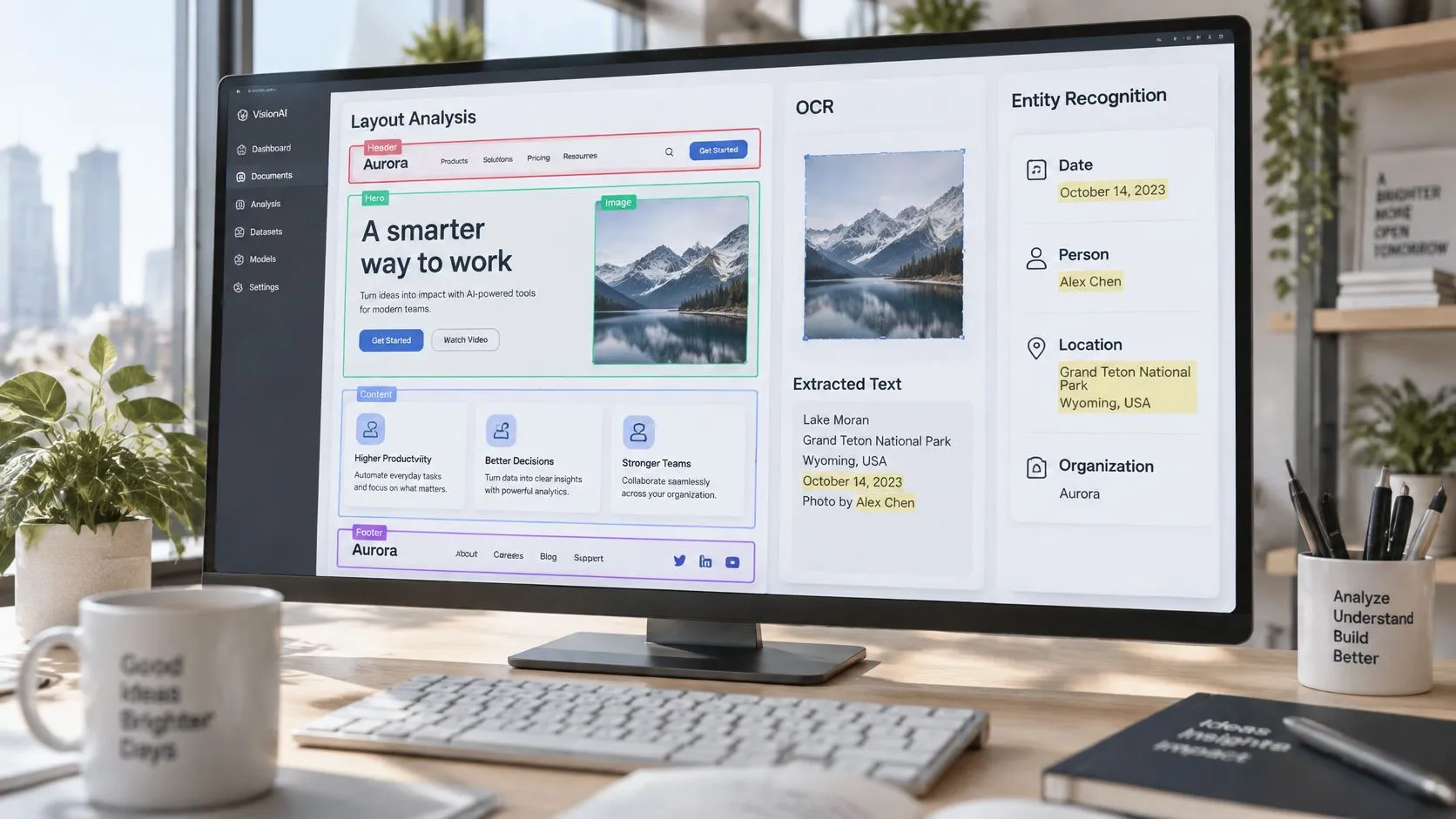
Visual layout analysis is a candidate technique for separating regions before transcription. For rendered archive pages, that might mean distinguishing the post body from navigation. For an image attachment, it might mean isolating a table from surrounding commentary. These are proposed processing tasks, not guarantees of accurate interpretation.
Match the technique to the evidence
Optical character recognition, or OCR, attempts to turn visible lettering into text. In a document-like attachment, preserve the transcription alongside its image reference and review status. Don’t treat text visible in a screenshot as proof that the screenshot is authentic.
Named entity recognition proposes labels for spans such as organization names or places. Keep the actual text span beside the normalized label so an analyst can check whether a nickname, quotation, or sarcastic reference was misinterpreted.
For conceptual background, Sift AI’s AI image analysis guide is a useful companion resource. A separate discussion of computer vision feature extraction can help frame which visual attributes your project should attempt to retain.
| Input example | Proposed processing | Required safeguard |
|---|---|---|
| Screenshot with lettering | OCR transcription | Preserve the image reference |
| Free-form organization mention | Entity extraction | Retain the supporting text span |
| Document-like table | Region and cell extraction | Flag uncertain cell associations |
Schema induction belongs in development, not uncontrolled production changes. You might ask a model to propose common fields across messy archive records, then have an engineer approve the mapping.
The resulting versioned schema should distinguish source fields, normalized fields, and inferred fields. If an extractor changes how it assigns an entity label, downstream users need a way to identify which records were processed under each interpretation.
LLM-Based Parsing Versus Traditional Extraction
Choose the least interpretive method that can reliably perform the task. A JSON parser is the appropriate starting point for structured responses. CSS selectors and XPath suit known HTML structures, while regular expressions can handle tightly bounded text patterns.
An LLM becomes a candidate when the task concerns meaning rather than location. Mapping differently worded passages into a controlled category is a different problem from reading an existing timestamp field. Combining those jobs in the same model call makes errors harder to isolate.
Traditional Parsing Versus LLM-Based Parsing
| Dimension | Traditional Parsing | LLM-Based Parsing |
|---|---|---|
| Best fit | Explicit fields and stable structures | Ambiguous text and semantic mapping |
| Cost | Primarily fetching, execution, and maintenance | Includes inference and output validation |
| Latency | Usually preferable for direct field access | Depends on model execution and input size |
| Accuracy | Exact extraction when rules match correctly | Requires evaluation of interpretive judgments |
| Maintenance | Update selectors and mappings | Maintain prompts, models, schemas, and test sets |
| Failure handling | Detect missing fields or invalid types | Also check unsupported or invented content |
| Auditability | Trace values to source locations | Retain evidence spans and processing versions |
These comparisons are architectural guidance, not benchmark results. Test the actual workload before estimating operating cost or deciding whether semantic parsing earns its place.
For example, a rule can extract a post’s supplied identifier without understanding the discussion. A model might instead propose whether that discussion concerns a named event. The first output should pass a type check; the second needs evidence-based evaluation against reviewed examples.
Use a parser to recover what the source says explicitly. Use a model only when the task requires a documented judgment about meaning.
Make uncertainty an accepted output
Require a bounded output schema, permitted categories, and an explicit abstention option. If the evidence doesn’t support a classification, an empty result with a reason is preferable to a plausible invention.
Maintain a reviewed test set that includes quotations, sarcasm, incomplete sentences, and image-derived text. Evaluate extraction mistakes separately from classification mistakes. Otherwise, an apparently poor language model may be receiving damaged input, or a successful parser may conceal unreliable downstream interpretation.
Real-World Use Cases for 4chan Scraper Pipelines
Longitudinal research and trust-and-safety monitoring can share collection infrastructure while requiring different evidence. The following scenarios illustrate design choices, not customer case studies or claimed outcomes.
For scale context, a published study collected more than 3.3 million threads and 134.5 million posts across almost 3.5 years, from June 2016 through November 2019, using live API monitoring and archived thread copies (longitudinal 4chan research). That example establishes the potential engineering workload, not a completeness guarantee for another collection.
An analyst studying discussion over time
Suppose a researcher wants to examine changes in discussion around a public event. Before assigning topics, the researcher needs a consistent observation window, a defined board scope, and a distinction between post creation time and retrieval time.
The analyst should compare periods only after checking collection health. A gap in retrieval must remain visible beside a quiet period in discussion, rather than being converted into an apparently meaningful decline. Archived recovery should preserve its own provenance so the researcher can distinguish contemporaneous observations from later reconstruction.
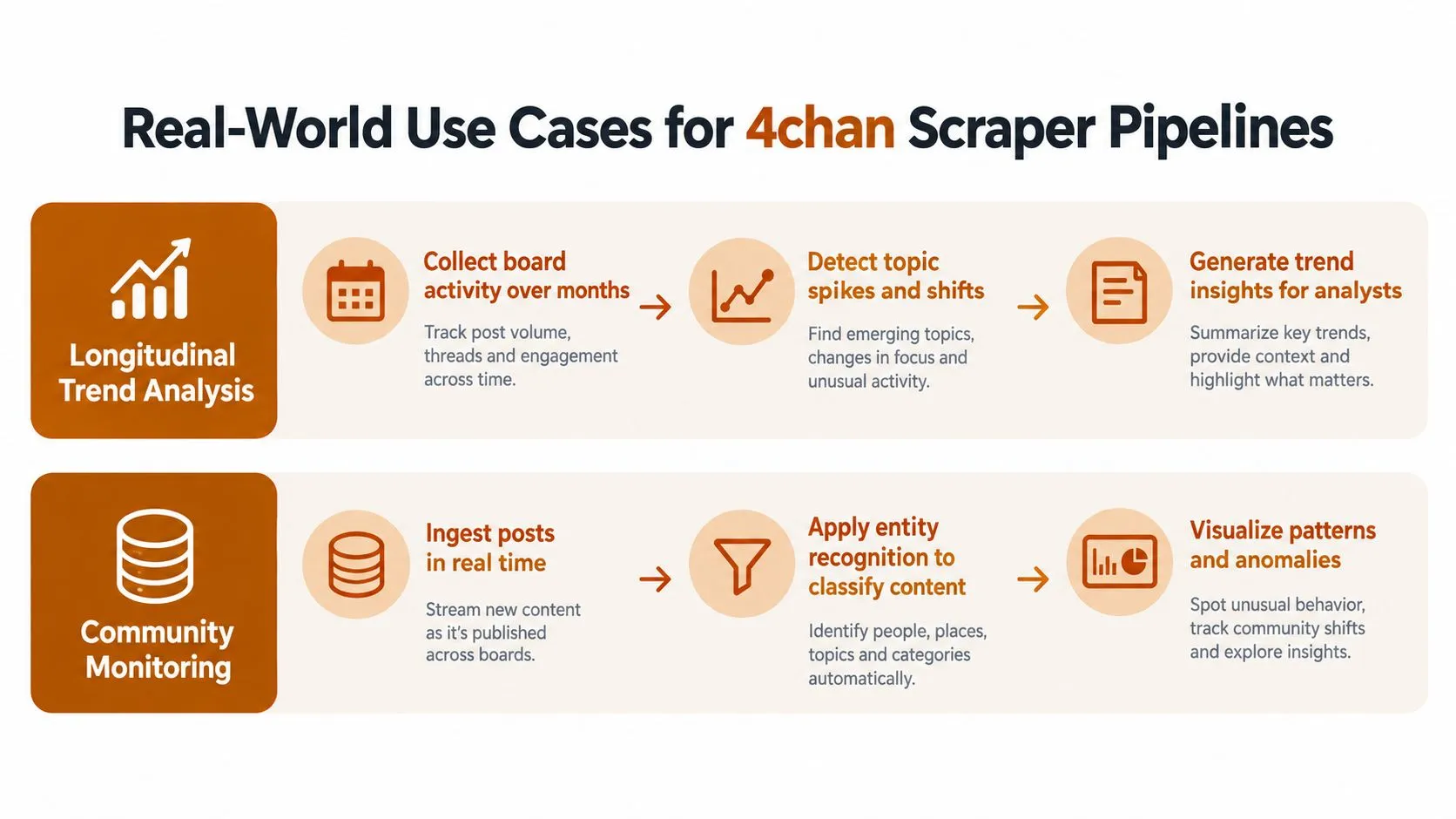
A safety team prioritizing review
A trust-and-safety team might use a similar pipeline to identify discussions requiring human attention. Instead of treating every model label as a finding, the team could group related content, attach supporting excerpts, and present a review queue.
The key distinction is between a review signal and a verified conclusion. Similar language across discussions may justify inspection, but it doesn’t by itself establish coordination or shared authorship.
- Research delivery: Include observation boundaries, missing intervals, and processing versions alongside analytical outputs.
- Safety delivery: Provide contextual excerpts, review status, and controlled access to sensitive material.
A comparison with Reddit web scraping can help teams formulate source-specific questions. It shouldn’t become permission to transfer assumptions about identity, retention, or discussion structure from one platform to another.
Both teams also need retention decisions before collection begins. Researchers may need reproducible analytical extracts, while reviewers may need restricted evidence packages. Collecting every available artifact without a defined use creates obligations without necessarily improving the decision either team must make.
Common Misconceptions About Scraping Ephemeral Boards
More posts don’t automatically mean better intelligence. A large dataset with undocumented interruptions may support weaker conclusions than a narrower collection whose boundaries an analyst can explain. Volume is a storage measurement, not a substitute for validity.
The anonymity, archive dependence, and disappearing content discussed earlier create an important constraint: analysts shouldn’t describe observed records as a census of participants or activity. Nor should they infer persistent individual identities merely because the dataset contains author-related fields.
Absence needs an explanation
A missing record can have several possible explanations. The collector may have missed it, a request may have failed, or a recovery source may not have retained it. Unless the evidence resolves the cause, the defensible label is unknown, not deleted.
The same discipline applies to repeated content. You need to distinguish duplicate observations of a post from separate posts that contain identical text.
| Observation | Defensible interpretation | Unsupported leap |
|---|---|---|
| A thread becomes unavailable | Availability changed | A moderator necessarily removed it |
| Similar text appears elsewhere | Content overlaps | The same individual posted it |
| Observed activity declines | Collected counts fell | Actual participation necessarily declined |
A bias audit should examine what the pipeline systematically leaves out. If the collection excludes images, describe the output as a text-focused dataset. If some boards lack usable archival recovery, explain why their coverage differs instead of merging them into an undifferentiated total.
A dataset is useful when its limitations travel with its conclusions.
Representativeness is a design question
Ask what population the analysis claims to describe. Is it the collected posts, observed discussions on selected boards, or a broader community? Each expansion requires justification that a larger file cannot provide by itself.
Build ethical data collection into that decision. Limit sensitive fields to a justified purpose, define who may inspect raw material, and avoid identity inference that the research question doesn’t require.
A smaller, documented sample can be the stronger choice when it allows careful review, consistent inclusion rules, and explicit uncertainty. That’s an engineering decision about fitness for purpose, not an argument against scale.
Designing a Defensible Scraping Pipeline
Start with the platform’s read-only JSON API, not repeated rendering of ordinary pages. Its documentation specifies no more than one request per second and at least 10 seconds between thread refreshes, and describes the thread indexes, individual thread documents, and conditional-request behavior needed for efficient collection (4chan API documentation).
Turn the design into operational checks
- Monitor changes centrally: Read
/{board}/threads.json, compare thread identifiers andlast_modifiedvalues, and queue changed/{board}/thread/{id}.jsondocuments. Use a shared scheduler rather than allowing independent workers to exceed the request budget. - Preserve responses: Store raw JSON and fetch metadata before transformation. Use
If-Modified-Sincewhere appropriate so unchanged resources don’t require redundant payload processing. - Reconcile unavailable threads: Attempt permitted archive recovery, while retaining separate states for live unavailability, recovery success, and unresolved recovery failure.
- Separate identity from observation: Use board, thread, and post identifiers for record keys. Store repeated fetches as observations, not additional posts.
- Validate delivery: Check field types, timestamp ordering, thread relationships, and unexpected schema changes before publishing an extract.
Retries should use bounded backoff and respect access restrictions. For throttling or anti-bot responses, slow or pause collection and investigate the response rather than attempting to bypass the restriction.
Make the delivery auditable
Each record should carry retrieval time, board and thread identifiers, source type, HTTP status, and processing version. Preserve edit or deletion indicators only where the source supports them. Don’t turn an inference into a source-supplied fact.
Operational dashboards should track pending recovery, failed retrievals, processing backlog, and collection interruptions. Define completeness metrics against an observable denominator, such as discovered threads, rather than implying knowledge of everything ever posted.
Apply data governance by design to delivery contracts as well as storage. Specify required fields, access controls, retention rules, and how consumers will learn about collection gaps or schema changes. A feed should arrive with enough context for its recipient to decide which analyses remain defensible.
What to Take Away and What to Do Next
A useful 4chan scraper is a monitored evidence pipeline with optional interpretive layers. The central design question isn’t whether you can extract more text. It’s whether a downstream analyst can explain where a record came from, what processing changed it, and which conclusions it can support.
Begin with the decision your team needs to make. A topic-research project, an image-analysis dataset, and a human-review queue need different fields and different acceptance criteria. Write those requirements before selecting models or expanding collection scope.
Define a pilot with explicit acceptance criteria
- Choose the boundary: Name the target boards, observation window, permitted content types, and excluded material.
- Specify the output: Define source fields, inferred fields, evidence references, and acceptable unknown values.
- Test difficult records: Include unavailable threads, malformed content, ambiguous language, and unsuccessful enrichment.
- Assign responsibility: Decide who handles collection outages, schema changes, model evaluation, and access reviews.
Choose self-built collection when your team can own those operational duties. Consider managed delivery when the priority is a recurring data contract and your engineers shouldn’t be responsible for maintaining the collector. In either case, evaluate the delivered evidence, not merely whether a sample file looks clean.
Plan for change without predicting exactly what will change. Review source behavior, API documentation, archive availability, and applicable legal requirements as ongoing operating responsibilities. Keep raw evidence and transformation history sufficiently separate that you can revise an interpretation without pretending you collected something different.
The strongest next step is a scoped feasibility exercise with a written schema and failure policy. Expand only after your team can explain the pilot’s missingness, validate its enrichments, and reproduce its delivered records.
WebscrapingHQ offers custom managed web data operations, including pipeline development, monitoring, and structured delivery, as an alternative to maintaining collection entirely in-house. Visit WebscrapingHQ with your proposed boards, output schema, delivery cadence, and governance requirements to discuss the feasibility of a source-specific pipeline.
Want this done for you?
Send us the URLs. We'll quote it in 24 hours.
Paste the URL(s) you want scraped. We'll reply within 24 hours with a feasibility check and a ballpark quote.