Jump to section
- Review Fields Worth Capturing Before You Scrape
- Review fields and why each one matters
- Keep context without collecting unnecessary identity
- Compliance Limits to Plan Around
- Separate permitted collection from downstream use
- Flag suspicious clusters rather than declaring fraud
- Matching the Collection Method to the Job
- Collection methods compared
- Network responses and managed delivery
- How to Collect Amazon Reviews Step by Step
- Run the collection with explicit checkpoints
- Make the pilot fail visibly
- Handling Blocks, Rate Limits and Proxy Failures
- Collection symptoms, causes and fixes
- Verify repairs at the right level
- Normalizing and Checking Review Data Quality
- Clean records without erasing evidence
- Score helpfulness in product context
- Evaluate across time and language
- Deciding Whether to Build In-House or Hire Managed Scraping
- Compare the obligations
- Evaluate the output contract
Most Amazon reviews scraping advice starts with a request library, a selector and a pagination loop. That’s the wrong starting point. A technically successful scrape can still produce an indefensible dataset if it doesn’t distinguish publicly visible reviews from restricted content, preserve collection evidence or explain why records disappeared between runs.
Start with provenance, the evidence of where each record came from and how it was obtained. Build around access state, capture timestamps, stable identifiers and vote denominators, then choose the simplest permitted collection method. That approach produces a dataset you can audit, repair and use without confusing missing access with missing customer opinion.
Review Fields Worth Capturing Before You Scrape
What question must the dataset answer? Tracking product defects requires variation and review dates; comparing sentiment across marketplaces requires language and regional context. A text-only export won’t support either task reliably.
Amazon reported that 125 million customers contributed nearly 1.5 billion reviews and ratings worldwide in 2022, according to its explanation of how it maintains a trusted review experience. At that scale, identifiers and observation context are essential to separating products, markets and collection runs.
Review fields and why each one matters
| Field | Why it matters | Example value |
|---|---|---|
| Review ID | Deduplication key and join across snapshots | Unique string per review |
| ASIN and marketplace | Ties each review to one product in one store | Product ID plus country domain |
| Title and body | Near-duplicate check and text analysis | Text as displayed, Unicode normalized |
| Star rating | Sentiment and rating distribution analysis | Integer on the marketplace scale |
| Review date | Trend analysis and time-based splits | ISO-formatted calendar date |
| Verified purchase flag | Filtering and segmenting reviews | Boolean when observable, otherwise null |
| Helpful votes | Weighting and quality scoring | Yes votes and total votes, where available |
| Variation | Separates colour, size or pack effects | Variant attributes as shown |
| Language and country | Multilingual splits and regional comparison | Language code and country where shown |
| Capture timestamp and access state | Auditability and provenance | UTC time plus public or signed-in |
| Raw HTML or rendered evidence | Re-parsing after site changes | Stored snapshot reference |
Read the identity fields together. Review ID identifies the review, while ASIN, marketplace and variation identify its product context. Don’t assume an identifier alone describes every listing on which a review appears.
Preserve displayed title and body separately from normalized text. Keep the review date distinct from the capture timestamp, and represent unobservable flags as null rather than false. For helpfulness, store the numerator and denominator separately; if the page exposes only a helpful count, leave the total unknown.
Keep context without collecting unnecessary identity
Add pagination position, detected language, displayed geographic attributes and parser version. Access state should describe the observed response, not justify collecting authenticated content; a public-only workflow should classify a sign-in redirect and stop.
For a sentiment-only project, omit reviewer names, profile links and unnecessary geographic detail. Variation and helpfulness can also stay outside the modeling export, but retain identifiers and provenance in the governed source dataset.
Our collection scope can pair reviews or ratings with product names, prices, stock and images when the analysis requires that context. Write the field list before fetching pages, and retain permitted raw evidence under a defined retention policy so extraction rules can be repaired later.
Compliance Limits to Plan Around
Publicly visible doesn’t mean unrestricted to republish. Collection, storage, analysis and publication are separate decisions. A permission assessment for internal aggregate analysis doesn’t automatically cover publishing review text or profiling reviewers.
Set the collection boundary before engineering begins: public material only, applicable robots.txt directives respected, marketplace terms reviewed and no shared accounts or workarounds for access controls. These are operational safeguards, not a substitute for legal advice.
Separate permitted collection from downstream use
Use a written handling policy with concrete rules:
- Minimize personal data. Exclude reviewer display names and profile links unless an approved purpose requires them.
- Control publication. Route verbatim review excerpts and reviewer-level profiling through legal review.
- Define retention. Assign expiry rules to raw evidence, normalized records and derived outputs.
- Support deletion. Make records traceable across snapshots, exports and downstream storage.
- Preserve flags. Record suspected manipulation separately from the original observation.
Aggregate rating distributions and topic frequencies have different exposure from verbatim text, but aggregation isn’t an automatic legal exemption. Our guide to legal risks in web scraping provides a practical framework for escalation.
Amazon reported that more than 40 fake-review brokers and related websites ceased illicit activity following its legal actions in 2024, in its account of global action against fake reviews. Don’t confuse extracting feedback with soliciting or manipulating it; Adbrew’s guide to Amazon reviews provides useful context for the review-generation side of that distinction.
Flag suspicious clusters rather than declaring fraud
A reviewer-product network method achieved 93% accuracy in work examining a random sample of 1,500 products that solicited fake reviews, as summarized by UCLA Anderson. That finding supports investigating reviewer overlap, not treating a shared reviewer as proof of wrongdoing.
Log each flag’s reason, rule version and disposition. Where reviewer-level processing hasn’t been approved, restrict screening to product-level timing and rating anomalies.
WebscrapingHQ only collects publicly available data, respects robots.txt where applicable and advises clients up front when additional legal review is required.
Matching the Collection Method to the Job
Use the least complex method that returns the permitted fields. A browser isn’t automatically better than an HTML parser, and a managed feed isn’t automatically more complete than the public source.
Inspect the response before choosing infrastructure. Determine whether review content exists in the returned HTML, appears only after rendering or isn’t available within the approved access scope.
Collection methods compared
| Approach | Best for | Main risk | Maintenance effort |
|---|---|---|---|
| Static HTML parsing | Pages that show reviews without scripts | Partial content and selector breakage | Low to medium |
| Headless browser rendering | Pages that load reviews through scripts | Higher cost per page and bot detection | Medium to high |
| Captured network responses | Review content delivered in separate data calls | Endpoints may change or be restricted by terms | High |
| Licensed or managed feed | Recurring datasets needing audit trails | Less control over field definitions | Low for the buyer |
Static HTML parsing is the default. Python Requests with BeautifulSoup or lxml gives you a straightforward fetch-and-parse workflow, with response evidence that’s easy to test against fixtures. Its main weakness is mistaking an incomplete response for the complete review source.
Use Playwright or Selenium when an inspected public page requires JavaScript to display permitted content. Wait for a specific review container or explicit empty-state marker rather than relying on an arbitrary sleep. Browser execution adds resource consumption and session-state complexity, so rendering every page unnecessarily increases operational work.
Network responses and managed delivery
Captured network responses can avoid fragile presentation markup when the page obtains content through separate data calls. However, an endpoint visible in browser developer tools isn’t necessarily a documented or permitted integration. Review terms, authorization requirements and legal scope before depending on it, and never replay authentication tokens to expand access.
A licensed or managed feed can reduce buyer-side maintenance, but inspect its definitions. Confirm whether a count describes ratings, written reviews, discovered records or collected records, and whether unavailable text is distinguishable from empty text. Our comparison of web scraping and APIs explains the broader control-versus-maintenance trade-off.
Computer vision and LLM extraction belong in a bounded fallback path. They can help interpret changing layouts, but they can also confuse product summaries with individual reviews or infer absent values. Validate their output against a typed schema and retain field-level evidence.
Start with HTML parsing for a product whose public reviews are visible. Add rendering only when inspection proves it’s necessary, not when a request encounters an access restriction.
Treat captured endpoints and licensed feeds as explicit procurement and legal decisions. Neither should become an undocumented shortcut around an incomplete public dataset.
How to Collect Amazon Reviews Step by Step
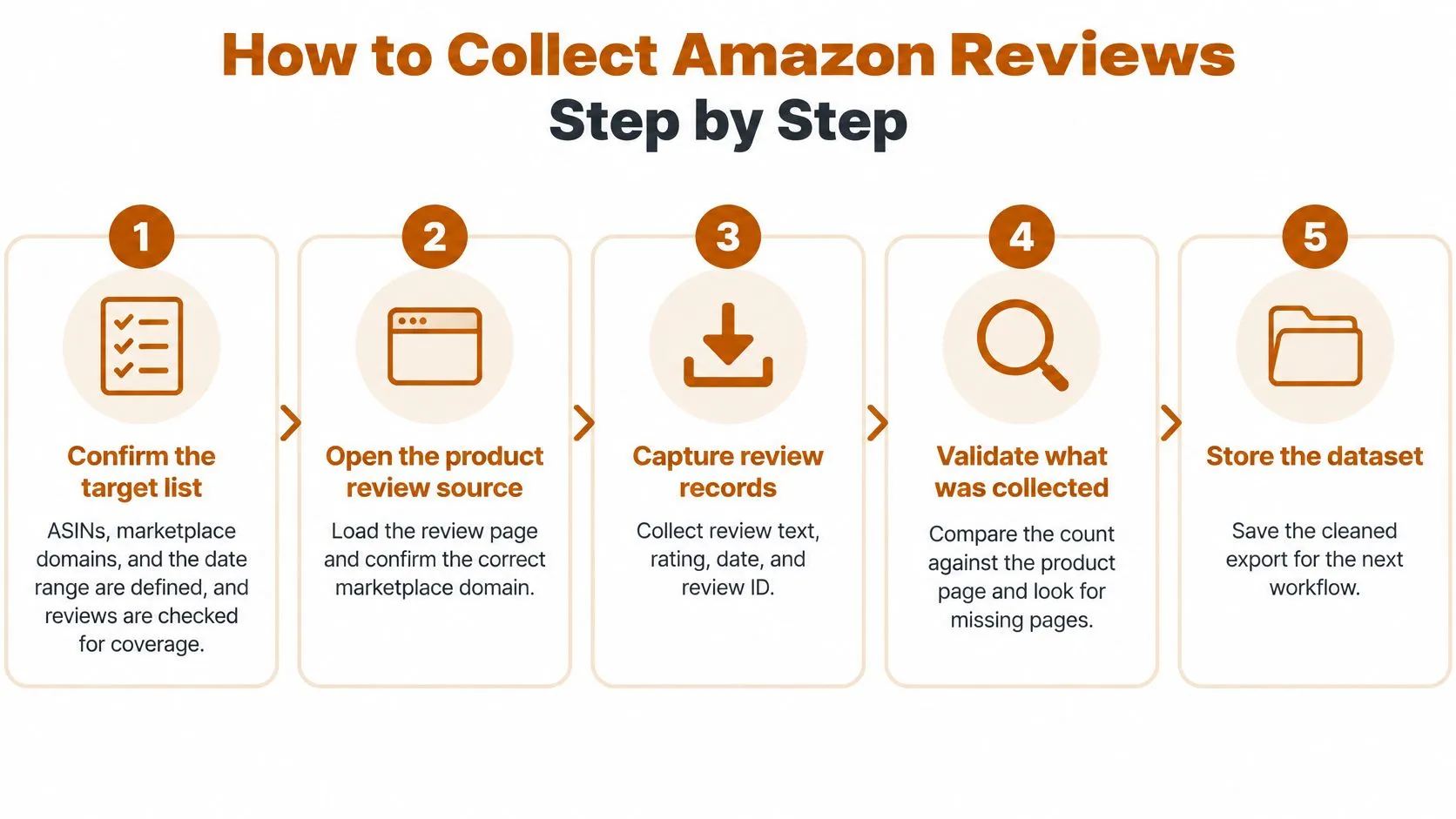
Build separate stages for discovery, fetching, parsing and publishing. A fetch failure should be recoverable without rerunning successful products, while a parser repair should work against stored evidence without another request.
Run the collection with explicit checkpoints
-
Confirm the target list. Define ASINs, marketplace domains, variations and the review-date range, then inspect whether the required records are publicly visible. Record exclusions immediately; the usual mistake is promising complete review history before checking access.
-
Discover the permitted review pages and record pagination links, sort order, filters and terminal-page evidence for each product. Don’t construct an unlimited page sequence from an assumed URL pattern, because an apparently successful response may repeat an earlier page.
-
Set a crawl budget. Establish per-product and per-marketplace request limits, low concurrency, timeouts and retry ceilings, with off-peak scheduling where appropriate. The budget must include retries and discovery requests, not just successfully parsed pages.
-
Save raw HTML or permitted rendered evidence before parsing, together with the capture timestamp, response classification, request context and content hash. Skipping this checkpoint makes selector repairs expensive because the original response can’t be reconstructed from a CSV.
-
Map each field to an extraction rule. Keep selectors and transformations in a versioned parser, and validate required identifiers, rating values and date parsing before accepting a record. Do not automatically substitute product-level ratings for missing review-level stars.
-
Log missing fields, repeated page fingerprints, pagination gaps and inaccessible continuations. Compute page coverage as collected review pages divided by discovered review pages, while recording discovery completeness separately so undiscoverable pages don’t disappear from the assessment.
-
Resolve repeated records. Deduplicate review observations within the run using review ID and marketplace context, then flag normalized title-body similarities for inspection. Preserve separate snapshots across runs instead of overwriting earlier observations or discarding legitimate edits.
-
Publish versioned CSV or JSON on the agreed schedule, accompanied by a manifest containing schema version, run status, collection scope and exceptions. Don’t publish a partial run as complete just because its export file was written successfully.
Make the pilot fail visibly
Test a product end to end and reconcile collected written reviews against the page’s displayed measures. A displayed rating count may include ratings without text or a broader variation scope, so disagreement isn’t automatically a parser defect.
Inspect the first and terminal collected pages, then replay the parser against saved evidence. Confirm that a challenge page, sign-in redirect and empty review list produce different statuses.
Release gate: A successful export needs both valid records and an explanation of what the run could not collect.
Store operational metadata in a run manifest rather than repeating every job attribute in every export row. Keep review observations append-only, and produce a separate current-state view for analysts who need the latest available record.
This separation lets engineers repair extraction without rewriting collection history. It also lets analysts exclude incomplete runs deliberately rather than discovering access gaps after a sentiment model has already consumed them.
Handling Blocks, Rate Limits and Proxy Failures
A review list that ends unexpectedly needs response classification before retries. Inspect whether the collector received a valid terminal page, a sign-in redirect, a challenge or repeated content.
Don’t assume every marketplace exposes the same public subset. Verify the actual access state for the target listing, preserve that result and stop when continuation requires authorization outside the project scope.

Collection symptoms, causes and fixes
| Symptom | Likely cause | Fix |
|---|---|---|
| Empty review list after first page | Page limits or sign-in needed for the full list | Record access state, stop that product and recheck its scope |
| CAPTCHA or challenge page | Bot detection triggered | Pause the job, reduce the rate and alert an operator |
| Duplicate reviews across pages | Pagination overlap or reordering | Deduplicate on review ID before counting |
| Fields suddenly empty | Selector drift after a layout change | Fall back to visual or LLM extraction and flag the schema change |
| Review count drops between runs | Reviews removed or reclassified | Compare timestamped snapshots before treating it as a scrape error |
For rate-related failures, reduce concurrency at the marketplace level and use bounded, jittered backoff. Honor retry instructions where provided, and prevent separate workers from independently retrying the same product.
Proxy handling must remain subordinate to access policy. For permitted traffic, retain a stable session through a product’s pagination sequence; if a proxy suffers a transport failure, checkpoint the job and revalidate its context before continuing through an approved replacement. Don’t rotate identities to evade an explicit restriction.
Verify repairs at the right level
A repaired selector can be checked immediately against stored fixtures. Rate stability, intermittent response variants and layout drift require monitoring across scheduled runs rather than a single successful retry.
Use separate counters for transport failures, challenges, restricted access, parser failures and valid empty responses. Our guide to reducing blocks while scraping complements that operational distinction, but no tuning change should turn a restricted page into an approved target.
Keep external commercial context separate from collection health. For example, a beauty intelligence team might inspect trending beauty promotions from AdLibrarySpy when investigating changes in review activity, but promotion activity doesn’t establish why records became inaccessible.
A challenge response is an operational event, not an empty review dataset.
WebscrapingHQ builds and operates custom, AI-enhanced pipelines for recurring structured delivery rather than one-off exports. Managed operation reduces customer-side maintenance, but analysts still need exception manifests to distinguish delayed delivery from an actual change in customer feedback.
Normalizing and Checking Review Data Quality
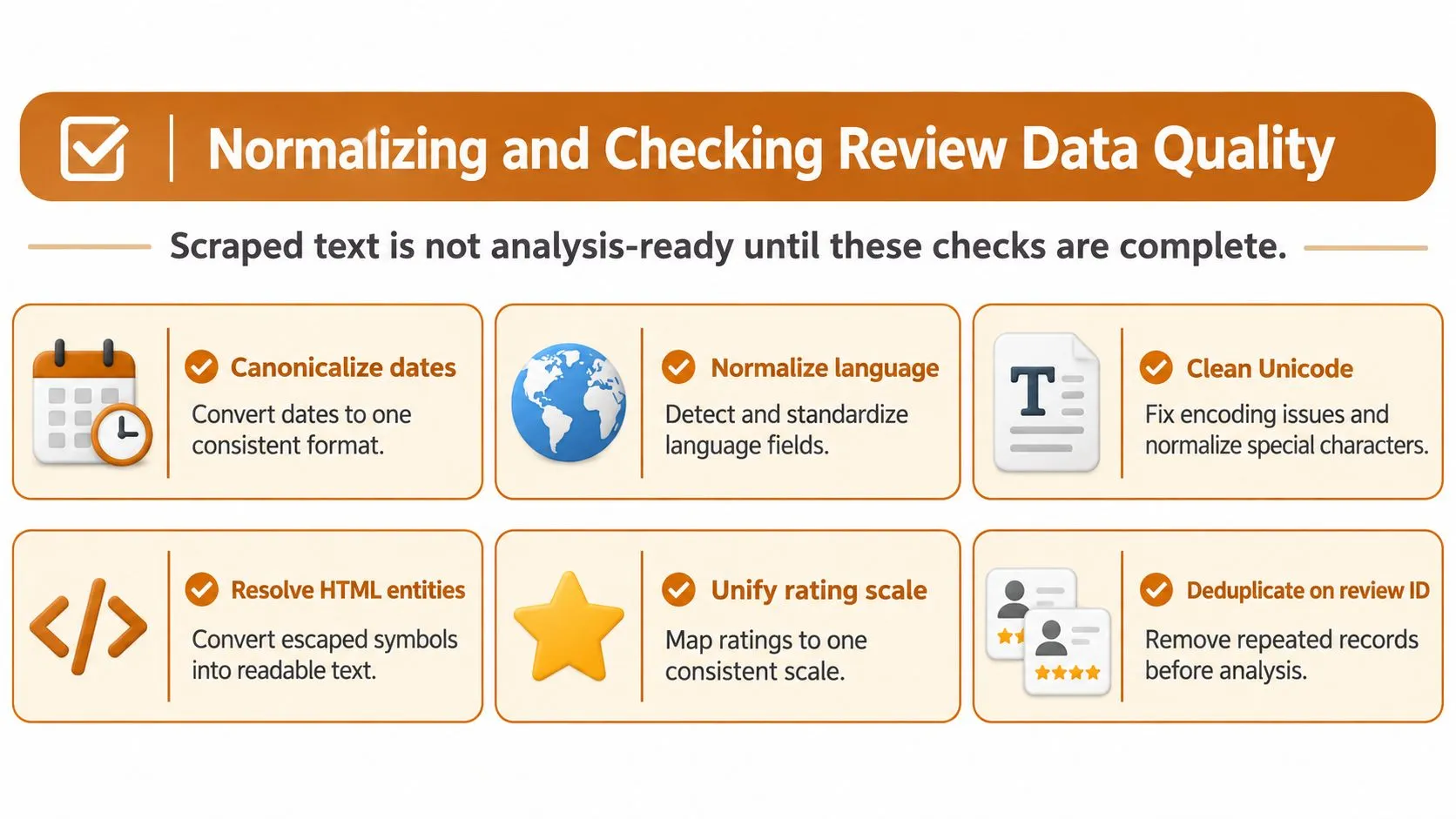
Scraped text isn’t analysis-ready. Maintain separate raw, normalized and analytical layers, with transformation versions connecting them, so cleaning decisions remain reversible.
Canonicalize dates using the displayed locale, normalize Unicode, decode HTML entities, and validate the marketplace’s rating scale. Preserve source strings alongside parsed values; an ambiguous date should become a flagged parsing exception, not a guessed timestamp.
Clean records without erasing evidence
Use review ID for exact deduplication and normalized title-body similarity for copied-content screening. The Cornell-hosted Amazon helpfulness study examined approximately 4 million reviews across 700,000 products and reported that about 1% were plagiarized.
Flag near-duplicate clusters instead of automatically deleting similar short reviews. Common phrases can match without establishing copying, while translated or lightly edited duplicates may evade exact matching.
Our Python guide to normalizing scraped data provides implementation context for keeping cleaning operations explicit and testable.
Score helpfulness in product context
Don’t treat helpful votes as unbiased labels. A foundational study of review helpfulness analyzed 1,587 reviews across six products and found a positive relationship between review depth and perceived helpfulness, with product type moderating the effects.
Calculate product-relative features such as star deviation from the observed product mean, rating variance, review age and display position. Label means calculated from a partial collected sample as sample statistics, not marketplace-wide values.
- Retain denominators. Calculate a helpfulness ratio only when both positive and total votes are available.
- Apply uncertainty controls. Use Bayesian smoothing or a documented minimum-vote rule rather than ranking sparse ratios directly.
- Keep exposure context. Older or prominently displayed reviews have had different opportunities to receive votes.
- Report sensitivity. Compare conclusions with and without flagged duplicate clusters.
Evaluate across time and language
Split training and evaluation records chronologically, and prevent duplicate families from spanning partitions. This tests performance on later observations without allowing repeated text to inflate apparent generalization.
Detect language per review rather than inferring it from the marketplace. Keep the original text and detected language beside any translation, and translate only when a downstream feature requires a shared language.
Run similarity checks within languages, then inspect cross-language matches separately for translated copies. Report missingness and collection coverage by language, category and marketplace; pooled results can otherwise conceal a poorly represented segment.
The resulting quality report should distinguish unavailable, unparseable, not displayed and not applicable values. Those states require different engineering fixes and different analytical treatment.
Deciding Whether to Build In-House or Hire Managed Scraping
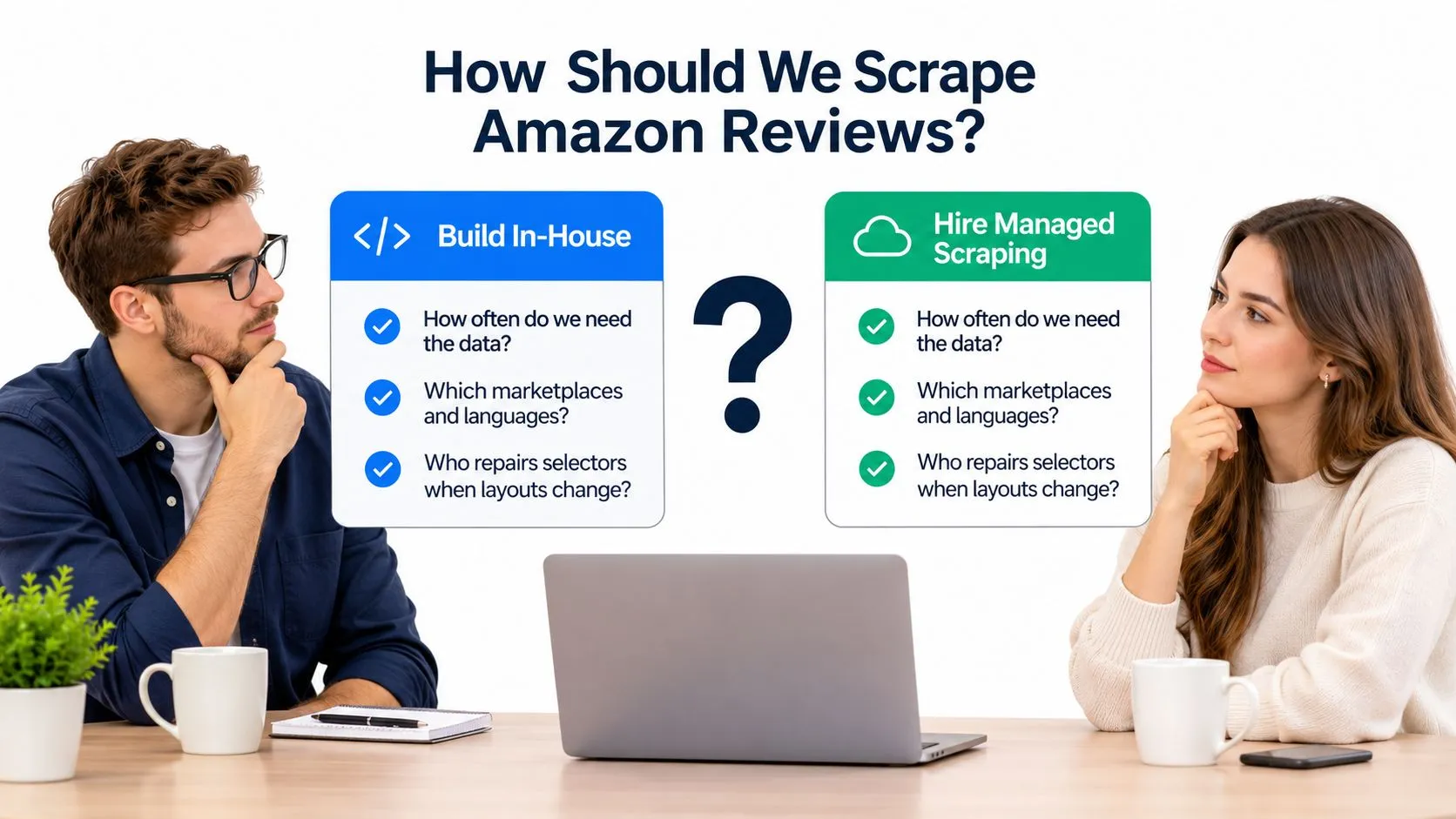
Choose based on operating responsibility, not the ease of writing an initial parser. An occasional, narrow study can fit an in-house Python workflow; recurring feeds need someone accountable for failures, schema changes and delivery exceptions.
Compare the obligations
| Decision condition | In-house fit | Managed fit |
|---|---|---|
| Collection frequency | Occasional, bounded study | Recurring downstream dependency |
| Marketplace and language scope | Narrow and predictable | Multiple locales and normalization requirements |
| Maintenance ownership | Named engineer with available capacity | Team wants delivery rather than tooling |
| Audit requirements | Internal evidence workflow is sufficient | Reproducible manifests and governed delivery are required |
For an in-house build, use the eight-step collection run with fixtures, raw snapshots and a versioned schema. Assign ownership before launch, including who pauses publication when access or extraction quality changes.
Our comparison of managed services and self-managed scraping helps assess that ownership trade-off. We don’t sell self-serve scraper access; our engagements focus on recurring managed delivery, with outputs including CSV, JSON, PDF, S3/GCS drops, webhooks and a dashboard.
Evaluate the output contract
Review sample raw and parsed records, exception handling and schema-change communication before committing. Our recurring feeds use versioned schemas, with breaking changes versioned and announced; access restrictions and suspected-manipulation flags should also have explicit acceptance rules.
Keep collection and publication requirements separate. A team planning to display Amazon customer reviews through Bragly needs a publication assessment, not merely an extraction specification.
Build internally when scope is bounded and maintenance has a named owner. Choose managed delivery when reliable recurring output matters more than owning the collector, and judge both paths against the same provenance and compliance requirements.
WebscrapingHQ offers custom, managed Amazon review extraction with recurring structured delivery and schema quality controls. Visit WebscrapingHQ with your target ASINs, marketplaces, required fields and delivery schedule to scope a public-data pipeline with explicit coverage and access-state reporting.
Want this done for you?
Send us the URLs. We'll quote it in 24 hours.
Paste the URL(s) you want scraped. We'll reply within 24 hours with a feasibility check and a ballpark quote.