
Jump to section
- Why Craigslist Phone Scraping Is Harder Than It Looks
- The real problem is contact recovery
- Obfuscation is old, common, and large-scale
- Core Extraction Workflow From Search Page to Parsed Number
- Start with listing discovery and identity capture
- Classify the contact path before you extract anything
- Fetch detail pages with the lightest tool that still gets the contact state
- Extract candidates, then score them against the listing context
- Normalize output for downstream use
- Parsing Approaches for Noisy Ad Copy
- Where each parser wins and fails
- Phone Parsing Approaches for Noisy Craigslist Ad Copy
- Pagination, Proxies, and Throughput Limits
- Pagination creates false confidence
- Proxy choice controls survival, not just speed
- Throughput limits show up as quality decay
- Legal Risks and the ToS Reality
- Legal Exposure at a Glance
- The compliance risk doesn’t stop at collection
- Building a Compliance-Aware Extraction Pipeline
- What a defensible pipeline looks like
- Product angle matters more than extraction bravado
- Choosing Between Build, Buy, or Outsource
- Build vs Buy vs Outsource for Craigslist Phone Extraction
Most advice about a Craigslist phone number scraper is wrong because it starts at the parser. That’s backwards.
The hard part isn’t matching digits. The hard part is recovering a usable contact path from listings where the poster may not expose a real phone number at all. On Craigslist, the visible contact option is often a reply relay, not a raw number. If your workflow doesn’t separate public digits, obfuscated digits, and relay-only listings, your output will look fine in testing and then collapse in production.
A lot of scraper tools fail here. They crawl search pages, run regex, export a CSV, and leave you with a field full of blanks. That’s not a parsing problem. It’s a product design problem.
Why Craigslist Phone Scraping Is Harder Than It Looks
The usual pitch is simple: fetch the HTML, run a phone regex, store the match. That works on a toy sample. It doesn’t hold up on Craigslist.
Craigslist has treated phone handling as part of its anti-abuse system for years. Reporting from May 2011 described a posting requirement to verify with a phone number and code sent to that phone, and later reporting noted limits of three verification calls per day and no more than one call every five minutes in some cases, which shows Craigslist was actively using phone-based friction to reduce abuse (historical reporting on Craigslist phone verification). Craigslist’s own help guidance also says it only verifies phone numbers when creating a posting, and that other verification requests are scams. That’s a strong signal that contact data on the platform has long been tightly controlled.
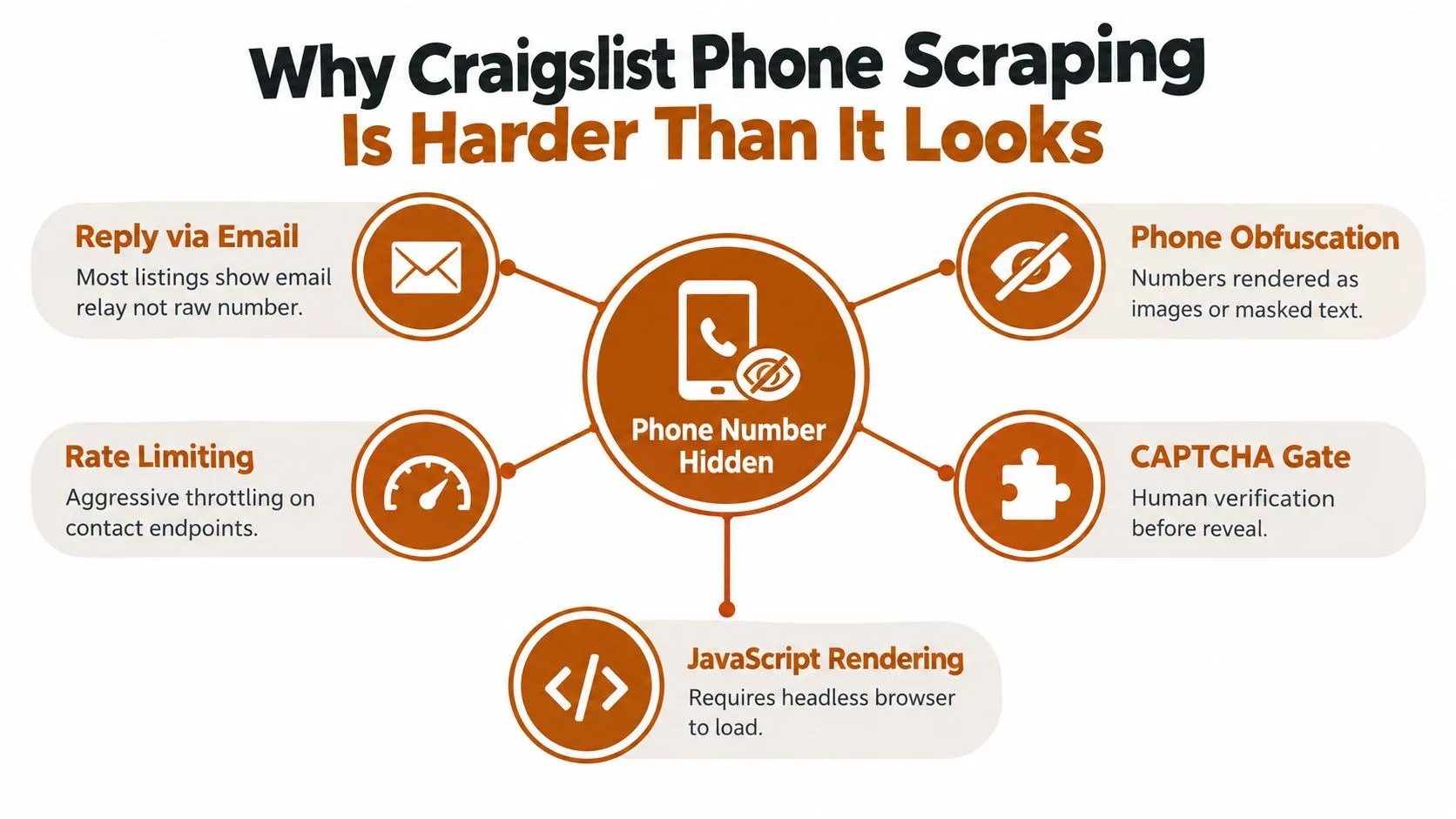
The real problem is contact recovery
Most failed implementations confuse listing extraction with contact extraction. Those are different jobs.
A listing can have:
- A visible phone number in the seller-written body
- An obfuscated phone number written in text form or broken formatting
- A reply path only, where the listing offers contact without exposing digits
That third case is why so many tools underperform. A scraper can successfully collect listings and still recover no phone number because there was never a public phone field to parse.
Practical rule: If your system doesn’t classify listings into visible-number, obfuscated-number, and relay-only buckets, it isn’t a Craigslist phone number scraper. It’s a brittle text matcher.
Obfuscation is old, common, and large-scale
This isn’t edge-case behavior. A peer-reviewed study that collected ads from 414 U.S. sites over July 1, 2009 to July 1, 2011 analyzed 67 million ads, found 652,014 ads containing phone numbers, and created 46,079 authorship-linked ad clusters. The same study explicitly notes that many ad authors used obfuscated telephone numbers, including writing digits as words, to bypass Craigslist filters prohibiting phone numbers in personal ads (peer-reviewed study on obfuscated contact data in online ads).
That’s the baseline reality. At scale, a Craigslist phone number scraper isn’t just matching (555) 123-4567. It’s normalizing messy text, recovering meaning from seller slang, and deciding when no public number exists.
If you want a broader framing of these failure modes beyond Craigslist, this guide on web scraping challenges is worth reading. The same pattern shows up on other hostile or semi-hostile targets. The visible HTML is rarely the whole job.
Core Extraction Workflow From Search Page to Parsed Number
Treat this as contact recovery, not phone parsing. The workflow that works on Craigslist is the one that separates listings with a real public number from listings that only expose a reply path.
Start at the search or category page, collect the listing targets, then inspect each detail page for the actual contact state. If you skip the detail page and scrape only result rows, you lose the context that tells you whether you found a seller-written number, a disguised number, or no number at all.
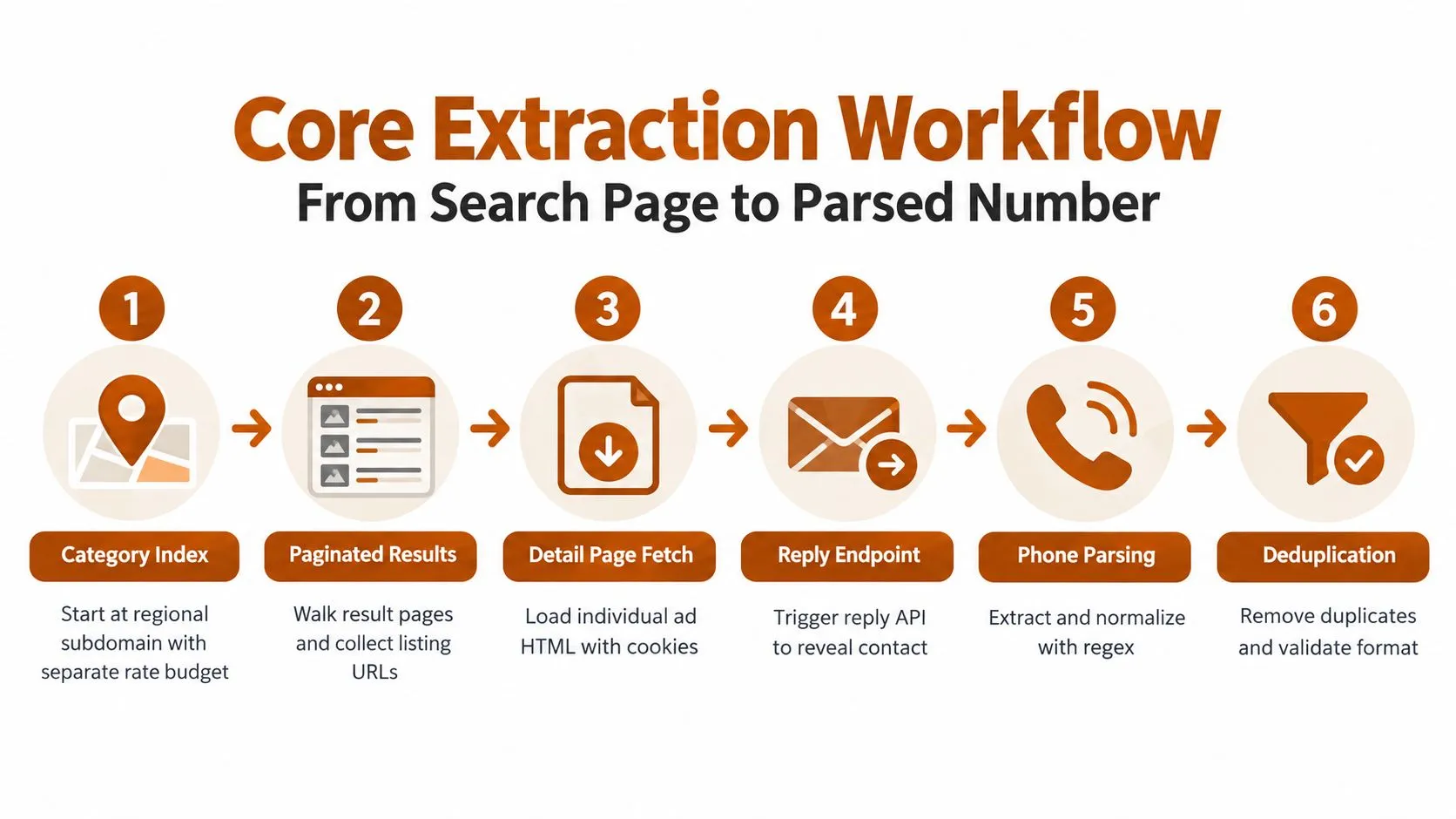
Start with listing discovery and identity capture
Pull these fields from the search page before you touch extraction:
- Canonical listing URL
- Posting ID
- Category
- Region or subdomain
- Timestamp, if exposed
Those fields do more than organize the crawl. They tell you how to tune recovery logic by market. A visible number pattern that appears often in one regional category may be rare in another, while reply-only listings can dominate entire segments.
Keep session behavior consistent between search pagination and detail-page fetches. Craigslist can respond differently across regions and request patterns, and unstable sessions create fake parser failures that are really fetch failures.
Classify the contact path before you extract anything
The first pass on a detail page should answer one question. What kind of contact surface is this?
Use four buckets:
- Visible public number in the ad body
- Obfuscated or fragmented number in the ad body
- Reply relay only, with no public number shown
- Ambiguous contact text that needs secondary review
This step decides whether extraction should even run. A lot of tools fail here. They search for digit strings, return blank output, and call the crawl complete. That is bad operational data.
Store a reason code for every miss. “Relay only” means the crawler worked and no public number existed. “Parser failed” means your recovery logic needs work.
Fetch detail pages with the lightest tool that still gets the contact state
Use simple HTTP requests for broad listing discovery. Use browser automation only where page behavior blocks reliable classification. That split keeps costs under control and preserves throughput.
A practical stack looks like this:
- HTTP client for search pagination and URL collection
- Browser automation for difficult detail pages or unstable reply flows
- HTML parser for body text and metadata extraction
- Normalization and validation layer for candidate phone output
Selector quality still matters. Bad targeting corrupts the whole pipeline before parsing starts. If your team is tightening extraction rules, this guide to CSS selectors for web scraping is a useful reference.
Extract candidates, then score them against the listing context
After classification, pull candidate contact strings from the ad body, structured fields, and any visible contact blocks. Then score each candidate against context signals such as nearby verbs like call or text, regional numbering expectations, and formatting consistency.
That is the part many teams get wrong. They treat every 10-digit pattern as a win. On Craigslist, some listings contain visible digits that are not the seller’s number, and many listings with valid contact intent expose only a relay path. Your system needs to separate visible digits from actual recoverable phone numbers.
One open-source Craigslist extractor uses a Bayesian classifier for phone extraction rather than relying only on regex, which matches what experienced scraping teams learn quickly on noisy ad text (open-source Craigslist data extractor using Bayesian classification).
Normalize output for downstream use
Once you recover a candidate number, normalize it into a single format and keep the raw source text beside it. Save the classification label, confidence score, and extraction method too.
That audit trail matters. It lets your growth team filter for high-confidence public numbers, review relay-heavy categories separately, and stop treating every empty result as the same failure.
Parsing Approaches for Noisy Ad Copy
Regex-only scraping is the beginner move. It’s fast, deterministic, and easy to demo. It’s also the first thing that breaks when sellers write numbers the way real people write them.
The better way to think about parsing is to choose the failure mode you can tolerate. Do you want speed and more misses, or broader recovery with more operational complexity?
Where each parser wins and fails
Regex handles clean copy well. It struggles when digits are split, rewritten as words, or mixed with surrounding junk text. It also grabs false positives from dates, prices, and postal patterns.
A Bayesian classifier is a practical middle ground. It uses context around the candidate string, which makes it more resilient when sellers write “call” or “text” near an obfuscated number. An open-source Craigslist implementation explicitly uses that approach for phone extraction, which tells you experienced builders already ran into regex limits.
LLM-based parsing is strongest on ugly long-tail copy. It can reconstruct intent from messy language better than hand-tuned patterns. The tradeoff is cost, latency, and non-deterministic output. That means you still need a validator after the model.
Phone Parsing Approaches for Noisy Craigslist Ad Copy
| Approach | Accuracy on Clean Copy | Accuracy on Obfuscated Copy | Cost per 1k Ads | Determinism |
|---|---|---|---|---|
| Regex | High | Low | Low | High |
| Bayesian classifier | High | Medium to high | Medium | Medium |
| LLM-based parsing | High | High | High | Low to medium |
A parser that wins on clean samples can still lose in production if your target market has multilingual listings, shorthand, or deliberate obfuscation.
There’s another under-discussed issue. Independent documentation notes that some phone extractor projects need retraining with roughly 1,500 local numbers to work reliably outside one metro area, which is exactly why a Craigslist phone number scraper should be tuned to the market it serves (discussion of relay gaps and region-specific tuning).
If you need a grounding in parser design itself, this explanation of what data parsing is is a solid refresher.
Pagination, Proxies, and Throughput Limits
Craigslist phone scraping usually fails before parsing does. The crawl reaches more pages, reports steady HTML fetches, and still recovers fewer usable contacts. That is not a regex issue. It is a contact-recovery issue. Deep pages contain more relay paths, more stale posts, and more sessions that look alive while the numbers you want never appear.
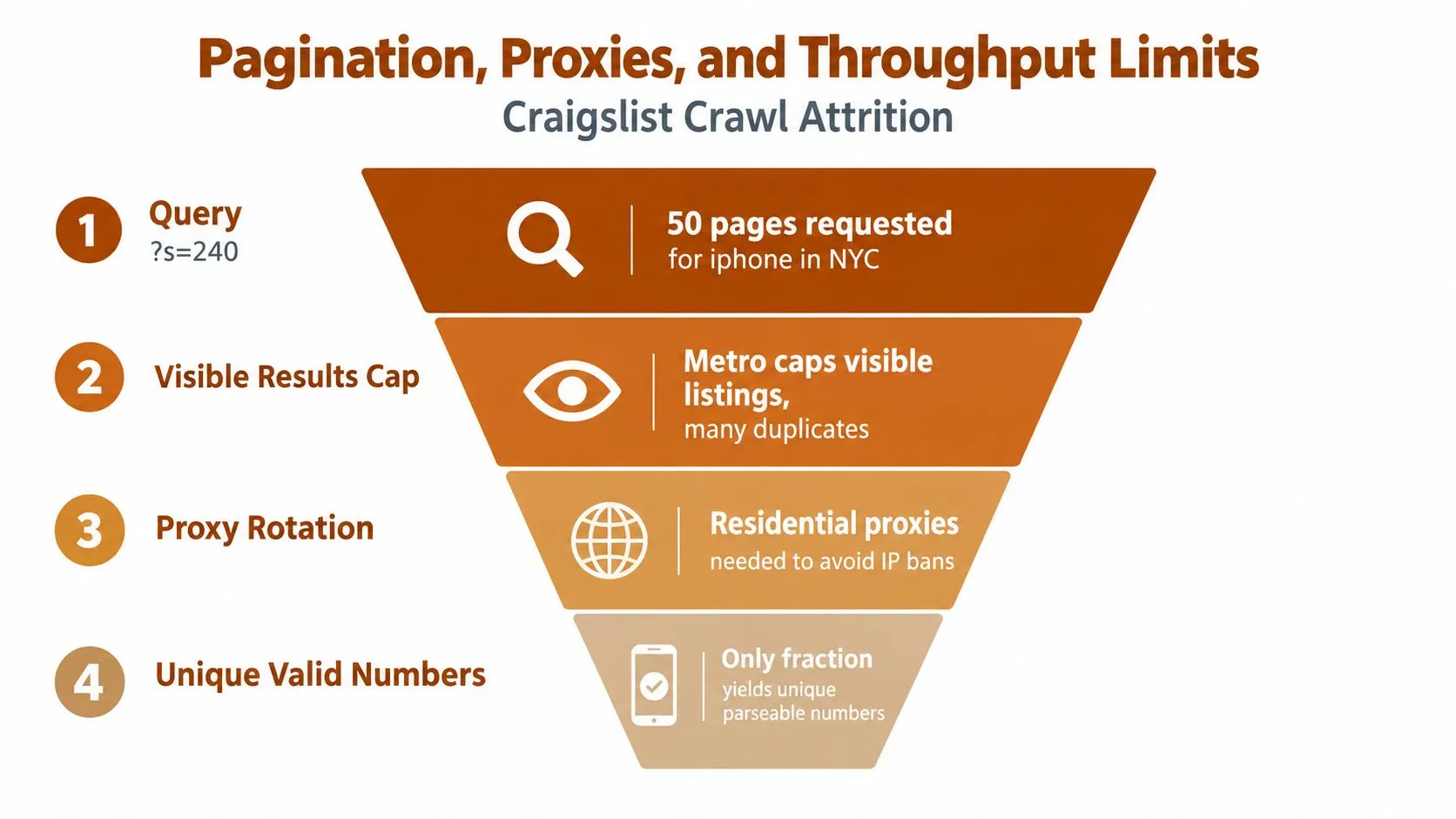
Pagination creates false confidence
Craigslist pagination is easy to overread. Search pages can return a large batch of listings per page, so page-count goals look productive in dashboards. They are not a useful success metric if your real goal is phone recovery.
Page depth usually lowers yield for four separate reasons:
- Duplicate and near-duplicate posts consume requests without adding net new contacts.
- Expired or low-signal detail pages still load, but offer no recoverable number.
- Relay-first contact patterns become more common, so visible digits drop even when the listing is real.
- Repeated access patterns increase block pressure and degrade session quality.
Measure output by validated contact-bearing records, split into visible phone numbers, probable relay-only listings, and true no-number listings. If you lump those together, you will misdiagnose the problem and keep scaling a crawl that is already losing money.
Proxy choice controls survival, not just speed
Cheap datacenter rotation works for light tests. It breaks down fast on Craigslist once you crawl across categories, cities, or deeper page ranges. Use residential or mobile proxies with consistent browser fingerprints and believable session flow.
Cold deep-linking is a common mistake. A session that lands directly on detail pages or jumps too far into pagination gets lower trust and weaker returns. Start on the search surface, keep request order human, and cap page depth per session. For teams comparing proxy behavior, this guide to static vs rotating proxies for scraping workflows is a useful reference.
Throughput limits show up as quality decay
Craigslist often degrades a session without throwing obvious errors. The page loads. The markup looks normal. Your recoverable contact rate drops anyway.
Track the signals that matter:
- Circuit breakers: Pause a session when phone-hit rate falls below its local baseline.
- Reason-coded misses: Separate “relay only,” “no visible digits,” “blocked detail page,” and “parse failure.”
- Small retry batches: Re-run affected slices instead of replaying whole page ranges.
- Jittered pacing: Vary timing enough to avoid machine-like access patterns.
One more rule: tune by market. A workflow that recovers visible numbers in one metro can collapse in another where sellers rely more heavily on obfuscation or Craigslist relay paths. If your target market trends relay-heavy, adding more requests will not fix yield. Better classification will.
Legal Risks and the ToS Reality
Most content gets unserious here. It talks about what’s technically possible and dodges what’s operationally safe.
Independent guidance summarizing Craigslist-specific scraping risk states that Craigslist’s Terms of Use explicitly prohibit automated collection by robots, spiders, scripts, and scrapers, and points to the legal record in Craigslist v. 3Taps, where continued access after blocking and a cease-and-desist was found to violate the CFAA. That matter later settled for $1,000,000 (analysis of Craigslist scraping risk and the 3Taps case).
Legal Exposure at a Glance
| Risk Vector | Trigger | Likely Consequence |
|---|---|---|
| Terms of Use breach | Automated collection from Craigslist without permission | Account blocks, IP blocks, contractual claims |
| CFAA exposure | Continuing access after technical blocking or cease-and-desist | Litigation risk and significant legal cost |
| Privacy compliance | Collecting personal contact data without a clear lawful basis | Regulatory exposure and internal compliance issues |
| Outreach misuse | Using scraped phone numbers for downstream messaging without proper controls | Consumer-protection and consent-related risk |
The compliance risk doesn’t stop at collection
Even if a number is public, that doesn’t make every downstream use safe. Personal contact data creates obligations. If your team is operating in a startup environment and wants a practical legal overview, this guide on data privacy for Florida startups is a useful read because it frames collection and use as separate compliance decisions.
The question isn’t “Can we scrape it?” The question is “Can we defend how we collected it, stored it, and used it?” Most growth teams ask the first question because it’s easier.
For a broader mitigation framework, this article on legal risks in web scraping and how to mitigate them gives a practical checklist.
Building a Compliance-Aware Extraction Pipeline
If you insist on collecting contact data from Craigslist, build the pipeline to exclude more than it includes. That’s the only defensible posture.
The strongest version of a Craigslist phone number scraper is not a brute-force harvester. It’s a filtered system that captures only numbers that sellers explicitly place in the body of the ad, ignores relay-driven contact paths, and logs how each record was collected.
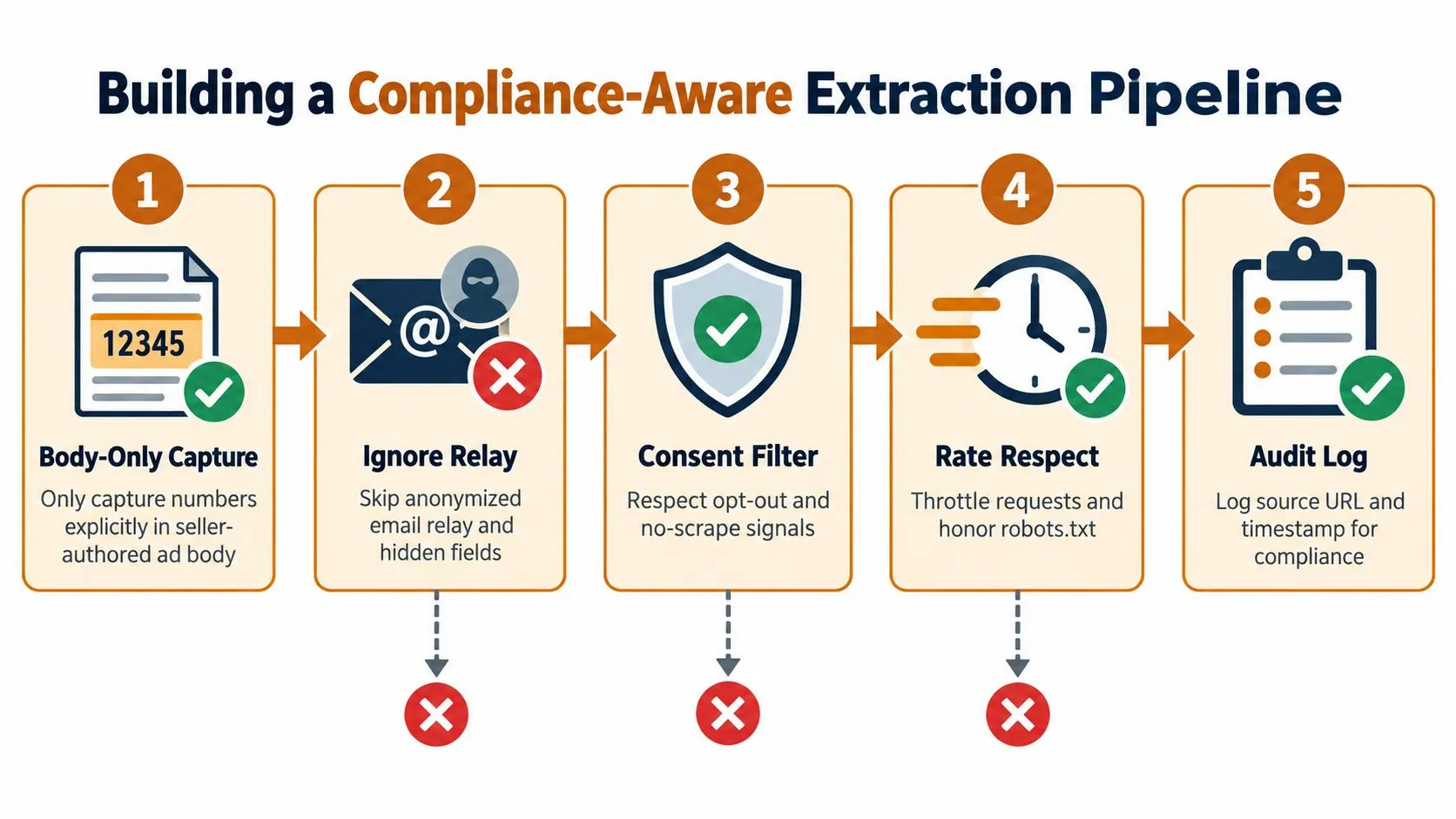
What a defensible pipeline looks like
You want a pipeline with hard filters, not soft intentions.
- Body-only capture: Only ingest numbers found in seller-authored listing text.
- Relay exclusion: If the listing offers contact only through Craigslist’s reply mechanism, skip it.
- Source provenance: Store the listing URL, capture time, and extraction method for every record.
- Suppression controls: Prevent downstream use until policy checks pass.
- Market tuning: Adjust parsing to the metro and language patterns you target.
That architecture produces less volume than a reckless scraper. Good. Lower volume with clear provenance is more useful than a bloated file full of ambiguous records.
Product angle matters more than extraction bravado
Most commercial tools market “lead generation.” That framing is weak for Craigslist because it ignores the gap between visible contact options and public phone numbers. The better product angle is compliance-aware contact recovery.
That can be built in-house, assembled from components, or handled by a managed provider. For example, WebscrapingHQ offers managed web data operations and custom extraction pipelines, including visual inspection and LLM-based parsing, which is the kind of setup that fits contact classification better than a one-click generic scraper.
The mature implementation doesn’t ask, “How do we collect more?” It asks, “Which records can we prove were collected from explicitly public fields?”
Choosing Between Build, Buy, or Outsource
Don’t choose based on engineering pride. Choose based on volume, geography, and risk tolerance.
If your team only needs light, occasional pulls from a small set of markets, building a full Craigslist phone number scraper is usually wasted effort. Craigslist changes behavior, contact exposure is inconsistent, and maintenance quickly becomes the job.
Build vs Buy vs Outsource for Craigslist Phone Extraction
| Approach | Best Monthly Volume | Est. Cost per 1k Records | Time to First Data | Compliance Burden | Maintenance Risk |
|---|---|---|---|---|---|
| Build in-house | High and recurring | Variable | Slow | High | High |
| Buy a tool | Low to moderate | Variable | Fast | Medium to high | Medium |
| Outsource to a managed team | Moderate to high with recurring needs | Variable | Medium | Medium | Low to medium |
Use a short checklist:
- If you need tight schema control and ongoing operations, build or use a managed partner.
- If you need quick testing, buy a tool, but verify how it handles relay-only listings.
- If you operate across multiple metros or languages, don’t trust an untuned extractor.
The wrong choice is the one that reports success based on scraped pages instead of usable, attributable contact records.
If you need this done properly, WebscrapingHQ builds and runs managed extraction pipelines for hostile, messy targets where simple regex scrapers break down. If your Craigslist workflow needs contact classification, market-specific parsing, or a compliance-aware data trail, visit WebscrapingHQ and start with a feasibility discussion before you waste time on another brittle scraper.
Want this done for you?
Send us the URLs. We'll quote it in 24 hours.
Paste the URL(s) you want scraped. We'll reply within 24 hours with a feasibility check and a ballpark quote.