Jump to section
- Why Taobao Is a Different Scraping Problem
- A marketplace, not a uniform catalog
- Three recurring constraints
- Designing a Production Extraction Workflow
- Make the batch prove itself
- Comparing Scraping Approaches Side by Side
- Proxies, Sessions, and Pacing That Actually Work
- Keep identity and session state coherent
- Monitor fields, not just pages
- Going Beyond Price Monitoring for Catalog Intelligence
- Extend the record to support real comparisons
- Cross-Border Data Compliance as an Engineering Requirement
- Build the controls into the pipeline
- Scheduling, Change Detection, and Alerting in Production
- Alert on business changes and collection failure
You have a product team asking for a reliable view of Taobao: current prices, seller activity, product variants, perhaps reviews and images for a sourcing or model-training pipeline. A quick browser script may return data today, then produce empty pages, duplicate listings, or a verification screen tomorrow. The hard part isn’t just extracting fields. It’s building a pipeline that can tell valid data from failed collection and govern what can be retained or sent across borders.
Why Taobao Is a Different Scraping Problem
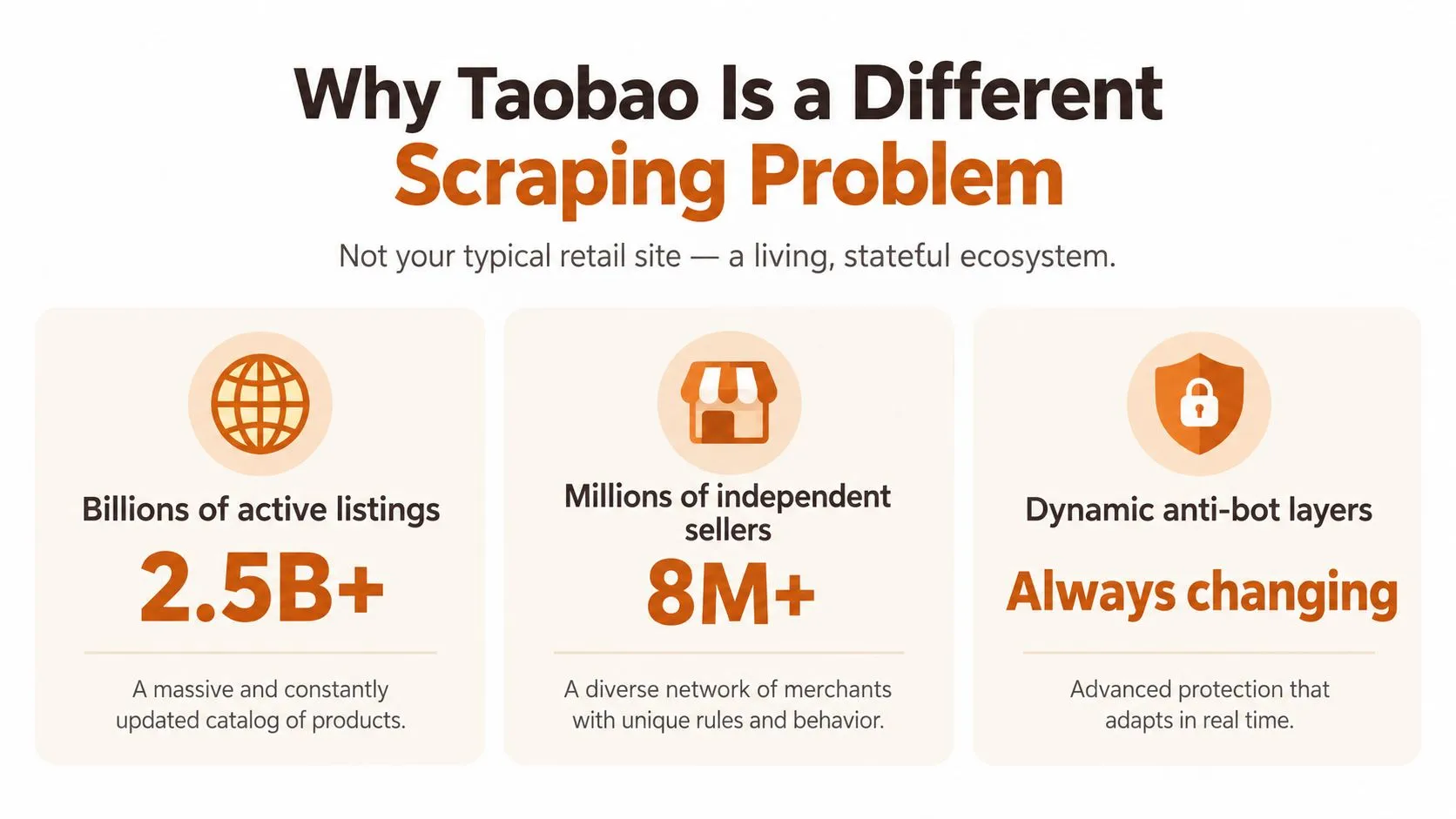
A catalog pipeline built for one stable product template will break on Taobao. Alibaba launched the consumer-to-consumer marketplace in May 2003, positioning it against eBay’s Chinese operations. From 2003 to 2005, Taobao’s estimated market share rose from 8% to 59%, while eBay China’s fell from 79% to 36%. eBay closed its Chinese site in 2006. Alibaba’s annual reporting documents those milestones, which help explain why Taobao is a mature, high-volume marketplace rather than a small catalog.
The scale figures are historical milestones, not a current inventory count. Taobao hosted more than 1 billion product listings by 2016, according to Alibaba’s FY2024 annual report. Taobao Marketplace and Tmall together recorded approximately RMB 3 trillion in transaction volume in 2017. By 2020, Taobao had about 10 million online stores, 726 million active buyers, and gross merchandise value of roughly US$945 billion, also reported in Alibaba’s FY2024 annual report. These figures come from distinct years and measure different things. For extraction teams, the practical point is that catalog data varies by category, seller, language, and time.
A marketplace, not a uniform catalog
Taobao’s consumer-to-consumer roots show up in its data. Listings differ in structure, seller presentation, and attribute quality. Tmall is a distinct marketplace within Alibaba’s commerce ecosystem, while Taobao includes a wider mix of sellers and listing types. A single page template or global catalog model will struggle to reconcile variants, seller-specific attributes, and localized text.
Two listings for the same underlying product may have different titles, images, options, and promotional prices. Capturing only the displayed title and price can erase distinctions needed for sourcing decisions or competitive analysis. Catalog quality depends on retaining seller and variant context, then checking whether records describe comparable offers.
Three recurring constraints
Product and search pages are stateful, JavaScript-rendered applications. A raw HTTP request may miss data loaded after client-side code runs. Access can also depend on logged-in sessions and anti-bot controls. A page that loads successfully can still yield unusable or incomplete records.
Collection and reuse raise contractual and cross-border governance questions as well. Alibaba’s terms restrict scraping and crawling technologies and distinguish technically accessible data from data users may be permitted to collect or reuse, as stated in its published service agreement. Build those limits into field selection, retention, and export decisions. A production design must account for marketplace variation, session state, and permitted use together.
Designing a Production Extraction Workflow
A production workflow starts with a data contract, not a browser script. Define what a valid record means before collecting anything. Otherwise, teams end up saving fields that are easy to capture but too inconsistent to support a reliable downstream decision.
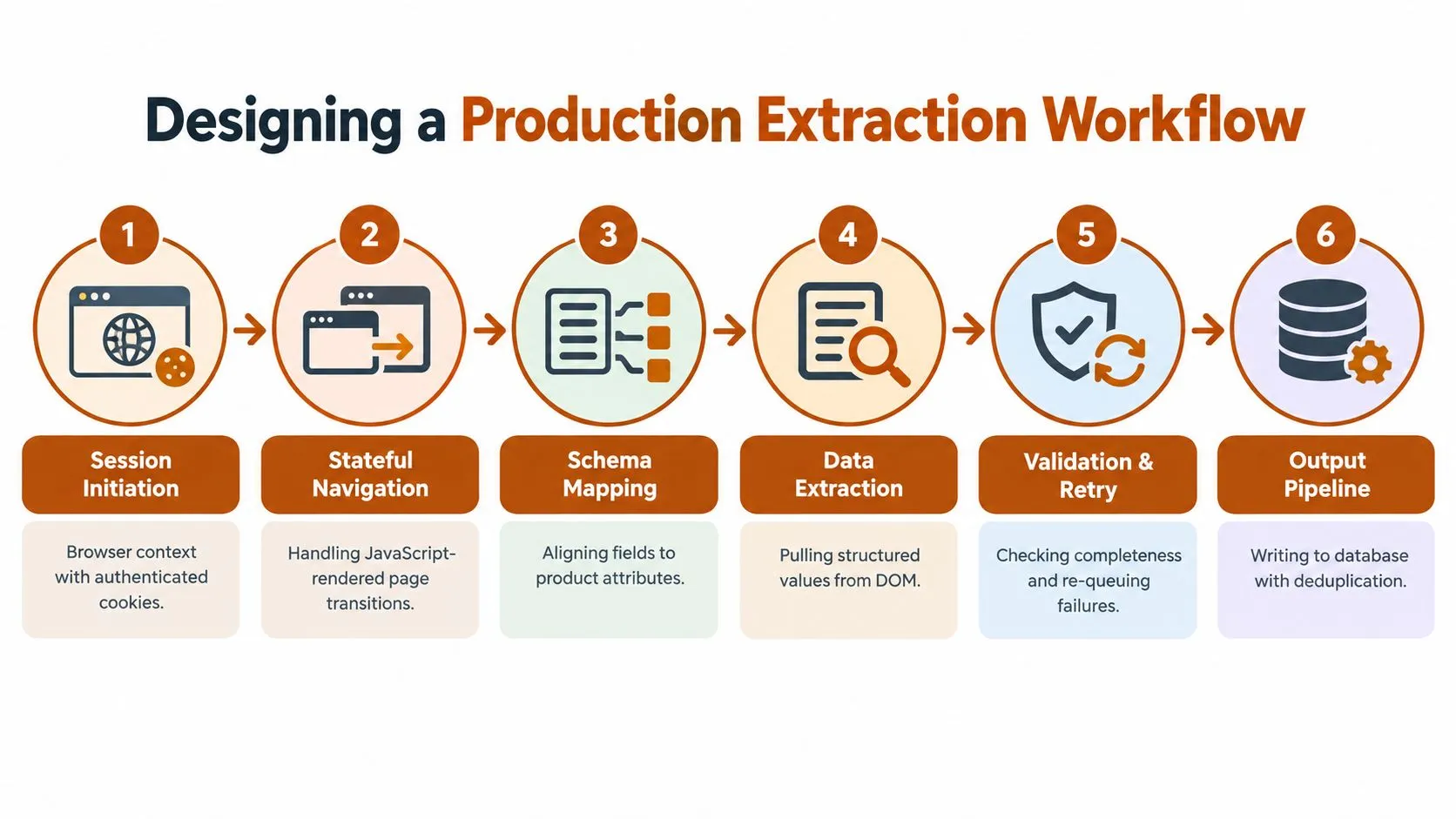
A practical sequence looks like this:
- Normalize the schema. Define fields such as item ID, seller, SKU or variant, price, inventory, shipping origin, review count, and capture timestamp. Decide how to represent missing values, multiple variants, and displayed prices that may reflect a promotion.
- Establish browser state. Use a real browser context that can set cookies and execute client-side rendering. Keep session creation separate from collection so you can diagnose authentication failures rather than confusing them with parsing defects.
- Inspect the data path. Observe the network requests that populate search results and product details. When a structured response is available and permitted for your use, it is often easier to validate than a nested page DOM.
- Parse with a fallback. Prefer structured responses where they’re stable. Keep rendered-page extraction as a fallback for fields that appear only after client-side rendering or aren’t present in the response you can reliably use.
- Validate every record. Check field types, required identifiers, price plausibility, and duplicates. Treat empty payloads, redirects, CAPTCHA pages, and unexpected result counts as collection failures even when the browser reports a successful navigation.
- Retry only after diagnostics. Check session health and request pacing before re-queuing. Repeating the same request against an unhealthy session often produces more bad data, not a recovery.
A 2024 comparative study of Taobao automation reported approximately 85% success and 98% data accuracy using Selenium, with CAPTCHA, dynamic loading, and IP blocking among the principal failure modes. Treat those results as study-specific, not a promise for your target queries or deployment conditions. The broader lesson is that browser automation can work, but success depends on validating the collected records rather than assuming the browser did its job.
Make the batch prove itself
Run a canary query before each batch and compare its result with an expected schema and baseline. If item IDs are absent, a mandatory field suddenly goes null, or the response redirects to verification, stop before the problem spreads through the full run.
Teams deciding whether to build an internal pipeline or buy operational support can use this overview of ecommerce data scraping services to frame the requirements. For research teams comparing product opportunities across marketplaces, a separate Amazon niche-finding resource can help structure the downstream market question. Neither replaces Taobao-specific validation. The rule remains: a batch is successful only when its fields pass checks, not when its pages load.
Comparing Scraping Approaches Side by Side
The right implementation depends on how often you need fresh data, how much engineering capacity you can spare, and how much risk you can tolerate when the platform changes. There isn’t a universal winner. Each approach trades control against maintenance.
| Approach | Engineering Effort | Anti-Bot Resilience | Schema Flexibility | Best Fit |
|---|---|---|---|---|
| Selenium or Playwright browser automation | Moderate to high | Depends on session health, pacing, and browser maintenance | High for visible page fields | Small research jobs or teams with browser automation expertise |
| mtop-style API interception | High | Can be fragile when request signing or protection changes | High when response structures remain usable | Experienced engineers who can maintain request inspection and parsing |
| Managed extraction service | Lower internal build effort, ongoing vendor coordination | Depends on provider coverage and operating model | Usually configured to a defined schema | Recurring collection where internal teams want to focus on downstream work |
Browser automation is the most intuitive starting point. Selenium and Playwright let you inspect what a user-facing browser can see, which helps when product details depend on JavaScript. The trade-off is operational upkeep: selectors, session behavior, page transitions, and browser versions all need attention. A script that runs for a one-off pull may become a maintenance obligation when it has to run repeatedly.
An mtop-style approach can avoid some DOM parsing, but it raises a different bar. A technical implementation reference describes Taobao access as relying on signed mtop requests and reports that pacing and a logged-in session both matter. If request signing changes, a parser built around captured responses may stop working without an obvious error. That can be worthwhile for a team with the expertise and monitoring to own the maintenance, but it’s a poor choice when nobody is responsible for that layer.
Decision test: Choose the least complex option that can meet your delivery and validation requirements, not the option that looks cheapest in a short proof of concept.
Managed services reduce the amount of infrastructure and anti-bot maintenance your own team must operate, but you still need to vet field coverage, data rights, delivery guarantees, and change-handling practices. The distinction between browser automation and API-based collection is also useful when weighing control against maintenance; this comparison of web scraping and APIs lays out that general trade-off.
For a team tracking inventory opportunities, product data also has to support the buying workflow, not just collection. A practical guide to inventory auction tips for clothing illustrates why product condition, category, and resale context can matter alongside a headline price. For an early-stage AI team, a small browser-based pull may be enough to test a schema. For a large retail organization running recurring research, the maintenance, governance, and delivery requirements may justify a managed operating model.
Proxies, Sessions, and Pacing That Actually Work
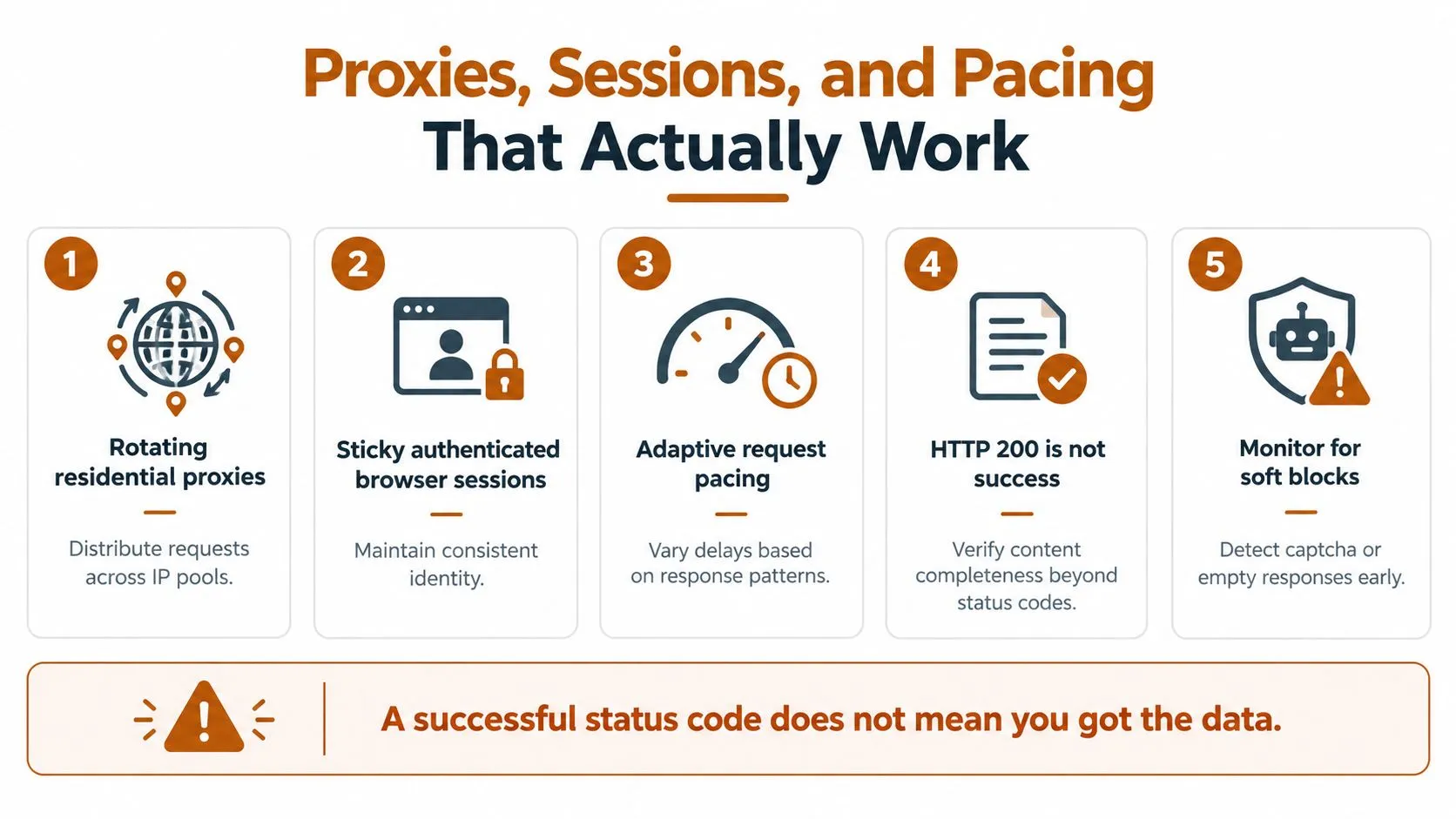
A 200 response isn’t proof of a successful scrape. Taobao can return a page with no usable products, redirect a session to verification, or deliver incomplete data without a conventional rate-limit response. Build your monitoring around record quality, not HTTP status.
Keep identity and session state coherent
A sticky authenticated browser context preserves a consistent session while a related set of requests runs. Changing identity or IP region without a reason can complicate diagnosis: a different response may reflect a changed session or locale rather than a listing update. Residential and datacenter proxies also have different operational characteristics, but neither type guarantees access. Select a proxy strategy based on permitted use, target geography, and observed response behavior, then monitor whether it produces complete, consistent records.
Pace conservatively. A technical implementation reference notes that rapid back-to-back requests can trigger parsing failures even after successful QR authentication. The operational response isn’t to retry faster or rotate identities indiscriminately. Reduce request pressure, check the session, and confirm that the result structure has returned to its expected state.
For teams evaluating proxy infrastructure, this guide to proxy servers for web scraping can help clarify the options. But proxy selection won’t fix a broken schema, a stale session, or a parser that mistakes a verification page for product data.
Monitor fields, not just pages
For every batch, check minimum result count, mandatory-ID coverage, duplicate rate, price plausibility, and null-field rates. Compare those measures against historical distributions for the same query rather than applying one universal threshold to every category. A search for a niche product shouldn’t be judged by the same result volume as a broad query.
When a check fails, quarantine the batch rather than merging it into the production dataset. Refresh sessions only after diagnosing whether the failure came from verification, incomplete rendering, or a parser change. Keep an audit trail with locale, account context, IP region, browser version, and capture timestamp, subject to your data-minimization rules.
Operational rule: Diagnose the response before you retry. Otherwise, a retry loop can turn a small collection failure into a large pile of invalid records.
Going Beyond Price Monitoring for Catalog Intelligence
A lowest-price table is easy to explain and often easy to collect. It is also a narrow view of a marketplace where titles, images, variants, reviews, and seller claims can determine whether two apparently similar listings are comparable.
There’s evidence that cross-border shopping isn’t only about low prices. During the 2025 Double 11 festival, Taobao reported that cross-border users spending more than RMB 500 per order increased 10% year over year, according to Taobao’s cross-border commerce announcement. That reported change doesn’t mean every category has shifted toward premium products. It does give sourcing and research teams a reason to examine product differentiation and higher-value positioning rather than treating the minimum price as the only useful signal.

Extend the record to support real comparisons
Preserve image URLs and variants, then normalize Chinese-language titles and attributes into fields that can be compared across sellers. Don’t flatten variant-specific details into a single product row if the color, material, or configuration changes the offer. Keep the original text alongside normalized values so analysts can trace a derived label back to its source.
Next, detect exact and near-duplicate listings. A match based on title alone can incorrectly merge distinct products, while image similarity can help flag likely duplicates for review. Separate observed attributes from seller claims, and treat review themes as evidence to assess rather than guaranteed proof of quality. Keyword stuffing, repeated promotional phrases, and vague superlatives shouldn’t count as product differentiation by themselves.
A richer schema might include source title, normalized attributes, image references, variant mapping, duplicate cluster, seller claims, review themes, and confidence score. The confidence score should reflect evidence quality, not imply certainty: for example, whether the attribute appears consistently in structured fields, text, and images. Keep reviewer or customer identifiers out of the dataset unless there’s a specific, assessed need to collect them.
For a team designing a pricing layer on top of this catalog, this perspective on smart pricing strategies for ecommerce can help connect product comparability to price decisions. And when unstructured pages need to become normalized records, this overview of AI data extraction services offers context for evaluating machine-assisted parsing. The aim is a sourcing dataset that explains why a listing may be worth benchmarking, not just what it costs.
Cross-Border Data Compliance as an Engineering Requirement
The question “Can this Taobao dataset go to an overseas analytics stack?” doesn’t have a safe, universal yes-or-no answer. China’s 2025 data-export guidance distinguishes general data from personal information and important data. General data containing neither may move across borders more freely, while personal information or important data can trigger requirements such as security assessments, certification, standard contracts, notices, consent, or other safeguards. The details depend on the data and circumstances, so teams should get qualified legal advice before collection or export.
That distinction changes schema design. A product title or aggregated price observation may be lower risk than a seller profile containing identifying details, a buyer review tied to an identifiable account, contact information, or location data. These examples aren’t legal classifications on their own. They’re prompts to examine what each field reveals, why it’s needed, and where it will be processed.
Build the controls into the pipeline
Start with a field inventory that names each collected field, its source, purpose, sensitivity, and intended destinations. Classify fields before they enter an export job. If a use case only needs price distributions by category, don’t collect personal identifiers because the scraper can see them.
Then define an export pathway for each field group. Decide whether processing should remain within a particular geography, whether a field needs aggregation or redaction before export, and who may access the resulting data. Set retention rules at the same time: keeping unnecessary fields indefinitely expands exposure without improving the intended analysis.
Alibaba’s platform terms separately restrict scraping and crawling technologies and describe platform-generated or derived information as Alibaba Data, subject to rights reserved by Alibaba and its affiliates to the maximum extent permitted by law. A compliant export decision doesn’t resolve the separate question of whether the collection itself is permitted under platform rules. Teams should review both the applicable terms and the governing law before deployment.
A production pipeline should generate an auditable record of source permissions, fields collected, retention rules, access controls, and downstream uses. Add the export decision and its owner to that record, along with any required legal review. A compliance checklist for ecommerce data extraction can help teams organize the review, but it isn’t a substitute for advice on a specific cross-border transfer.
Scheduling, Change Detection, and Alerting in Production
A recurring Taobao pipeline should compare each new successful snapshot with the last validated snapshot, not just diff page markup. Page-level diffs are noisy because layout changes can obscure meaningful changes in the offer. Record-level comparison gives the team a clearer basis for detecting shifts in price, stock, seller, title, or review count.
Set collection cadence by decision need. A fast-moving category may justify more frequent checks than a stable catalog audit, while routine price monitoring may fit a daily run. Don’t treat those schedules as guarantees of freshness; collection frequency must remain compatible with session health, platform rules, and the time needed to validate each batch.
Alert on business changes and collection failure
Retry logic should use bounded attempts and backoff, with a pause when session or field-level diagnostics fail. Schedule work around your traffic and operating constraints rather than assuming that parallel requests always improve throughput. Save successful snapshots so a later run can distinguish a real listing change from an extraction anomaly.
Wire alerts to two separate classes of events:
- Business changes: Flag price or stock movements that cross thresholds your team has defined, and identify seller, title, or review-count changes for review.
- Data-quality changes: Alert when mandatory fields disappear, duplicate rates rise, result counts fall outside query-specific expectations, or verification pages appear.
- Catalog drift: Send a periodic summary of new, removed, and materially changed listings so teams can spot longer-term shifts without inspecting every record.
When a batch fails validation, keep it out of downstream feeds and notify the owner responsible for recovery. That separation protects models and reports from ingesting incomplete data. For teams that prefer a maintained pipeline to ongoing scraper operations, managed web data services can provide scheduled structured feeds and monitoring instead of requiring the internal team to maintain every collection component.
WebscrapingHQ scopes, builds, and operates custom extraction pipelines with monitoring, retries, schema controls, and scheduled delivery in formats such as CSV, JSON, and webhooks. If you need Taobao catalog or pricing data delivered with operational support, contact WebscrapingHQ to discuss your fields, governance requirements, and update cadence.
Want this done for you?
Send us the URLs. We'll quote it in 24 hours.
Paste the URL(s) you want scraped. We'll reply within 24 hours with a feasibility check and a ballpark quote.