Jump to section
- What a Web Scraping Service Provider Delivers
- Buying an operation rather than a script
- Managed Service or In-House Scraping Compared
- When internal ownership makes sense
- When managed delivery is the better allocation
- Pricing Models and What Drives Total Cost
- What moves the operating cost
- Define the billable unit
- Reliability and Scalability Tests That Predict Uptime
- Signals engineering should inspect
- Test the complete operating stack
- Compliance Evidence to Demand Before You Sign
- Require reviewable evidence
- Collect less when less serves the purpose
- SLA Terms and Delivery Formats to Specify
- Translate quality requirements into clauses
- Case Examples From Compliance, Retail and AI Teams
- Compliance review needs an evidence product
- Retail monitoring needs continuity through source drift
- Image intelligence needs asset-level acceptance
- Shortlist Providers With a Scored Checklist
- Use evidence to assign the score
- Run a narrowly scoped pilot
Your team has a scraper that worked during the demonstration. Now the source has changed its layout, the latest delivery is incomplete, and an engineer is postponing product work to repair it. Procurement has competing quotes, but each supplier measures something different: requests, pages, records, or access to infrastructure.
Choosing a web scraping service provider means deciding who owns those failures and what evidence proves the data is usable. Prioritize documented compliance controls, measurable data-quality commitments, and a clear operating boundary. A low request price won’t compensate for missing inventory, untraceable personal data, or a feed your team must continually repair.
What a Web Scraping Service Provider Delivers
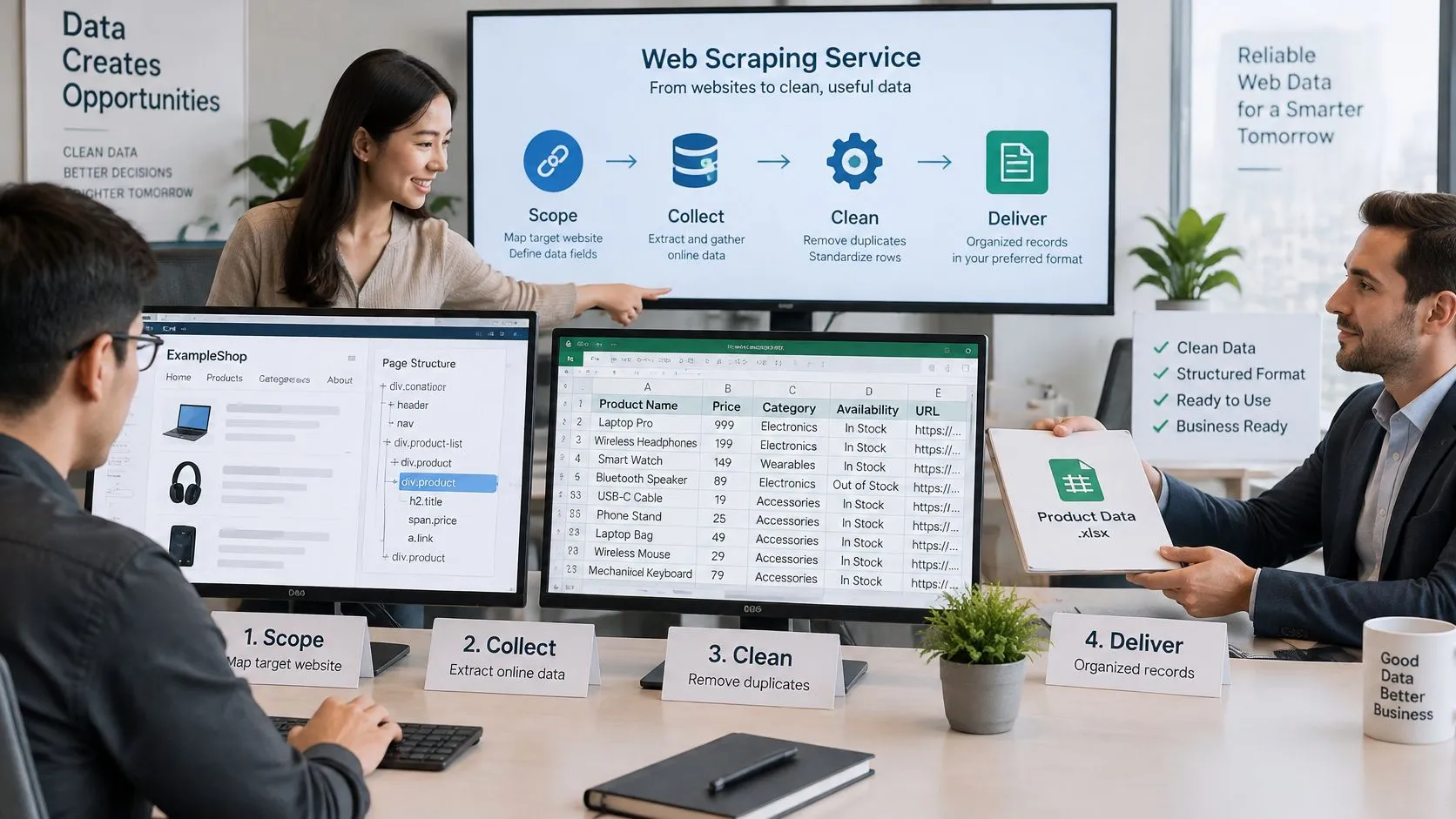
A web scraping service provider runs the data collection operation for a client, from assessing target sites to delivering clean, structured records on an agreed schedule. You buy a maintained outcome, not merely code that retrieves pages.
Say a consumer goods team needs competitor listings for a recurring assortment review. An engineer can write a Python script using Requests and BeautifulSoup, or use Playwright when the page requires browser rendering. The initial file looks satisfactory, but a dependable operation also needs source discovery, pagination checks, field validation, and someone responsible when the site changes.
Buying an operation rather than a script
A scraper is a machine that needs an operator on call. A managed provider acts more like a utility, maintaining the machinery so the agreed supply continues.
The operational scope should include:
- Feasibility and estimation: Assess each source, required field, update frequency, and access constraint before committing to delivery.
- Custom extraction: Build against the source structure and the buyer’s schema rather than forcing every site into a generic template.
- Ongoing maintenance: Monitor runs, investigate failures, retry recoverable errors, and adjust extraction logic.
- Infrastructure and validation: Operate proxies and browsers, manage access challenges, and reject malformed records before delivery.
At WebscrapingHQ, we build and operate custom, AI-enhanced pipelines that deliver structured data repeatedly rather than as one-off exports. Our explanation of cloud-based web scraping provides useful context for separating execution infrastructure from the business output.
Typical buyers include ad verification bureaus, consumer goods brands, AI teams collecting training material, marketplace enablers, and market research teams. Their common requirement isn’t a particular scraping library. It’s continuity.
Practical rule: If a recurring business decision requires the feed, compare operating models. If you only need a single research export, a tool may be sufficient.
Managed Service or In-House Scraping Compared
The central decision is who carries setup, maintenance, and infrastructure responsibility. Outsourcing collection doesn’t remove the buyer’s responsibility for purpose, acceptance criteria, or downstream use.
Managed provider versus in-house scraping
| Factor | Managed provider | In-house team |
|---|---|---|
| Setup and time to first dataset | Scoping, feasibility, and cost estimate before build | Build time set by internal engineering capacity |
| Maintenance when sites change | Provider monitors, retries, and re-tunes scrapers | Internal engineers patch scrapers after breakage |
| Proxy, browser, and CAPTCHA handling | Included in managed infrastructure | Sourced and operated by the internal team |
| Cost structure | Recurring fee tied to scope and volume | Staff, infrastructure, and proxy costs, often hard to forecast |
| Control over logic and schedule | Set through agreed specifications and SLA | Full control, with full responsibility |
| Compliance evidence | Provider supplies its documented artifacts for buyer review | Owned internally and recorded by the buyer |
When internal ownership makes sense
Keep collection in-house when unusually sensitive information cannot leave approved internal systems. The same applies when your security architecture prohibits the access arrangements a supplier would need.
A single stable source can also justify internal development, particularly when extraction is straightforward and delayed delivery has little consequence. An engineering team already operating browser automation, proxy infrastructure, and production monitoring has a different cost base from a team starting from nothing.
Don’t confuse an existing script with existing operational capacity. Someone still needs to review failed jobs, investigate suspiciously empty results, and maintain dependencies.
When managed delivery is the better allocation
Managed delivery makes sense when source changes compete with product engineering priorities or when stakeholders require a fixed delivery schedule. It also establishes a clearer accountability boundary: the supplier operates collection, while your team accepts or rejects the resulting data.
A hybrid model often works well. Internal engineers own the schema, entity matching, and business rules; the provider owns retrieval and source-specific maintenance.
Our operating model is explicit: we don’t sell self-serve access to scrapers, APIs, or a platform for your team to run. We run the pipeline and hand you the data through a managed engagement.
For a useful parallel in evaluating outsourced technical operations, AskYourQA on test automation ROI is relevant to the distinction between building automation and sustaining it.
Before comparing fees, record the engineering time spent repairing breakages, maintaining infrastructure, and reconciling failed deliveries. Apply your actual loaded labor cost, add infrastructure spending, and compare that total with the proposed managed scope. Include the product work those engineers would otherwise complete.
Pricing Models and What Drives Total Cost
Pricing models and their trade-offs
| Pricing model | How it is billed | Best fit | Watch for |
|---|---|---|---|
| Recurring retainer | Fixed monthly fee for agreed sources and update frequency | Ongoing monitoring and recurring reports | Fees continue when source volume falls |
| Volume-based | Charged per record, page, or request delivered | Variable or seasonal demand | Retries and duplicates may be billed as units |
| Campaign project | Fixed fee for a defined scope and delivery window | One-off or time-boxed research | Limited support after handover |
| Tiered SLA package | Fee bands by delivery frequency and response time | Regulated or time-critical feeds | Confirm exactly what each tier covers |
| Hybrid | Base retainer plus overage for extra sources | Growing programs | Overage rates and caps must be in writing |
These are market contracting models, not interchangeable offers from every supplier. We focus on recurring work and don’t offer one-time scrapes or a per-seat subscription tier. Expect a scoped quote following feasibility review, not a software-seat price.
What moves the operating cost
Price follows the work required to produce accepted data, not the number of URLs on a source list.
- Target sites: Each distinct source introduces its own extraction logic, access behavior, and maintenance exposure.
- Page complexity: JavaScript rendering, interactive filters, and infinite scrolling require more browser work than straightforward HTML retrieval.
- Refresh frequency: Hourly collection creates more execution and monitoring work than weekly collection.
- Proxy and browser load: Geographic coverage, browser duration, and identity management affect infrastructure consumption.
- Governance and reporting: Compliance review, evidence capture, and custom report templates add work beyond extraction.
- Recovery allowances: Retries, re-tuning, and exceptional source changes need explicit commercial treatment.
Our automated versus manual data extraction cost comparison helps frame the distinction between execution expense and the labor needed to produce a usable result.
Define the billable unit
Require a written definition of a record, page, or delivered row. A request that returns a challenge page should not automatically become an accepted product record. Neither should repeated retrieval of the same observation inflate delivered volume without disclosure.
Specify how the contract treats duplicates, failed requests, corrected batches, historical backfills, and additional sources. Confirm whether recovery work consumes the ordinary allowance or triggers a separate charge.
Compare total cost per accepted delivery, not the cheapest advertised request rate.
Treat any price without a source list, schema, cadence, and acceptance criteria as provisional. Published price ranges cannot settle a buying decision when suppliers are quoting different responsibilities.
Reliability and Scalability Tests That Predict Uptime
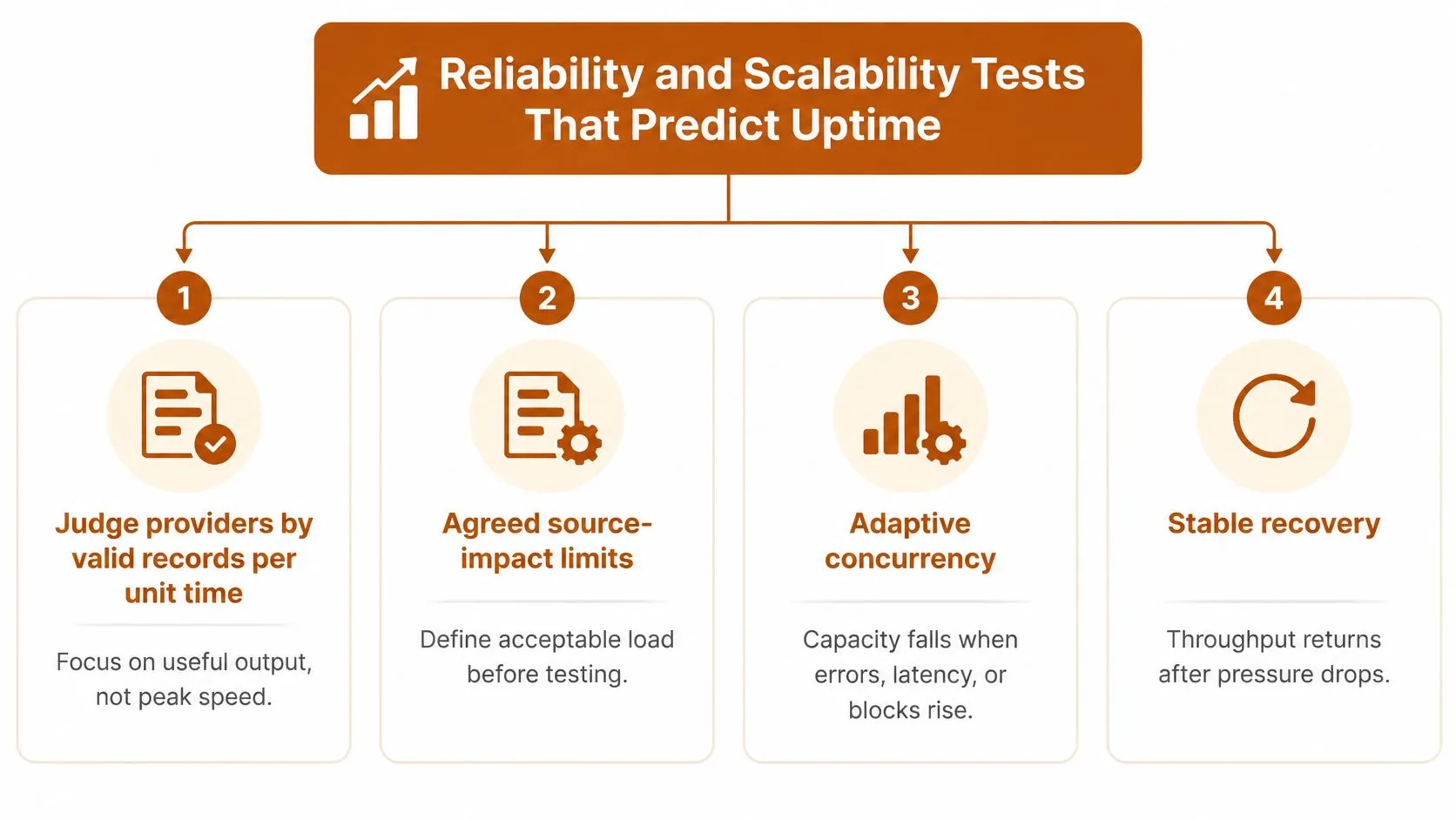
Judge a provider by valid records delivered per unit time within agreed source-impact limits, not its maximum request rate. Fast retrieval is irrelevant when the output is incomplete or the collection process overloads an origin.
Google’s crawl-budget documentation describes host-load assessment using parallel connections, connection duration, latency, time to first byte, rate-limit responses, and server errors. Its crawl capacity decreases when latency or errors rise and can increase when responses remain fast and stable.
That is the right principle for a production acceptance test: adaptive concurrency, not a fixed throughput promise.
Signals engineering should inspect
Require a monitoring demonstration that connects these signals to operational actions:
- Parallel connections and connection duration: Show how much simultaneous work reaches each origin and how long connections remain occupied.
- Latency and time to first byte: Inspect median and tail latency, including p50 and p95, rather than relying on averages.
- Rate-limit and server-error ratios: Separate HTTP 429 responses from 5xx failures so operators can distinguish pressure from other faults.
- Retry amplification: Measure additional attempts relative to original work. Rising retries can conceal declining efficiency.
- Successful-record yield: Track accepted observations, not merely successful HTTP responses.
- Freshness lag: Measure how far delivered observations trail the required collection window.
Use independent collection budgets by hostname, protocol, geography, and identity pool. A global concurrency ceiling cannot distinguish a healthy origin from an overloaded source, and it can let one failing destination consume capacity needed elsewhere.
Test the complete operating stack
Monitoring should drive throttling. Throttling should govern collection identities and rotating proxies, with browser execution reserved for sources that need it.
Failures should trigger bounded retries with exponential backoff, not unrestricted repetition. Extractor changes should pass through schema versioning, and automated quality checks should determine whether a batch is safe to deliver.
Our managed infrastructure includes rotating proxies, a browser fleet, CAPTCHA resolution, retries, schema versioning, and automated QA, with monitoring for dynamic sites. Those components support operations; their presence alone isn’t proof of delivery quality.
Use data pipeline monitoring tools to frame what engineering needs to observe. During evaluation, have the supplier explain a controlled slowdown and show the recovery trace, including queued work and rejected output.
Finish with concrete questions: What happens to throughput when a target site slows? Which metric triggers throttling? A credible answer names the signal, the action, and the recovery condition.
Compliance Evidence to Demand Before You Sign
Public availability does not settle legal permission. Procurement should reject a compliance statement that stops at the claim that anyone can view the page.
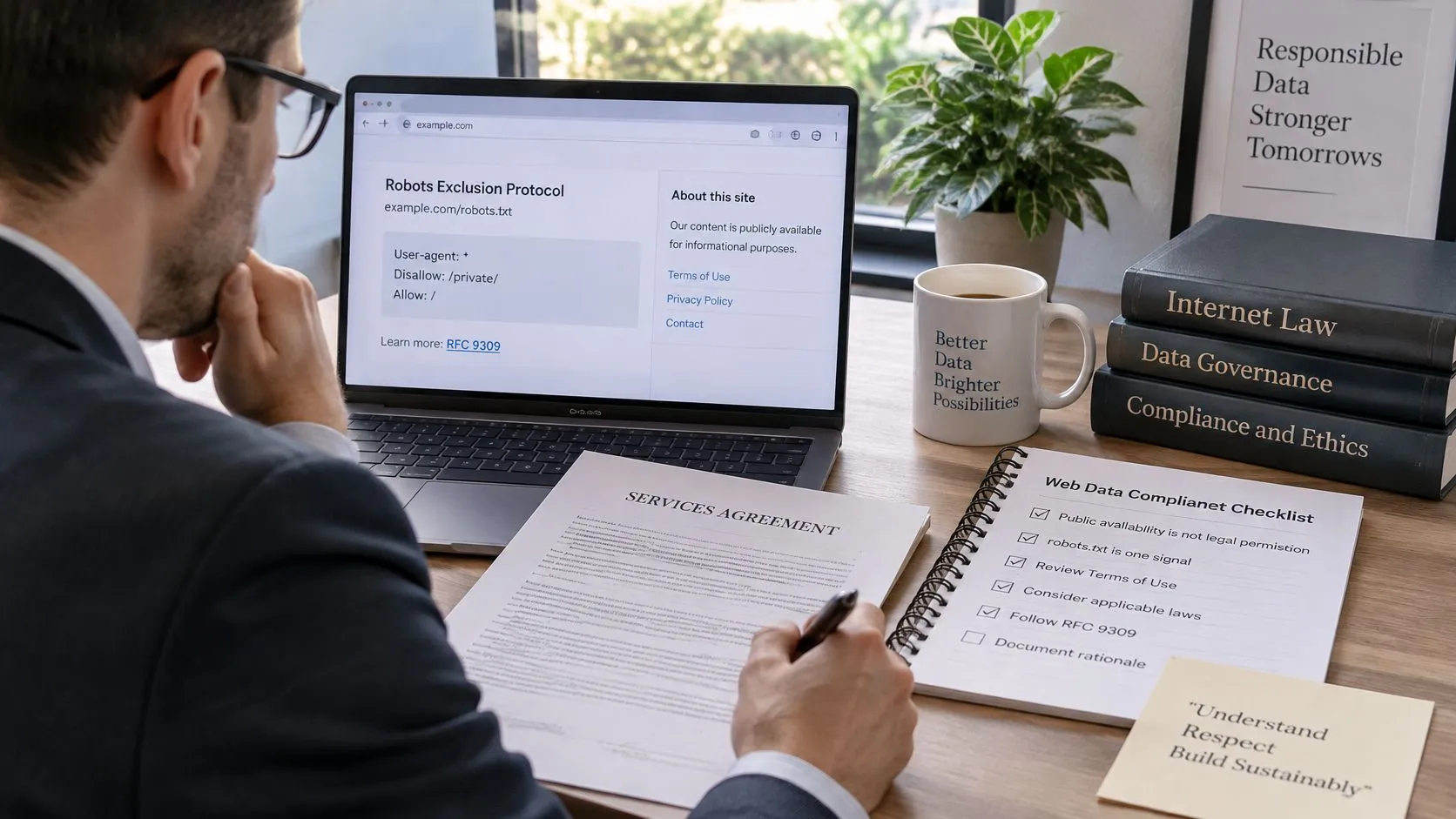
The Robots Exclusion Protocol in RFC 9309 defines how website operators publish crawler instructions, but it does not grant legal permission to collect data. Treat robots.txt as an operational signal within a broader review of collection purpose, contractual restrictions, privacy obligations, and downstream use.
The European Data Protection Board’s guidance on anonymization and web scraping for generative AI makes purpose limitation, transparency, minimization, accuracy, and sensitive-data controls relevant when scraping involves personal data, including publicly visible information.
Require reviewable evidence
Give legal, security, and procurement teams artifacts they can inspect:
- Field-level lineage: Identify the source, collection timestamp, transformation, and destination for each field.
- Retention rules: Document storage locations, access restrictions, expiration, and treatment of backup copies.
- Validation logs: Preserve evidence of excluded fields, redaction, and quality checks without unnecessarily retaining sensitive content.
- Lawful-purpose assessment: Record the applicable basis for personal-data processing, including consent or legitimate-interest analysis where relevant.
- Deletion and objections: Demonstrate a reproducible process for locating affected records, stopping further collection, and propagating approved deletion.
- Change control: Record new purposes, newly discovered sensitive fields, and changes to approved source coverage.
Collect less when less serves the purpose
For an AI classification project, a page’s category and relevant text may be sufficient. Collecting author contact details merely because they’re available adds governance work without improving the task.
Use schema-first design, exclude unnecessary fields before collection, redact residual sensitive content after extraction, and maintain documented site exclusions. Minimization can improve model inputs by removing irrelevant identifiers and reducing the opportunity for unintended memorization.
Cross-border programs require jurisdiction-specific review rather than a universal compliance promise. Our guide to GDPR and web scraping provides context for discussing EU personal-data requirements with counsel.
We only scrape publicly available data, respect robots.txt where applicable, and flag projects needing additional legal review at the outset. We’ve delivered recurring work involving healthcare, finance, EU data, and ad verification, scoped to each client’s compliance posture.
The decisive procurement question is: Which fields will you refuse to collect, and how will you prove their exclusion?
SLA Terms and Delivery Formats to Specify
An available service can still deliver unusable data. Your service-level agreement should define accepted observations and measurable outcomes, not only infrastructure uptime.
In its analysis of more than 200 billion web and API transactions, F5’s Advanced Persistent Bots Report found that scrapers generated over half of web-content requests. Traffic volume doesn’t establish whether a returned page contains the expected inventory, a regional variant, or a challenge screen.
Translate quality requirements into clauses
Write each commitment with a measurement method, reporting window, exclusions, and remedy.
- Source coverage: Name the agreed sources, categories, and pagination boundaries. Identify unavailable inventory separately from uncollected inventory.
- Freshness: Define the permitted lag and timestamp basis. If source-change time is unknowable, distinguish observation age from detection delay.
- Field completeness: Identify mandatory fields and distinguish legitimate nulls from extraction failures.
- Duplicates and anomalies: Define record identity, duplicate handling, and investigation triggers for unexpected shifts.
- Challenge detection: Exclude blocked responses and challenge pages from accepted output.
- Geography and language: Specify collection context and comparable coverage across requested variants.
- Escalation: Name the incident owner, response commitment, reporting cadence, and remedy for missed metrics.
Delivery formats and when to use them
| Format | Best for | Cadence or delivery option |
|---|---|---|
| CSV or JSON Lines feed | Analytics warehouses and data pipelines | Daily, weekly, or hourly with a versioned schema |
| PDF compliance report | Review, audit, and sign-off by nontechnical teams | Monthly, as a zipped batch or individually by webhook |
| Webhook delivery | Event-driven downstream systems | Push on agreed delivery events, with acknowledgment handling specified |
| S3 drop | Cloud storage ingestion | Scheduled batch placement in an agreed bucket and path |
| Dashboard | Stakeholder review without engineering support | Optional, agreed per engagement |
Match format to the consumer. A procurement reviewer needs findings and evidence; an ingestion job needs typed fields, stable identifiers, and predictable file handling.
Our CSV and JSON Lines feeds use versioned schemas, with breaking changes versioned and announced. Our PDF reports use a client-co-designed template containing a structured cover page, findings with visual evidence, and a raw-data appendix.
For catalog workflows, product content enrichment with NanoPIM is relevant when planning the downstream enrichment stage. Keep collection acceptance separate from enrichment acceptance so each failure has an owner.
Prefer verified observations with confidence indicators and incident histories over URL counts. Finally, specify raw-data retention and the evidence available for disputes, subject to the approved minimization policy.
Case Examples From Compliance, Retail and AI Teams
Our engagement examples show why the output specification matters as much as the extractor. Treat them as provider-described work to verify against your own requirements, not a guarantee that another source will behave identically.
Buyer requirements and delivery in three cases
| Buyer | Requirement | Delivery | What to check |
|---|---|---|---|
| Ad verification bureau | Monthly compliance review of dealer sites | Monthly PDF compliance report with exceptions highlighted | Exception rules and report template agreed before build |
| Retail operations team | Daily search result tracking when page structure changes | Daily CSV or webhook feed | Drift handling and schema versioning |
| Visual intelligence platform serving Fortune 500 retailers | Structured image bundles at scale | Image bundles on a confirmed SLA | Deduplication rules and format conversion |
Compliance review needs an evidence product
For the bureau described in our ad verification engagement, the useful deliverable is a reviewable compliance report, not a directory of downloaded pages. Reviewers need exceptions highlighted and supporting evidence placed beside the finding.
That requirement changes implementation. The team must agree what constitutes an exception, which visual evidence supports it, and how the report presents uncertain findings. Settle the report template and exception logic before building extraction.
Retail monitoring needs continuity through source drift
Our retail operations work includes handling search-results scraper drift when Google changes its document structure, with delivery through a daily CSV or webhook. The buyer’s operational need is a comparable sequence of observations despite changes in page implementation.
A changed selector is therefore a maintenance event, not an acceptable reason to send malformed rows. During procurement, request an example showing how the supplier identifies drift, protects the downstream schema, and distinguishes genuine ranking changes from extraction errors.
Image intelligence needs asset-level acceptance
For a visual brand intelligence platform serving Fortune 500 retailers, we deliver structured image bundles on a confirmed SLA. An image consumer needs more than a successful download: each asset must remain associated with its source and relevant metadata.
Define deduplication and format conversion requirements before accepting a comparable engagement. For AI use, also establish the permitted purpose and provenance fields rather than treating an image bundle as automatically suitable training material.
A comparable reference states the output unit, format, cadence, and acceptance boundary. A recognizable customer category alone proves little.
Require evidence relevant to your workload. A report-generation reference doesn’t establish image-processing capability, and a high-volume image feed doesn’t prove a supplier can produce an auditable compliance finding.
Shortlist Providers With a Scored Checklist
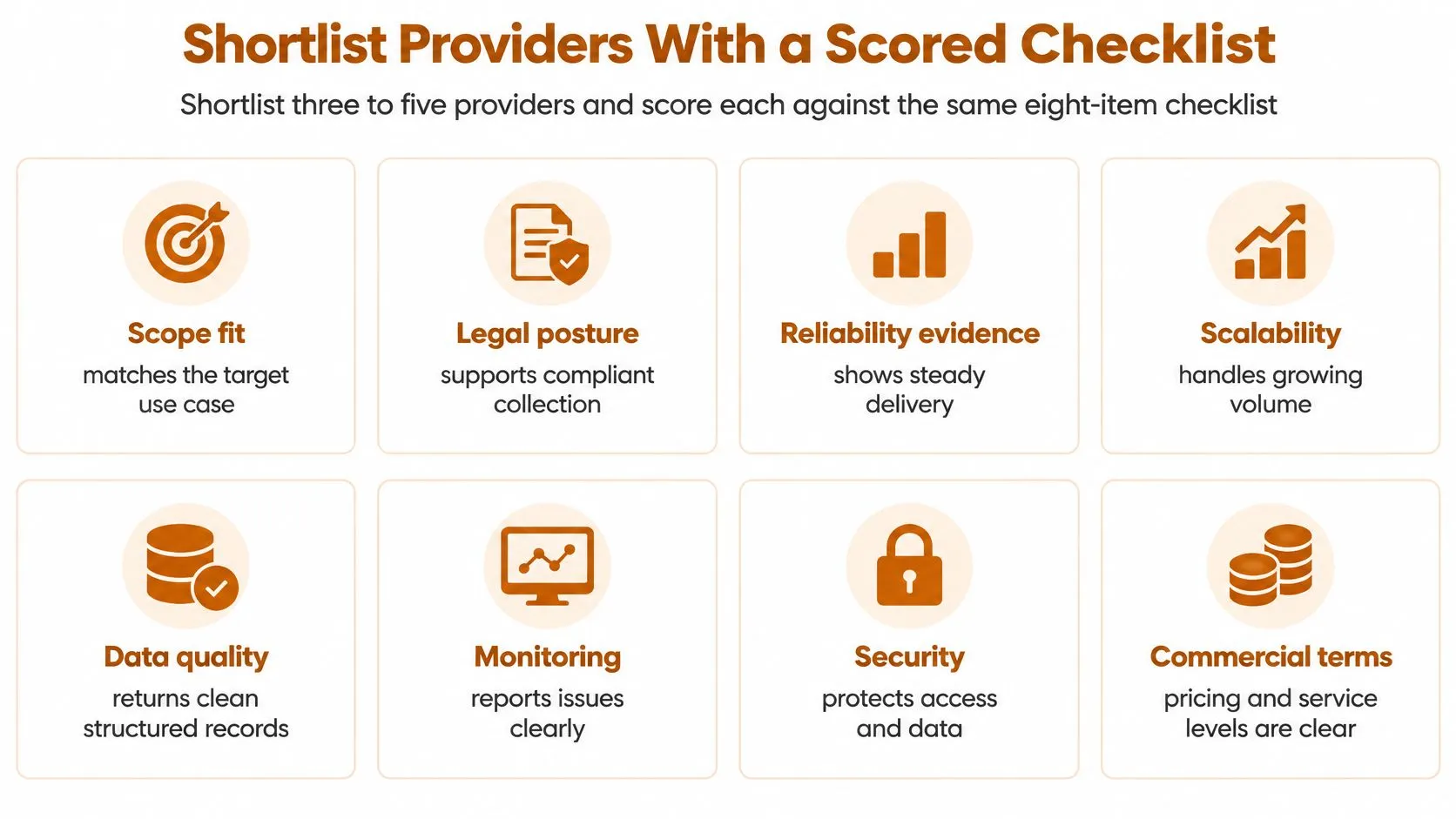
Shortlist three to five providers and apply the same evaluation method to each. Make compliance evidence a pass-or-fail gate before commercial scoring: a supplier that cannot support your approved collection purpose should not advance because its quote is attractive.
The following weights are a recommended procurement tool, not industry benchmarks. Score each criterion from zero to five, where zero means no evidence and five means evidence demonstrated in your pilot; multiply the score by the weight divided by five.
Use evidence to assign the score
| Criterion | Recommended weight | Evidence required |
|---|---|---|
| Source-specific scoping | 10 | Feasibility assessment and explicit exclusions |
| Measured SLA outcomes | 20 | Metric definitions and acceptance results |
| Monitoring and alert visibility | 15 | Operational dashboard or equivalent incident evidence |
| Compliance artifacts | 20 | Reviewable governance package after passing the gate |
| Written billing unit | 10 | Billable-unit definition, overages, and correction treatment |
| Compatible delivery formats | 10 | Sample output accepted by the receiving system |
| Comparable references | 5 | Relevant case with volume, format, and cadence stated |
| Site-change escalation | 10 | Named ownership and demonstrated recovery process |
Keep reliability and compliance above price for recurring or regulated work. Evaluate the commercial quote alongside this score rather than letting a cheap request rate obscure missing controls.
For embodied-AI procurement, the Bright Data alternatives for embodied AI comparison from truelabel can help identify candidates. Apply your own acceptance requirements instead of adopting another buyer’s ranking.
Run a narrowly scoped pilot
Use the source with the highest business value, not the easiest source to scrape. A recommended two-week pilot should test freshness, completeness, exceptions, and delivery integration against the quoted scope.
Record rejected batches and manual interventions alongside accepted output. Have engineering validate ingestion, legal review the evidence package, and procurement reconcile the billable units with delivered results.
We offer a free consultation where you describe your requirements and receive a quote within 24 hours. Because ours is a custom managed service rather than a self-serve tool, define the pilot as a scoped engagement with explicit acceptance criteria.
This week, prepare the target source list, required fields, output format, and business deadline. Use that document for every supplier discussion so the resulting proposals are comparable.
WebscrapingHQ builds and operates custom, AI-enhanced scraping pipelines for recurring structured feeds and compliance reports. Visit WebscrapingHQ to request a free consultation, bringing your source list and required output format so we can scope collection, delivery, and the evidence your team needs to approve the service.
Want this done for you?
Send us the URLs. We'll quote it in 24 hours.
Paste the URL(s) you want scraped. We'll reply within 24 hours with a feasibility check and a ballpark quote.