Jump to section
- What Web Scraping Price Monitoring Is and Why It Matters
- How an Enterprise Price Pipeline Fits Together
- Setting Refresh Cadence and the Price Data Model
- What each observation must carry
- Reading Dynamic Prices in a Cheapest-Competitor Alert
- Staying Unblocked Without Collecting Wrong Prices
- Controls that keep the price honest
- Compliance Limits and What Scraped Prices Can Prove
- What a discount file must contain
- Choosing Delivery Formats for Downstream Systems
- Versioning and the audit packet
- Costing, Scoping and Requesting a Quote
A price on a page becomes useful evidence only when it is tied to the correct product, a timestamp, and a market. Without those fields, a recorded difference may reflect a mismatched item or location rather than a real price change.
A European Commission study finalized in 2014 mapped 1,042 comparison tools across the European Union. It found that 74% of EU consumers had used one, and price was the most important criterion for 79% of users. The study also found that 65% of surveyed users had experienced an issue, including incorrect prices in 21% of reported cases. Those figures show why price collection alone is insufficient: commercial decisions depend on whether each observation can be matched and validated.
Web scraping price monitoring creates a time-stamped record for pricing leads, compliance reviewers, and repricing systems to assess. Its value lies in producing evidence they can use, not merely capturing a number.
What Web Scraping Price Monitoring Is and Why It Matters
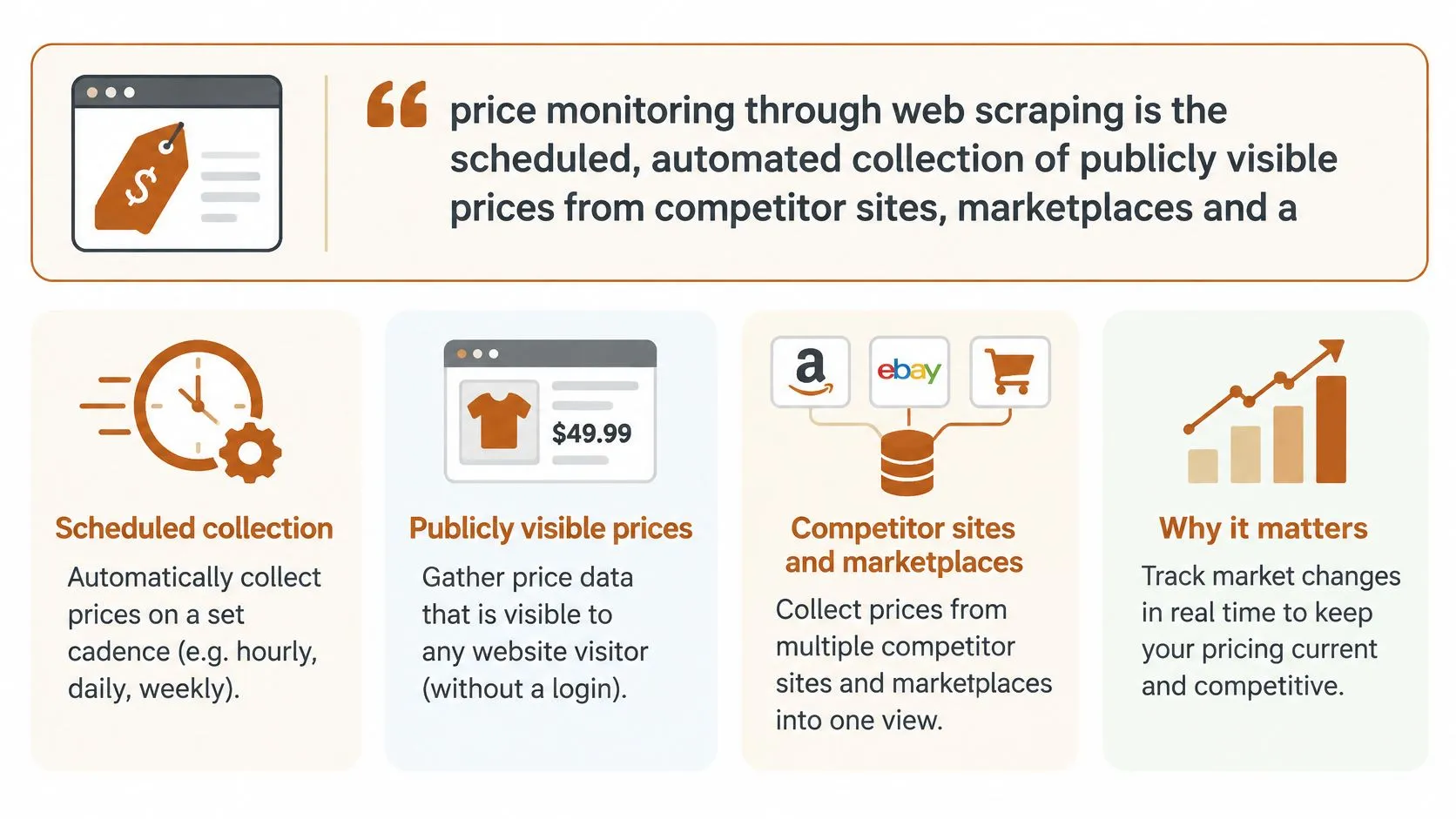
Price monitoring through web scraping is the scheduled, automated collection of publicly visible prices from competitor sites, marketplaces and a company’s own listings, stored as a time series that can be compared across dates, sellers and regions.
Think of a shelf auditor who walks every store on a fixed route, writes down each price, and notes when it changed. A scraper does that walk across thousands of pages an hour. The route, the product identity, and the timestamp are what turn a screenshot into a series.
That practice is not a one-off check, and it is not a consumer comparison site that displays offers to shoppers. It is also not the repricing tool that acts on the feed. Monitoring produces the evidence. Something else consumes it. Teams that blur those roles end up tuning a crawler when the fault is a bad product match, or they reprice off a number nobody has validated.
The European Commission’s e-commerce sector inquiry reported that 53% of surveyed retailers tracked competitors’ online prices, 67% of those retailers used automatic software, and 78% of retailers using that software subsequently adjusted their own prices. The survey covered retailers operating in the European Union. Monitoring was already a pricing input, not a research hobby. Retailers were reacting as competitors moved, so freshness, match quality, and alerting decided whether the adjustment was grounded.
The same inquiry is a useful frame for competitive intelligence gathering: a price series only helps if the products are comparable and the change is real.
Before any build, answer three questions.
- Which products matter most. Promotion-sensitive SKUs and a long-tail catalogue do not deserve the same spend.
- How quickly a change must be seen. A four-hour lag is fine for a stable item and useless during a flash promotion.
- Which decision the data will feed. Repricing, a compliance file, and a category review do not need the same fields or the same proof.
How an Enterprise Price Pipeline Fits Together
Treat the pipeline as an assembly line with an inspection station at every handoff. A failure at any station can still emit a plausible number. Each station therefore needs its own monitor, not a single end-of-line check.
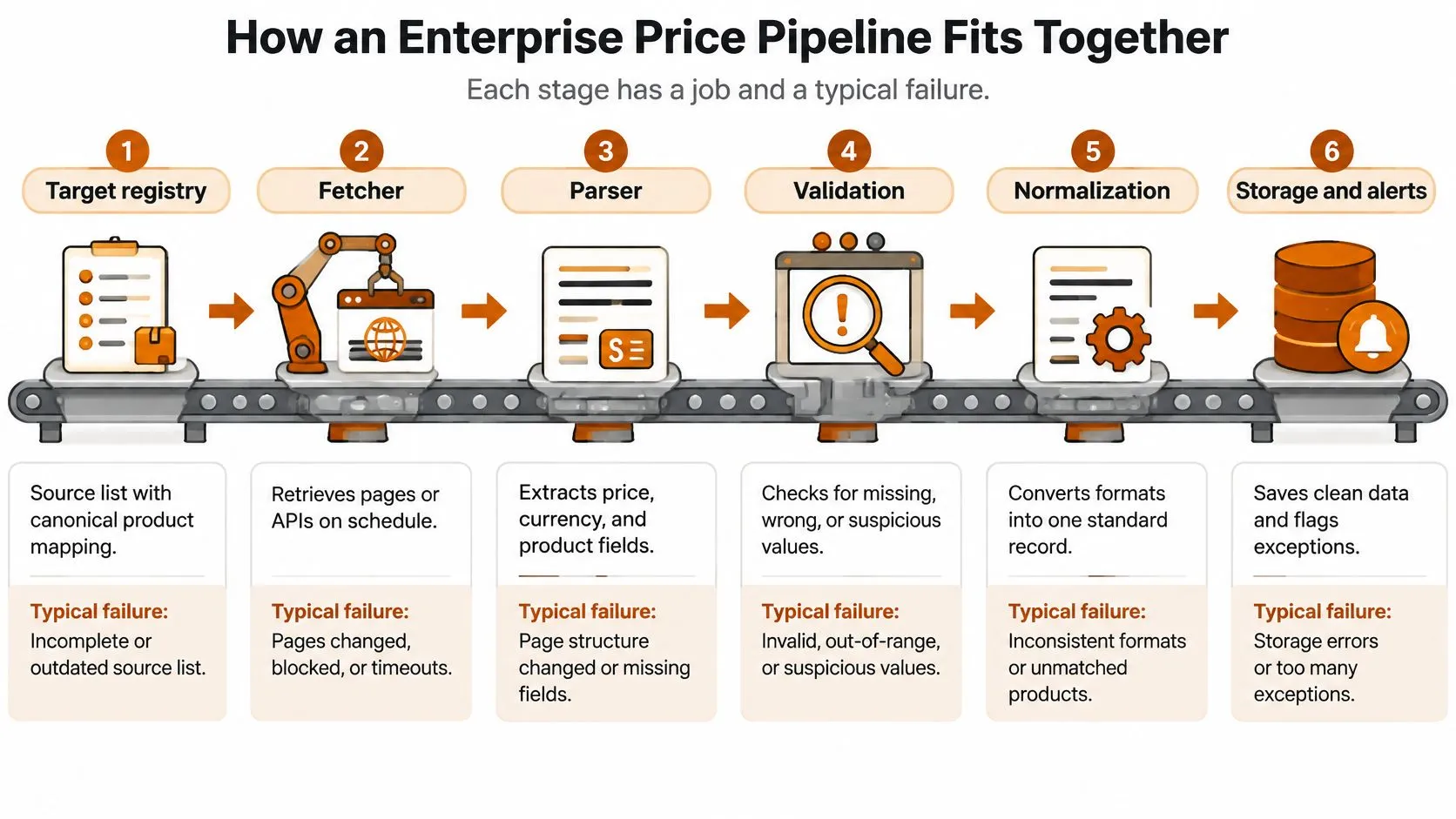
Running that line on shared infrastructure is what cloud-based web scraping is for. The commercial risk sits in the handoffs below, not in where the process is hosted.
- Target registry. Each row names the source, a canonical product identifier, the retailer SKU, country, currency, and refresh tier. A missing tier sends a stable page through an expensive browser path, or a promoted SKU through a daily job.
- Scheduler. It queues promotion-sensitive items ahead of stable catalogue pages. A flat queue makes every SKU wait behind work that did not need to run.
- Fetch layer. Lightweight HTTP retrieval goes first. Proxies and rendered browsers are reserved for pages that fail a cheap fetch. Rendering everything multiplies cost without improving match quality.
- Extraction. Selectors or model-based parsing pull price, stock, and seller. Computer vision covers a price that exists only in an image or a layout that moves. A parser aimed at the struck-through list price stores a number the shopper never pays.
- Validation gate. Structural checks reject a record before it enters the dataset. Skip the gate and a challenge page becomes a price.
- Identity matching. Each accepted record maps to a GTIN, UPC, ASIN, or retailer SKU. A title-only match joins two variants and invents a gap.
- Normalization. Currency, tax and shipping context, seller, and stock state are separated before any delta. A tax-inclusive figure next to a tax-exclusive one looks like a cut.
- Storage. Timestamped history stays, and raw evidence stays for material changes. Without the prior valid state, change detection has nothing honest to compare.
- Change detection. The latest validated observation is compared with the previous valid state, not with a failed crawl in between. Duplicate snapshots create false movement.
- Delivery. Feeds, reports, or alerts go to the system or person who acts. A feed with no freshness or rejection metric forces that consumer to guess whether the pipeline is healthy.
Practical rule: If a stage can emit a number that looks commercial and is wrong, that stage gets its own success metric.
Setting Refresh Cadence and the Price Data Model
Cadence is a control loop, not a single cron expression. Sample volatile and promotion-sensitive SKUs often. Slow the stable catalogue so browser time, proxy traffic, and storage stay proportional to decision value. Industry technical guidance describes refresh periods from roughly 15 minutes to 4 hours for prioritized products, with commodity monitoring commonly on 4-to-24-hour cycles, and it recommends retaining at least 90 days of history for trend, seasonality, and benchmark work, as set out by Web Data Insights.
Assign a product by watching how often its price moves across a sample week, then place it on the nearest tier. A SKU that jumped twice in seven days does not belong on a weekly job. A SKU that has not moved in a month does not need a fifteen-minute poll.
| Product tier | Refresh interval | Typical use | History kept |
|---|---|---|---|
| Promotion-sensitive or fast-moving SKUs | 15 minutes to 4 hours | Repricing and promotion response | At least 90 days |
| Commodity or high-volume categories | 4 to 24 hours | Category benchmarking | At least 90 days |
| Stable long-tail catalogue items | Daily or weekly | Assortment and trend checks | At least 90 days |
What each observation must carry
The key is a canonical identifier, a GTIN, UPC, ASIN, or retailer SKU, not the URL. URLs are renamed, parameterized, and retired. An identifier survives that. Keying on the URL splits one product into two series and hides a real change inside a false gap.
Each stored observation carries the identifier, price, currency, tax and shipping context, seller, stock state, source, collection timestamp, validation status, and schema version. Deltas are computed only after those fields are filled. A price without stock state cannot tell a promotion from a clearance of the last unit.
Schema drift is the quiet failure. A DOM change, a JavaScript migration, or an on-site experiment can yield null or stale values while HTTP still returns success. We monitor for schema drift and re-tune scrapers within 48 hours at no additional charge on every recurring engagement. Ask any provider for that same clock, and for a metric that flags null price rates by domain before the feed is trusted again.
Reading Dynamic Prices in a Cheapest-Competitor Alert
A cheapest-competitor alert is evidence to assess, not an instruction to reprice. Dynamic offers can vary with time, inventory, shopper location, and customer context. A single observation cannot show whether a price difference is persistent or comparable.
Store collection location, guest or logged-in state, stock level, and timestamp with each observation. Then test the alert on three dimensions:
- Persistence. Does the lower price recur across samples within the same refresh window, or appear only once?
- Dispersion. Does the same product show different prices by location or session? A single “cheapest” label can conceal that range.
- Movement pattern. How often does the price change, and by how much? Direction alone is a weak signal.
Price increases and decreases can occur at similar frequencies in multi-country retail tracking. That makes the count of upward or downward moves less informative than their size, timing, and persistence.
Algorithmic pricing also complicates interpretation. A lower displayed price does not, by itself, establish why the offer changed or whether it will remain available. A 2025 study using Amazon data reports that, under high consumer search costs, interacting learning algorithms can coordinate on prices below competitive levels by also coordinating advertising bids, as described in the International Journal of Research in Marketing study. The reported result concerns pricing and advertising behavior; it does not establish collusion.
A useful alert therefore pairs the observed price with its history, location and session context, stock, delivery terms, and search visibility. Discount verification requires comparing like with like: a temporary, location-specific offer is not equivalent to a persistent price available under the same conditions. Without that context, “cheapest” describes one observation, not a reliable market position.
Staying Unblocked Without Collecting Wrong Prices
The expensive failure is silent. A soft block returns HTTP success with a challenge page, partial product data, or a misleading default price. The job looks green. The price is wrong.
A web-measurement experiment that visited 10,000 high-traffic websites under four browser configurations found a 15.2% soft-block rate for headless Chromium, against 7.2% for headed Chromium and 6.8% for both headed and headless Firefox, according to Hunt Benito’s measurement write-up. Headless Chromium roughly doubled the Firefox rate. Browser choice is a reliability decision.
| Browser configuration | Soft-block rate | Monitoring implication |
|---|---|---|
| Headless Chromium | 15.2% | Highest risk; validate every page and escalate blocked pages to a profile change |
| Headed Chromium | 7.2% | Roughly half the headless rate, at higher resource cost |
| Headed Firefox | 6.8% | Lowest rate reported, and similar to headless Firefox |
| Headless Firefox | 6.8% | Same rate as headed Firefox in the study |
Controls that keep the price honest
Use staged collection. HTTP retrieval stays in place where structural checks pass. Only the failing pages escalate to a rendered browser, under a domain-specific profile, with request pacing and session continuity. Proxy setup belongs in that same control set. The Stella Proxies tips for web scraping are a useful checklist for rotation and session habits before a domain’s block rate becomes the story. A fuller blocking playbook sits in our note on how to avoid getting blocked while scraping.
Classify the response, not just the status code. Require product-ID presence, a valid currency, a non-null price, an expected SKU count, and the absence of challenge-page signatures. Set alert thresholds per domain, geography, and browser profile, against that domain’s own block-rate baseline. A source can look healthy in aggregate while one locale degrades without notice.
On our recurring engagements, monitoring alerts us, not the client, when a target site changes or the extraction success rate dips. The client should still be able to see the dip. Log, per request, the domain, geography, browser profile, HTTP status, validation result, field-completeness score, and proxy cohort. An unexpected drop can then be diagnosed in hours instead of after a week of biased prices.
Compliance Limits and What Scraped Prices Can Prove
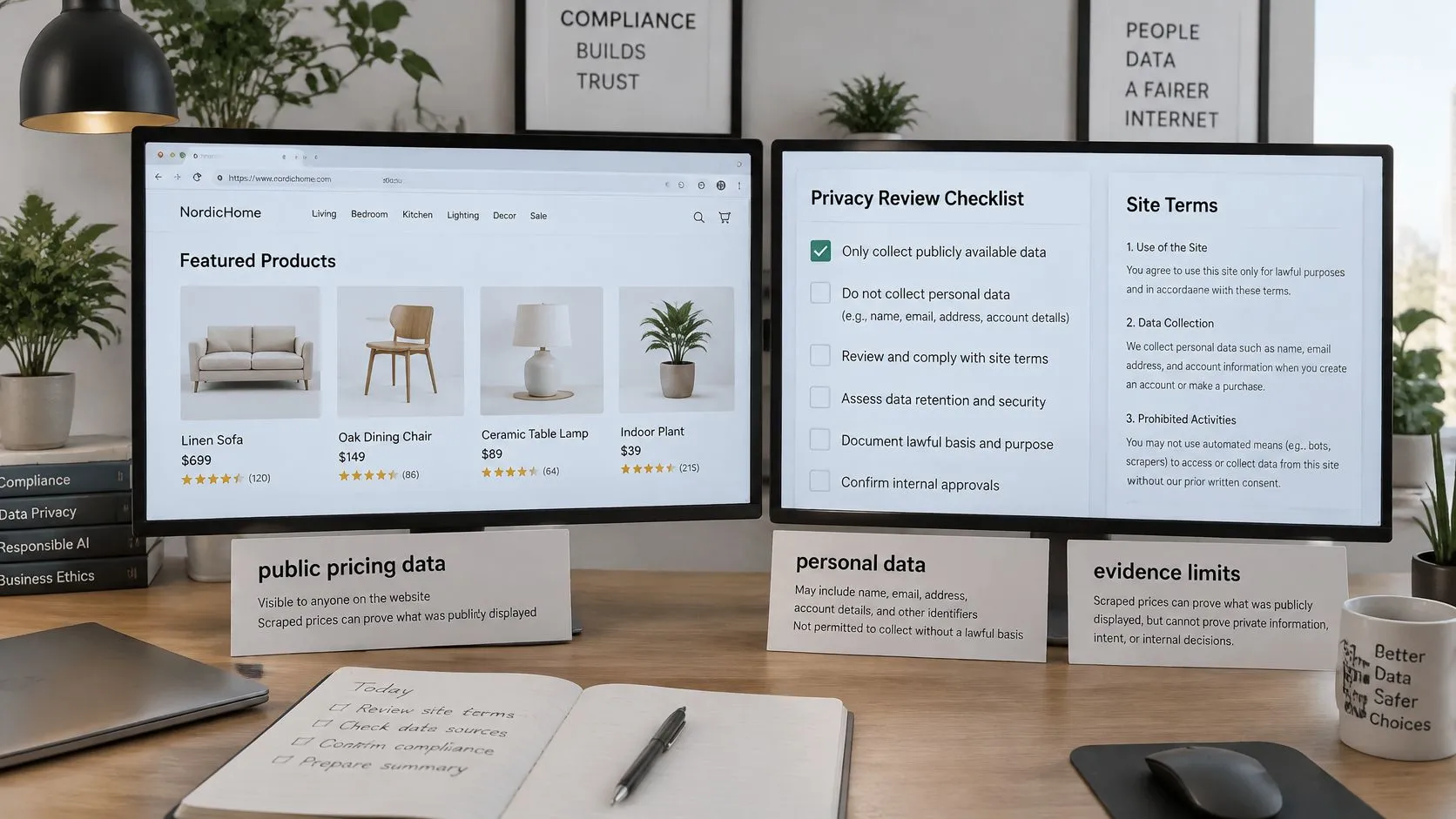
A price record can show what a shopper could see at a given time. To assess whether a discount was genuine, analysts also need a reliable product match, historical prices and evidence of the costs attached to the offer.
Collection should focus on public product and pricing data, with personal data kept separate. Review source terms and robots directives, and set request rates the site can serve. Most WebscrapingHQ engagements cover product, pricing, listing or public-company data, and personal data in deliveries is rare. Work involving healthcare, finance or EU data is scoped to the client’s compliance posture. Counsel should review the sources and terms before a programme goes live. See the guidance on ethical data collection.
What a discount file must contain
The European Commission’s 2025 sweep screened 314 traders across 25 countries during Black Friday and Cyber Monday and found that one in three failed to display discounts correctly. EU rules require claimed price reductions to reference the lowest price used during the previous 30 days and to include unavoidable costs from the outset. Regulators in other markets, including Latin America, have also begun asking for historical price records to assess whether discounts are genuine.
A verification set needs more than today’s shelf price:
- Historical price lineage covering the prior 30 days, with sampling frequent enough to reduce the chance of missing the lowest price between runs.
- Product-variant matching, so a 500 ml unit is not compared with a 750 ml unit.
- Shipping and mandatory fees captured alongside the price, since these costs can change the effective offer.
- Timestamped evidence, including raw page captures for material changes.
- Country-specific rule logic, with coupons and membership prices distinguished from public reference prices.
A discount is supported when the reduction is measured against the prior lowest public price for the same variant. A high reference price that was barely used can make a return to the usual price appear to be a sale. An auditable report should therefore connect the applicable rule to the price history, product match, fees and captured evidence. A cheapest-competitor alert without that evidence identifies a difference, but cannot establish whether the products or offer conditions are comparable.
Choosing Delivery Formats for Downstream Systems
Pick the consumer before the format. A warehouse, an alerting service, an auditor, and a category manager do not want the same artifact, and forcing one shape on all four creates a second pipeline inside the buyer’s team.
| Format | Best fit | Delivery pattern |
|---|---|---|
| CSV or JSON Lines feed | Data warehouses, BI and repricing engines | Daily, weekly or hourly with a versioned schema |
| Webhook | Event-driven systems and alerting workflows | Per delivery, as results are ready |
| S3 drop | Cloud data lakes and analytics pipelines | On the agreed schedule |
| PDF compliance report | Brand compliance and audit teams | Monthly zipped batch, or per webhook |
| Dashboard | Category managers reviewing trends | Optional, scoped to the engagement |
Versioning and the audit packet
CSV and JSON Lines feeds run on daily, weekly, or hourly schedules with a versioned schema. Breaking changes are versioned and announced, so a repricing job does not discover a renamed field in production. That announcement is part of the contract, not a courtesy email after the fact.
A PDF compliance report is a different object. We render it from a template co-designed with the client, with a structured cover page, findings with visual evidence, and an appendix of raw data. Delivery is a monthly zipped batch, or individual reports via webhook. Auditors need the picture and the underlying rows together. A feed alone does not give them that packet.
Every feed should carry freshness, completeness, duplicate rate, and rejection rate beside the prices. The downstream owner can then trust or hold a batch without reverse-engineering the crawl. Name that owner, the refresh need, and the audit requirement first. The format follows those three answers, and not the other way around.
Costing, Scoping and Requesting a Quote
Cost follows scope, not the count of websites. The drivers that move a monthly figure are the number of targets and SKUs, the refresh tier, the share of pages that need a rendered browser, proxy and anti-bot difficulty, geographic and language spread, validation depth, how often schemas change, and the delivery format. A daily HTTP fetch of a stable HTML price is a different cost object from a four-hour rendered crawl across three currencies.
Say a catalogue holds 5,000 SKUs across three retailers. 300 promotion-sensitive SKUs run every four hours, six runs a day, 1,800 fetches. The other 4,700 run daily. That is 6,500 page fetches a day. If about 20% of pages need a rendered browser, that is roughly 1,300 browser renders a day. A 90-day window at one observation per fetch is about 585,000 stored observations, with raw evidence kept only for material changes. The renders and the evidence store, not the three domains, dominate the bill.
Building in-house means engineers for maintenance, proxy contracts, on-call cover when sites change, and storage. Buying managed collection means a contract minimum plus integration into the systems that consume the feed. We do not sell self-serve seats, and we do not run one-time scrapes. A single research pull needs a different route. Managed scraping engagements start at USD 500 per month, with the minimum commitment scoped per project. How to judge a web scraping service provider comes down to whether that scope is written as tiers, formats, and failure handling, rather than as a page count.
Prepare five items before the call.
- List the sources and the number of product pages on each.
- Assign every product to a refresh tier using the cadence table.
- Define the compliance posture: data types, countries, and confirmation that personal data is excluded.
- Name the downstream consumer and the output format that consumer can accept.
- Specify a successful run: completeness thresholds, and the owner who receives alerts.
A free consultation is the point where the client describes that scope and receives a quote within 24 hours. The quote should state the refresh tiers, the delivery format, and how site changes and blocks are handled, before any commitment. Start with the most important tier only. Check cost and field completeness on that slice, then expand once the evidence is holding up.
WebscrapingHQ designs and runs managed price-monitoring pipelines, from scheduled collection through validation, history, and delivery in the format your pricing or compliance team already uses. If you need a feed you can defend, rather than a spreadsheet of unchecked prices, tell us the sources, the tiers, and the decision the data will feed. Visit WebscrapingHQ to request a consultation and a quote within 24 hours.
Want this done for you?
Send us the URLs. We'll quote it in 24 hours.
Paste the URL(s) you want scraped. We'll reply within 24 hours with a feasibility check and a ballpark quote.