Jump to section
- Why Image Scraping Is More Than Downloading Files
- The pipeline has changed
- Discovering and Extracting Image URLs from Modern Websites
- Match the extractor to the delivery pattern
- Build an image map, not a flat URL list
- Download Strategies That Handle Scale and Failures
- Make failure a normal state
- Deduplication and Metadata Capture for Quality Control
- Metadata is part of the dataset
- Storage and Delivery Options for Production Pipelines
- A practical hybrid pattern
- Legal Compliance and Anti-Bot Mitigation Strategies
- Make source rules operational
- Building Reliable Pipelines with Monitoring and Maintenance
The popular advice about web scraping images is usually wrong at the point where it matters most. A short script can find img tags and save files, but that doesn’t mean it has captured the right assets, preserved useful context, or produced data that another system can trust. Production work starts with understanding how a site delivers images, then continues through validation, deduplication, metadata governance, storage, compliance, and ongoing maintenance.
By 2025, image scraping was already being treated as a practical data acquisition method for computer vision rather than an experimental workaround. Production-oriented guidance describes collecting thousands of web records, filtering by resolution and aspect ratio, removing duplicates with perceptual hashing, and preprocessing images with OpenCV before model training (Dataset for Machine Learning). The hard part isn’t downloading bytes. It’s converting unstable, unstructured web visuals into a governed and repeatable image dataset.
Why Image Scraping Is More Than Downloading Files
A downloaded file without context is a weak data asset. If the pipeline doesn’t preserve the source page, selected URL, capture time, dimensions, content type, and processing history, downstream teams can’t reliably determine what the image represents, where it came from, or whether it has changed. Search systems may index the wrong variant, computer vision models may learn from placeholders or watermarked thumbnails, and compliance teams may be unable to trace an asset back to its origin.

The operational model is closer to structured data engineering than to a file-saving script. An image pipeline should produce at least two connected outputs:
- The binary asset, stored in its original form when permitted, or in a deliberately converted format.
- The image record, containing provenance, technical properties, classification fields, and processing status.
That distinction matters across use cases. An ecommerce intelligence system needs to connect a product image to a product identifier, variant, source page, and display position. A computer vision dataset needs stable labels, dimensions, quality checks, and transformation history. An ad verification workflow may need a captured image, the page context, and an auditable record of when the content was observed.
The pipeline has changed
The operational history of image scraping shows a clear progression. In 2015, a PyImageSearch tutorial reflected an early phase based on Python, Scrapy, and Pillow, where developers collected image files directly from webpages. By 2019, collection guides were already using browser inspection and XHR requests to identify image URLs at scale, while newer approaches emphasize structured JSON containing full-size URLs, thumbnails, dimensions, and source pages (A Guide to Data Collection for Training Computer Vision Models).
The change isn’t just about faster extraction. It reflects a shift in what teams expect from the result. A production dataset needs schema checks, repeatable preprocessing, duplicate detection, and clear decisions about which source variants are acceptable.
Practical rule: Treat every image as a record with a binary payload, not as a file with an optional filename.
A reliable design also separates acquisition from interpretation. First, capture what the page exposes and preserve the original evidence. Then normalize URLs, validate content, create derivatives, extract text or visual features, and apply business rules. Keeping those stages distinct makes it possible to rerun preprocessing without repeatedly requesting the target site, and it gives reviewers a defensible audit trail. A deeper discussion of the business value appears in why image data scraping matters for modern businesses.
Discovering and Extracting Image URLs from Modern Websites
The first technical decision shouldn’t be whether to use BeautifulSoup, Scrapy, Selenium, or Playwright. It should be where the image URL exists. On a static page, it may be in src. On a lazy-loaded page, it may sit in data-src or data-original. Responsive layouts often expose several candidates through srcset, while JavaScript applications may fetch image records through XHR or GraphQL responses after the initial document loads.
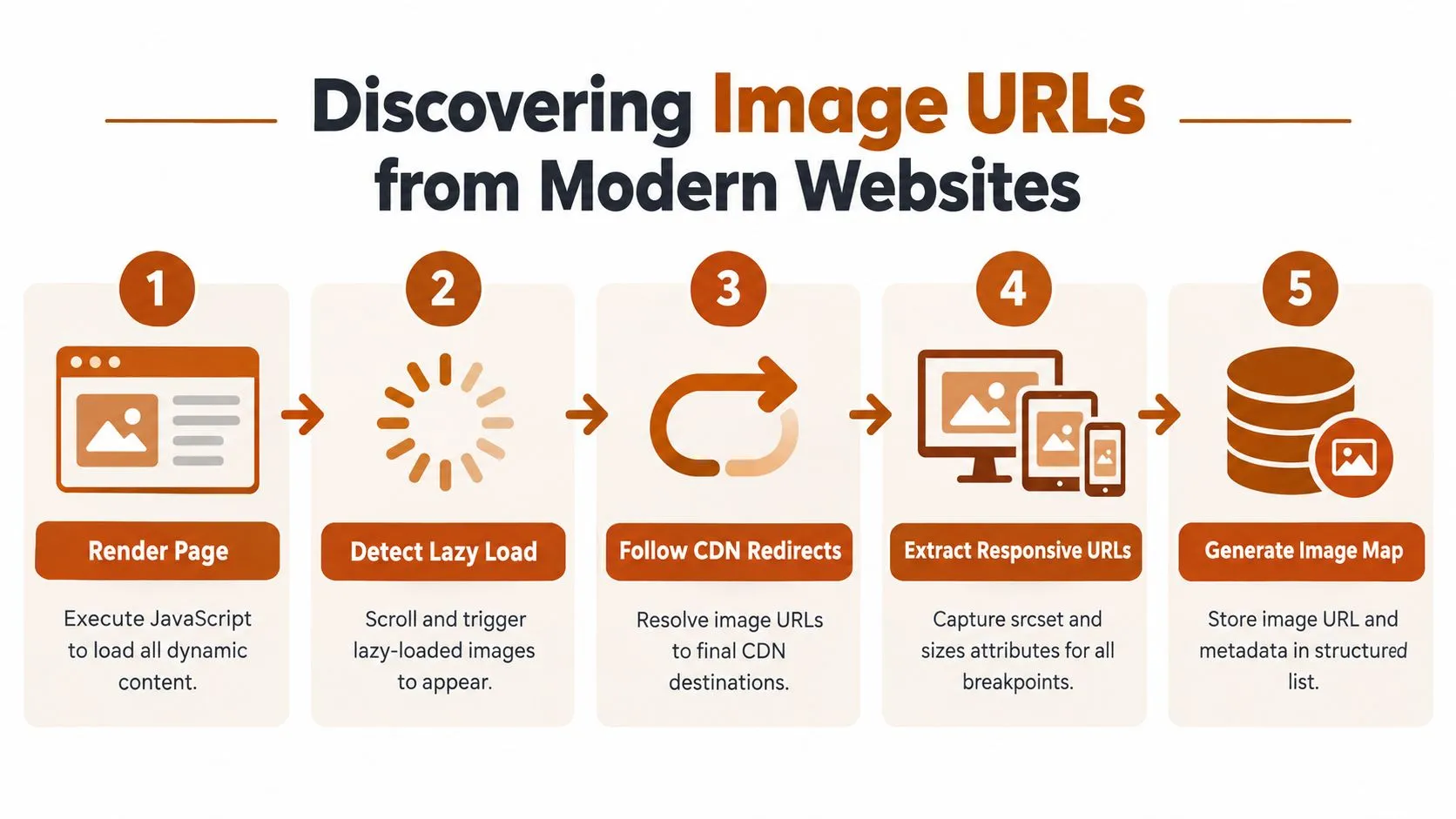
Start with the browser’s page source and network panel. If the desired URL appears in the original HTML, an HTTP client and parser may be sufficient. If it appears only after rendering, inspect the requests that deliver the gallery data. This diagnosis prevents a common failure mode, a scraper that successfully collects hundreds of transparent placeholders because it never looked beyond the initial src attribute.
Match the extractor to the delivery pattern
For a static ecommerce page, parse the img, picture, and source elements, then resolve relative paths against the page URL. For a responsive product gallery, parse every srcset candidate and retain the width descriptor so the selection policy can choose an appropriate variant. Don’t automatically select the largest file. A high-resolution original may be unnecessary for a catalog index, while a training dataset may require a minimum resolution and a consistent aspect ratio.
Lazy loading requires a different approach. Some pages replace a placeholder only after the image enters the viewport, so a browser must scroll through the gallery and wait for the DOM to update. Others expose the eventual URL in a custom attribute, making browser automation unnecessary. The efficient choice is to inspect first and escalate only when the data isn’t available through direct requests.
News sites and social feeds introduce additional complications. Image URLs may be wrapped in CDN redirects, signed with short-lived parameters, or embedded in JSON responses rather than visible markup. A network listener can capture the response that contains the canonical media record, but the pipeline should still retain the page URL and the request timestamp because the media URL may not remain stable.
Build an image map, not a flat URL list
For each candidate, store a structured record with fields such as:
- Source context: page URL, discovered location, and the element or API object where the image appeared.
- URL variants: original candidate, resolved URL, final redirect destination, thumbnail URL, and selected high-resolution URL.
- Presentation data:
alttext, dimensions, aspect ratio, position, and responsive width descriptor. - Acquisition state: discovery time, download status, HTTP result, content type, and validation outcome.
Some workflows also need a controlled way to expose or track image references outside the original page. A utility such as convert images to trackable URLs can be useful when a team needs identifiable links for review workflows, provided the use complies with the source site’s terms and the rights attached to the image.
Browser automation should be reserved for genuine rendering requirements, interaction-triggered galleries, and network inspection. It carries higher resource and maintenance costs than direct HTTP extraction. For implementation patterns around JavaScript-rendered pages, see extracting data from JavaScript pages with Puppeteer.
Download Strategies That Handle Scale and Failures
Once the pipeline has a trustworthy image map, downloading becomes an orchestration problem. A loop that sends one request after another is simple to understand, but it offers poor recovery and can waste time when a host responds slowly. An aggressive concurrency setting is worse. It can overload the origin, trigger defensive controls, and turn a recoverable collection job into a blocked one.
Use a bounded worker pool with connection reuse. Stream response bodies in chunks instead of loading entire files into memory, and write to a temporary object or filename until validation succeeds. The final move should be atomic, so a process restart doesn’t mistake a partial file for a completed asset.

Make failure a normal state
A resilient downloader records state per image rather than relying on a single batch result. Each record should distinguish between a transient network failure, an HTTP rejection, an invalid content type, a corrupt image, and a policy decision to skip the asset. That distinction determines whether the system retries, escalates, or closes the record.
A practical retry policy uses bounded exponential backoff with jitter. Retry only failures that are plausibly temporary, and don’t repeatedly request an asset that consistently returns an access denial or a non-image response. Preserve the response headers, final URL, and error category in structured logs so operators can identify a site-level problem instead of inspecting individual files manually.
Before committing an asset, validate more than the HTTP status:
- Content type: Confirm that the response claims an image media type, then inspect the file signature where the processing library supports it.
- Completeness: Compare available size information with the bytes written, while allowing for servers that omit or alter length headers.
- Decodability: Open the file with an image library and verify that it can be read.
- Dimensions: Reject placeholders, unusably small variants, or images that fail the use case’s aspect-ratio rules.
- Provenance: Store the requested URL and the final redirected URL together.
Conversion belongs after validation, not before it. WebP and AVIF can be efficient delivery formats, but downstream systems may require JPEG, PNG, or another standardized representation. Keep the original when rights and storage policy permit, then create a derivative with an explicit format, color-space, quality, and transformation record. Never overwrite the source and assume the derivative is interchangeable.
Download discipline: A successful request isn’t a successful image acquisition until the file is complete, decodable, correctly classified, and linked to its source record.
Memory management deserves equal attention. Stream large responses, keep image decoding bounded, and avoid opening an entire batch simultaneously. Queue metadata and binary processing separately when possible, allowing the downloader to release network resources before CPU-heavy conversion begins. Guidance on handling related document downloads is available in how to download HTML files, and the same separation between retrieval, validation, and persistence applies to image assets.
For resumability, use stable object keys derived from an internal record identifier or a content hash, not the position of an image in a batch. A checkpoint should record discovery, download, validation, conversion, and publication separately. That makes a rerun idempotent and prevents a network interruption from forcing the pipeline to download everything again. Broader patterns for handling these stages are covered in batch data processing.
Deduplication and Metadata Capture for Quality Control
Raw image collections are rarely clean. The same product may appear through multiple CDN URLs, compression levels, crops, thumbnails, or watermarked variants. Exact URL matching catches only the easiest duplicates. Two files can have different names and byte representations while showing nearly identical visual content.
Use a layered deduplication strategy. Start with normalized URL comparisons and cryptographic checksums for byte-identical files. Then add perceptual hashing for visually similar assets. A perceptual hash represents image structure rather than exact bytes, which makes it useful for finding duplicates that differ through resizing, recompression, or minor transformations.
Don’t let the hash make the business decision by itself. A near-match may be a duplicate product image, or it may be a legitimate alternate angle. Store the candidate relationship and let a rule based on source, dimensions, crop, watermark status, or catalog identity determine whether to merge, retain, or review it.
Metadata is part of the dataset
A useful image schema should preserve both technical facts and source context. At minimum, capture:
- Provenance: source page, requested URL, final URL, capture timestamp, and discovery method.
- Technical properties: media type, file size, width, height, aspect ratio, color profile when available, and derivative format.
- Semantic context:
alttext, nearby product or article identifiers, captions, and page position. - Quality state: placeholder detection, corruption status, duplicate group, watermark flag, OCR status, and human review state.
- Governance fields: license or usage assessment, retention decision, transformation history, and schema version.
Missing metadata creates more than an analytics inconvenience. It can make a training set impossible to audit and can obscure whether a downstream user is working with an original capture, a thumbnail, or a converted derivative. An alt tag generator can support review and drafting workflows, but generated descriptions should be treated as suggestions and checked against the actual image and source context.
OCR illustrates why quality control must continue beyond download. On a sampled web-image evaluation set, the benchmark reported the following results (OCR benchmark for web images):
| Model | Accuracy | Precision | Recall |
|---|---|---|---|
| PaddleOCR | 0.579 | 0.567 | 0.684 |
| EasyOCR | 0.426 | 0.442 | 0.469 |
| Tesseract | 0.168 | 0.184 | 0.177 |
| TROCR | 0.054 | 0.049 | 0.078 |
These figures shouldn’t be treated as a universal ranking for every image category. They do show a substantial spread across models on text-rich web images, which is why representative samples, preprocessing, and model selection belong in the pipeline. A blurry thumbnail, a compressed screenshot, and a clean product label won’t produce the same OCR behavior.
Deduplication and metadata also support visual feature workflows. Before extracting embeddings, labels, or image classifications, remove known junk and retain the transformations applied to each file. The downstream design principles in computer vision feature extraction depend on knowing which image was processed and how it reached that stage.
Storage and Delivery Options for Production Pipelines
Storage should follow the access pattern, not the other way around. A training corpus is usually read in batches and benefits from immutable object keys and manifest files. A search or catalog application may need fast metadata queries and predictable image delivery. A compliance archive prioritizes retention, provenance, access controls, and evidence preservation over presentation speed.
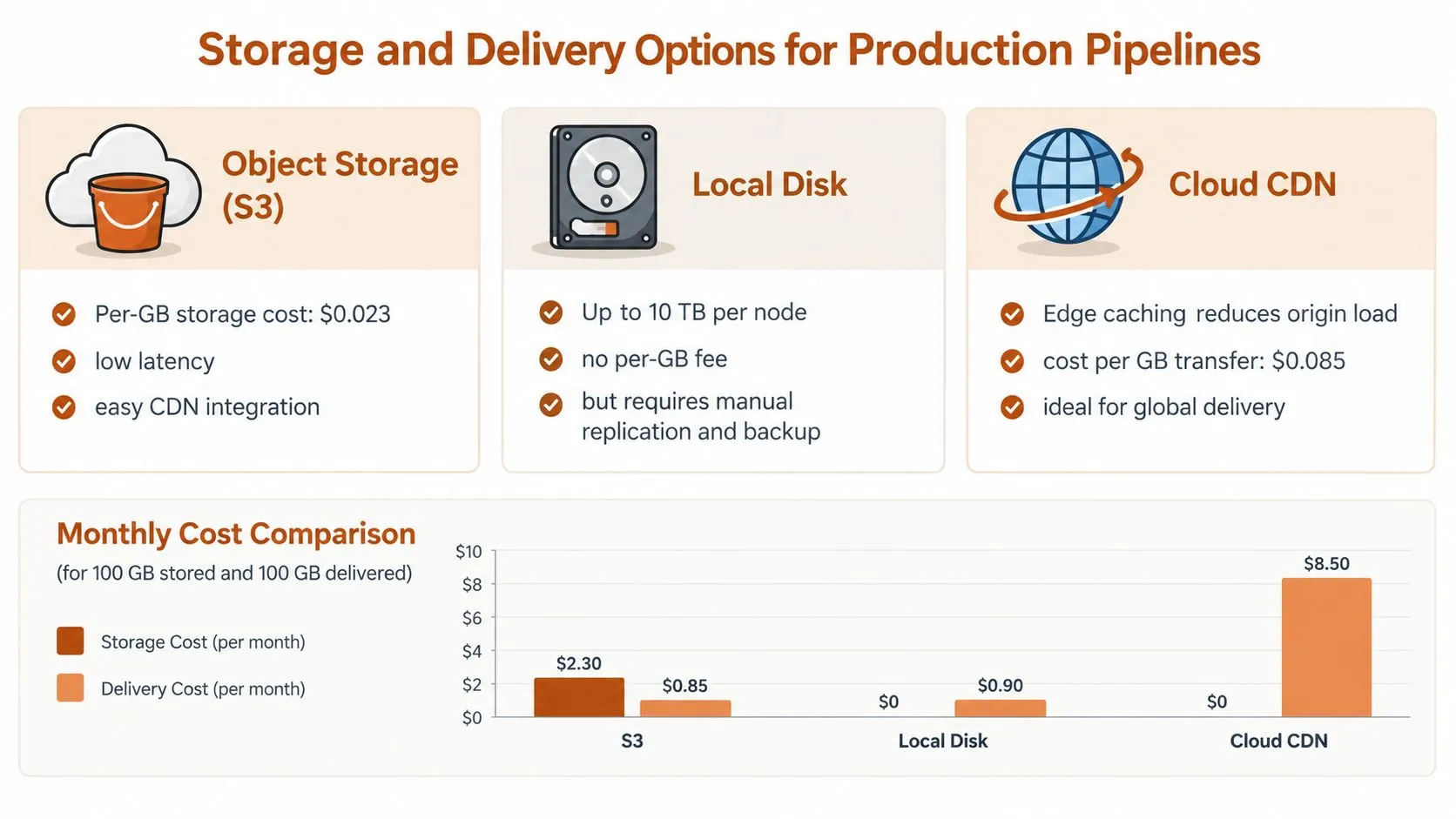
Object storage is the usual foundation for large collections because it separates binary assets from compute and supports lifecycle policies. Store records under stable identifiers, keep metadata in a queryable index, and generate manifests for batch consumers. The path should be an implementation detail. Applications should query by product, source, capture period, or review state rather than constructing file paths directly.
Local disk can be appropriate for temporary staging, browser capture, or a controlled processing node. It becomes fragile when a node fails, a team needs access from another region, or multiple workers write conflicting versions. If local storage is used, the pipeline must explicitly manage replication, backup, eviction, and recovery.
A CDN belongs in the delivery layer when users or downstream applications repeatedly request the same derivatives. It can reduce origin requests and improve geographic access, but it adds cache invalidation, signed URL, and content policy decisions. Don’t place every original asset behind a public delivery path. Separate private evidence from approved derivatives and apply access controls to both.
A practical hybrid pattern
A architecture often uses four layers:
- Landing storage preserves validated source files and acquisition metadata.
- Processing storage holds normalized derivatives, OCR outputs, hashes, and feature artifacts.
- Metadata indexing supports queries by source, entity, quality state, and governance status.
- Delivery infrastructure serves approved derivatives through an API or CDN.
The landing layer should be as immutable as policy allows. The processing layer can be rebuilt when conversion settings or models change. This separation protects the evidence while keeping downstream experimentation flexible.
Encryption, access logging, retention rules, and regional placement should be selected according to the content and the organization’s obligations. A lifecycle policy can move older assets to less expensive storage or delete temporary derivatives, but it shouldn’t remove provenance records that the business still needs. Cross-region replication may improve resilience, yet it can also affect data residency and access governance.
The cleanest API returns an image reference plus its metadata, transformation state, and access policy. That design lets consumers ask for “the approved product image for this item” or “all images captured from this source during a defined period” without knowing where the bytes live.
Legal Compliance and Anti-Bot Mitigation Strategies
The most dangerous assumption in image scraping is that public visibility equals permission to copy. It doesn’t. A publicly accessible photograph can remain a protected creative work, and risk often arises from what happens after collection, including wholesale republication, embedding in a commercial archive, inclusion in a training dataset, or use in an AI system.
The correct compliance question is not only “Can the crawler fetch this URL?” It is also “What use is permitted for this image, in this jurisdiction, under this source’s terms?” A factual record that an image appeared on a page is different from storing and redistributing the image itself. Those actions should have separate policy classifications and retention decisions.
Make source rules operational
Before collection, record the source domain, applicable terms, robots guidance, intended purpose, allowed request behavior, and review owner. Don’t treat a single global policy as sufficient for every site. Marketplaces, editorial archives, user-generated content platforms, and public-sector sources can expose different rights and restrictions.
The legal environment is also becoming more specific for AI data use. Recent guidance notes that the EU AI Act and EU copyright text-and-data-mining rules introduce disclosure and opt-out expectations that can affect training data sources, making source-by-source and jurisdiction-specific review important (Is Web Scraping Legal). Requirements can change, and this isn’t legal advice. The practical response is to preserve source provenance and make every collection decision inspectable.
Anti-bot controls create a parallel operational issue. Dynamic interfaces, visual challenges, request throttling, robots rules, and image-heavy rendering can prevent a basic HTML parser from seeing the content. Recent coverage describes a move toward computer vision and vision-language extraction as websites rely more heavily on visual layouts and explicit crawler controls (AI Web Scraping in 2026).
Don’t respond to a block by blindly increasing concurrency or rotating access methods without authorization. That approach can worsen the block and may violate the source’s rules. Instead, reduce request pressure, honor permitted access paths, use official feeds or licensed data where available, and escalate visual or JavaScript rendering only when the collection is authorized.
Compliance principle: A technically successful capture can still be an unacceptable acquisition if the intended use, source terms, or jurisdictional rules don’t support it.
Maintain a compliance ledger alongside the image manifest. It should connect each asset or source group to the collection purpose, rights assessment, permitted transformations, distribution status, and deletion or review date. For sensitive archives, preserve the original page evidence separately from public-facing derivatives. That structure gives legal and product teams a way to answer questions without rerunning the scraper or relying on memory.
Building Reliable Pipelines with Monitoring and Maintenance
A production image scraper is a service that observes changing websites. Selectors drift, APIs change, responsive variants disappear, CDN behavior shifts, and anti-bot systems react to traffic patterns. Reliability comes from detecting those changes before bad data reaches a model, index, customer report, or compliance archive.
Monitor the full path, not just request success. Useful signals include discovery yield, proportion of placeholder candidates, valid image rate, redirect changes, decode failures, duplicate clusters, OCR completion, schema violations, and processing latency. Alert on changes from a source-specific baseline rather than applying one global threshold to every site.
Use schema versioning for metadata and transformation records. When a new field becomes necessary, add it without invalidating older records, then define a migration or backfill policy. Keep failed samples and representative page snapshots available for debugging, subject to the source’s permissions and your retention rules.
Human escalation should be deliberate. Route repeated structural failures, ambiguous rights decisions, and unexpected visual changes to an operator with enough context to act. The maintenance practices in how to maintain web scrapers for long-term use apply especially well to image workflows because a scraper can keep returning valid HTTP responses while collecting the wrong visual variant.
The strongest pipelines combine bounded acquisition, explicit validation, perceptual deduplication, governed metadata, controlled storage, and source-aware compliance. That combination turns web scraping images from a fragile download task into an operational data product.
WebscrapingHQ provides managed web data operations and custom scraping pipelines for image capture, high-resolution extraction, deduplication, format conversion, schema governance, monitoring, and anti-bot mitigation. If your team needs recurring image intelligence, computer vision training data, or auditable visual compliance outputs without maintaining the infrastructure internally, visit WebscrapingHQ to discuss the target sources, schema, cadence, and delivery format.
Want this done for you?
Send us the URLs. We'll quote it in 24 hours.
Paste the URL(s) you want scraped. We'll reply within 24 hours with a feasibility check and a ballpark quote.