Jump to section
- Table of Contents
- Why Most UK Web Scraping Projects Fail After Launch
- The real failure mode is drift
- Production scraping is an operations problem
- Selecting the Right Python Libraries for Your Target Sites
- Match the tool to the page class
- Build for failure, not for happy paths
- A Stepped Approach to Proxy and Anti-Bot Handling
- Escalate by page class, not by instinct
- The primary failure mode is schema drift
- Use the lightest effective bypass
- Parsing Strategies for HTML and JS-Rendered Pages
- Anchor to meaning, not to decoration
- Use layered extraction for mixed targets
- Understanding the True Cost of Recurring Scraping Operations
- Initial quotes rarely reflect maintenance
- Cost follows change rate
- Navigating UK Legal and Compliance Requirements
- The risk is often downstream use, not collection alone
- Contracts and governance have to match the data
- Orchestrating and Monitoring Production Pipelines
- Keep orchestration boring
- Monitor by page class
The biggest mistake in Web Scraping Services UK is treating library choice as the hard part. In production, the scraper rarely fails because a selector was clever enough or not. It fails because the site changes, the bot rules tighten, the schema drifts, and the team behind the scraper never budgeted for that upkeep.
The UK has already moved past the “is this real work” debate. The Office for National Statistics said its CPIH basket had 730 items, with 192 collected centrally, about 26% of the total basket, and that it was already using Import.io for collection work in 2017, which shows how mature web scraping had become in official measurement by then (ONS research update). That matters because it proves the discipline is operational, not experimental. The hard part is keeping pipelines alive after launch, not proving they can run once.
Table of Contents
Open Table of Contents
- Why Most UK Web Scraping Projects Fail After Launch
- Selecting the Right Python Libraries for Your Target Sites
- A Stepped Approach to Proxy and Anti-Bot Handling
- Parsing Strategies for HTML and JS-Rendered Pages
- Understanding the True Cost of Recurring Scraping Operations
- Navigating UK Legal and Compliance Requirements
- Orchestrating and Monitoring Production Pipelines
Why Most UK Web Scraping Projects Fail After Launch
The primary focus often shifts to the first extraction, with less attention given to the fourth week. A scraper that works against a clean staging sample can still fall apart once the target site changes markup, starts rate-limiting aggressively, or adds a new anti-bot layer that only shows up under real traffic. The first lesson in Web Scraping Services UK is simple, the code is rarely the bottleneck, the operating environment is.
The real failure mode is drift
Site redesigns are the most underestimated risk because they don’t always break everything at once. One class of pages stays stable, another changes field names, and a third begins returning incomplete or gated content. That’s why production scrapers need change detection, not just parsers.
Practical rule: treat every target as a living interface, not a static document. If you don’t monitor for schema drift, you’re just waiting for the next silent data defect.
This is also where teams get trapped by shallow “how to scrape” content. A guide that only covers selectors or browser automation misses the maintenance burden that starts after the first successful run. For a good example of the kinds of implementation mistakes that keep surfacing, see this breakdown of common web scraping errors and their fixes.
Production scraping is an operations problem
The UK market has matured enough that this is no longer an edge-case engineering task. It’s a managed data operation, and it behaves like one. Page volatility, CAPTCHA pressure, and source-specific bans drive the cost, while parsing logic is usually just the visible part of the stack.
That’s why tool selection only solves part of the problem. You can write a clean crawler and still lose if you can’t absorb HTML changes, rotate fingerprints, or route failures into retries without corrupting downstream data. The teams that survive long term build for observability first, extraction second. In practice, that means page-class monitoring, schema versioning, and a rework budget that assumes the target will change.
Selecting the Right Python Libraries for Your Target Sites
The best Python stack depends on what the site is doing, not on what’s popular in tutorials. If a page is static, Requests + BeautifulSoup is often enough, and it should be the default starting point because it keeps the fingerprint light and the failure surface small. If the page renders data in JavaScript, you move up to a browser tool. If you’re crawling many pages at concurrency, Scrapy earns its complexity.
Match the tool to the page class
The practical decision is usually straightforward. Start with plain HTTP and custom headers. If the response contains the data you need, stop there. If the page is protected or rendered client-side, escalate only as far as necessary.
| Library | Best For | Concurrency | JS Rendering | Fingerprint Risk |
|---|---|---|---|---|
| Requests + BeautifulSoup | Static pages, simple extraction | Low to moderate | No | Lower |
| Scrapy | High-volume crawling across many URLs | High | Limited without add-ons | Lower to moderate |
| Playwright | Dynamic pages, browser interaction, API interception | Moderate | Yes | Higher |
| Selenium | Legacy browser automation and brittle interactive flows | Low to moderate | Yes | Higher |
That matrix is less about “best tool” and more about damage control. In blocking-heavy environments, a browser won’t magically fix access. Independent benchmarks on protected sites show plain HTTP averaging about 45.1% success, custom user-agent headers about 50%, full browser-agent requests about 51.2%, and Playwright only 29.3% in one case study, which is a reminder that automation alone doesn’t solve access problems (ScrapeOps blocking case study).
Build for failure, not for happy paths
Library choice matters less than the way you handle exceptions, retries, and page-specific edge cases. I’ve seen clean scrapers fail because one missing field propagated through the pipeline and broke downstream joins. Good error handling keeps that from becoming a production incident, and robust exception handling in Python is worth reading if you want your scraper to fail loudly instead of silently.
If you’re running many URLs across multiple page types, concurrency strategy matters just as much as parser choice. Threading, async jobs, and browser pools all behave differently when target sites slow down or start returning partial content, so it’s worth aligning your architecture with your crawl shape, not your team’s comfort zone. The internal trade-off is simple, higher throughput means less tolerance for sloppy state management, which is why multi-threading in Python web scraping should be paired with strict queue and retry discipline.
A Stepped Approach to Proxy and Anti-Bot Handling
Proxy strategy works best when it is incremental, not theatrical. Start with the lowest-fingerprint request that can plausibly work, then escalate only after the site shows you it needs more help. That keeps spend under control and avoids paying residential-proxy rates for pages that would have accepted a normal request.
Escalate by page class, not by instinct
A search page, a product page, a SERP, and a compliance report do not deserve the same bypass method. Segment them first, then test each class under realistic concurrency. The most expensive mistakes I see come from teams treating every URL like the same target, then wondering why one template works in staging and fails under live traffic.
The practical goal is simple. Separate page classes, measure success and block rates for each one, and only then decide whether the lighter path is enough. If you need a comparison of proxy choices, static versus rotating proxies is a useful reference because it frames the decision around workload shape instead of vendor hype.
The primary failure mode is schema drift
Proxy issues get blamed first, but the deeper problem is usually schema drift. A target site changes markup, swaps a field name, or moves content behind a different request path, then the scraper starts returning partial data that looks valid until downstream joins break. That kind of failure is expensive because it often survives basic health checks.
Escalation should follow evidence. A search page may need stronger anti-bot handling than a product detail page, and a compliance report may need a different request profile again. Test each route with the headers, cadence, and concurrency you expect in production, then keep the simpler setup wherever it still holds.
Use the lightest effective bypass
A stepped method usually looks like this.
- Plain HTTP first: collect the page without browser overhead if the content is already in the response.
- Header tuning second: set realistic user-agent and request headers before introducing heavier tooling.
- Managed unblockers next: move to proxy or anti-bot services when a site consistently blocks basic access.
- Browser automation last: use Playwright or Selenium when the page requires rendering or scripted interaction.
That ladder is there for a reason. Every extra layer adds maintenance burden, more moving parts, and more ways for a site change to break the job. Browser automation also increases operational cost because it is slower, noisier, and more sensitive to small changes in page behavior.
Proxy choice should be tied to the actual failure mode. A site that returns clean HTML but rate-limits aggressively may only need better session rotation and backoff. A site that checks browser signals more heavily may need a managed service or a full browser path, but only for the page classes that prove they need it. For a closer look at the trade-offs between proxy types and rotation patterns, the static versus rotating proxies guide is a practical starting point.
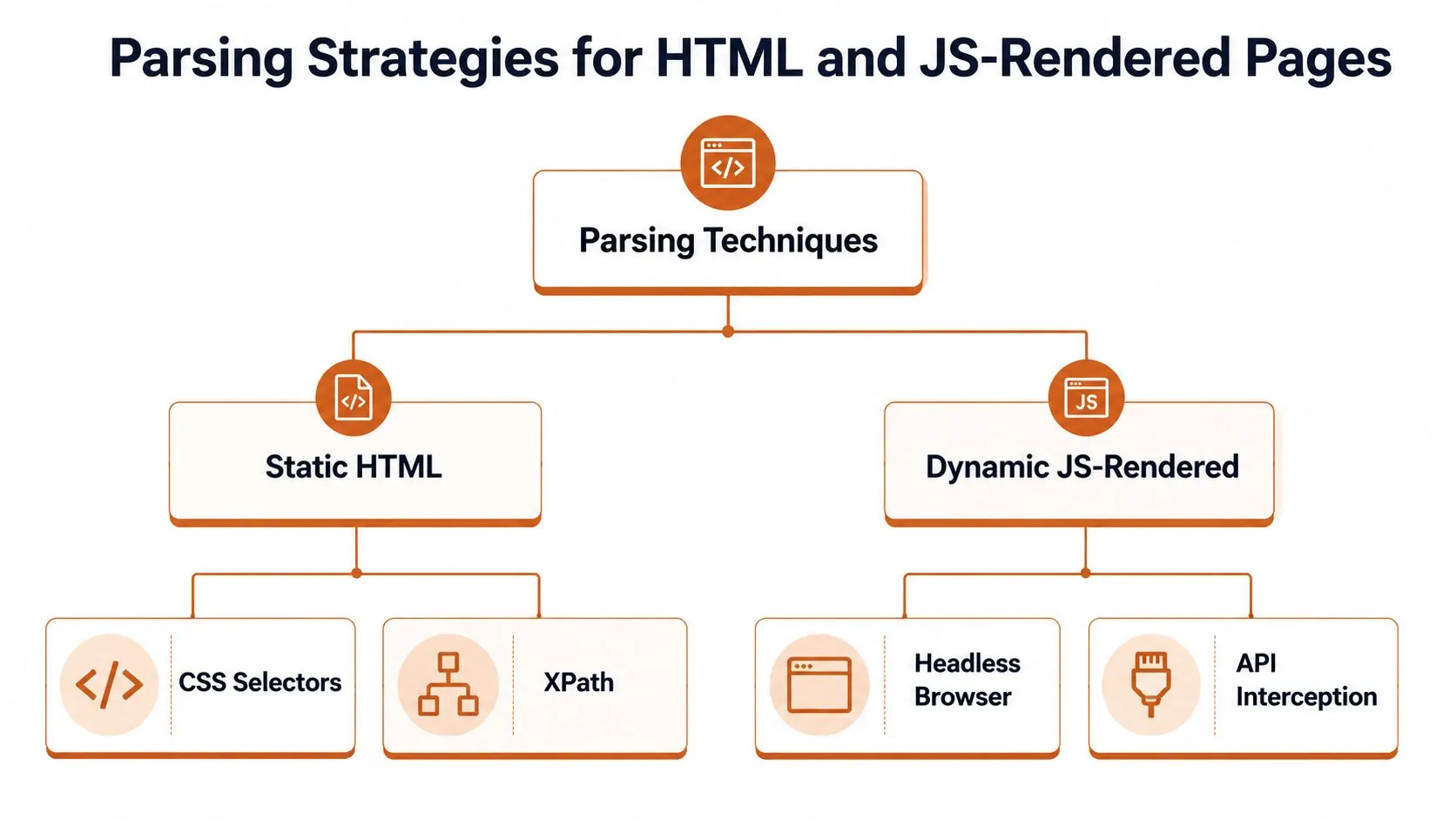
Parsing Strategies for HTML and JS-Rendered Pages
Parsing is where a lot of scraping budgets disappear after launch. Teams wire selectors to whatever looks convenient in the DOM, then the site team ships a redesign and the scraper starts returning blank fields, shifted columns, or half the intended records. Stable parsing starts with structure that means something, not with whichever class name happened to work during setup.
Anchor to meaning, not to decoration
For static HTML, CSS selectors and XPath are still the first tools to reach for. They’re fast, easy to reason about, and usually simpler to maintain when the page structure is predictable. The practical move is to select by stable relationships, labels, table positions, headings, and repeated blocks, rather than by autogenerated classes that can change overnight.
That choice matters because brittle selectors create hidden maintenance work. A scraper can appear healthy for weeks, then fail without warning after a minor template change, and the recovery time is usually longer than the original build estimate.
For dynamic pages, the problem changes. JavaScript-rendered content may need a headless browser, API interception, or a hybrid path that pulls the data endpoint instead of the painted page. That approach is often cheaper and more durable than replaying a full browser session for every request.
Browser-heavy paths also need tighter control over execution. The optimizing JavaScript scraping with Playwright guide is useful here because it focuses on keeping browser use targeted instead of treating automation as the default for every page.
Use layered extraction for mixed targets
The world rarely stays neatly static or dynamic. Ecommerce listings, job boards, dealer reports, and search results often mix structured fields with embedded free text, images, and repeated modules. In those cases, a layered parser works better than one technique forced onto everything, because each content type can be handled by the least fragile method available.
That layered approach also gives you more room to absorb site drift. A page can keep the same visible layout while changing the markup underneath, or it can preserve the HTML while moving key fields into scripts or embedded JSON. Separate handlers for each content class reduce the blast radius when one of those patterns shifts.
LLM-based parsing has a place when the page is semistructured but stubborn, and computer vision becomes practical when the data lives in screenshots, PDFs, or image-heavy listings. WebscrapingHQ uses managed pipelines, including computer vision and LLM-based parsing, for some extraction workflows, which matches how mixed-format targets are handled in production.
Keep raw HTML, rendered snapshots, and extracted records separate. That lets you reparse historical data when the target changes, instead of recollecting everything from scratch. It also makes schema diffs easier to audit, which matters when a site starts reshuffling content blocks without warning.
For browser-heavy extraction, a controlled Playwright path usually fits better than broad automation. You still need to manage render timing, selector stability, and the extra load that comes with a real browser, but you avoid paying that cost on pages that do not need it.
Understanding the True Cost of Recurring Scraping Operations
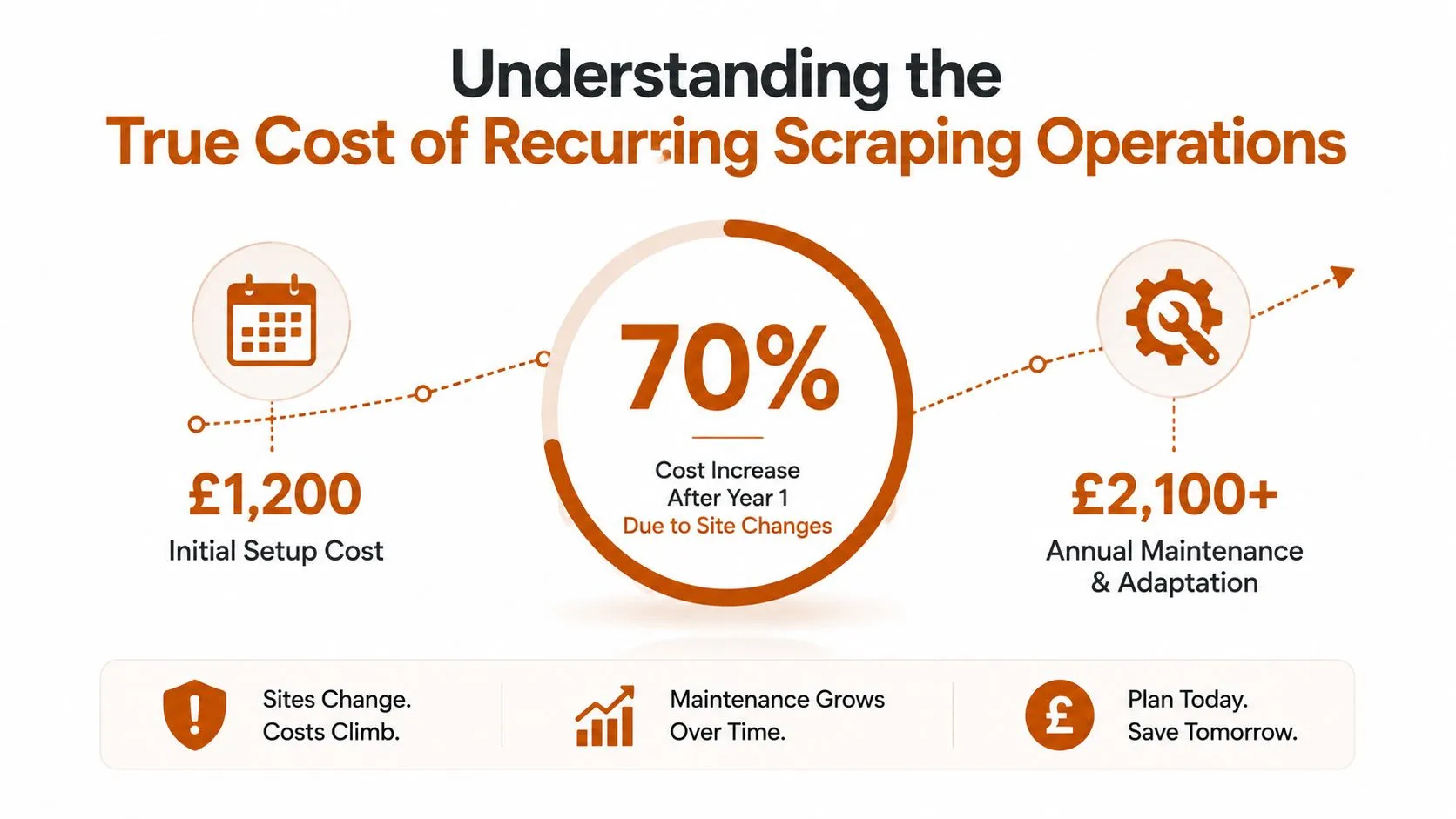
A lot of UK pricing pages make recurring scraping sound like a one-time procurement decision. It isn’t. The initial build is just the first invoice, while the ongoing bill is shaped by site volatility, CAPTCHA pressure, schema rework, and the monitoring required to notice failures before downstream users do.
Initial quotes rarely reflect maintenance
UK service pages often quote broad ranges such as £750-£2,500+ for recurring projects or £2,000-£15,000/month for more complete managed programmes, but those ranges usually describe delivery scope, not the full maintenance burden (UK Data Services service page). The missing line item is change handling. If the target changes every few weeks, the team spends time revalidating selectors, re-running tests, and patching edge cases that didn’t exist at kickoff.
That’s why fixed-scope API-style tools can look cheaper at the start and then become awkward when the source is volatile. They’re fine for stable targets. They’re much less comfortable when the page layout shifts, the anti-bot posture changes, or the output schema needs to stay identical for downstream systems.
Cost follows change rate
The best pricing models acknowledge that recurring scraping is an adaptation service as much as an extraction service. If the site is stable, a lighter model works. If the site changes frequently, you need monitoring, retry orchestration, proxy rotation, and re-tuning baked into the engagement.
Bottom line: the real cost driver is not the first extraction, it’s the number of times the source makes you revisit it.
That’s also why operational support matters more than polished demos. A scraper that looks cheap but breaks every other week becomes expensive once analysts, engineers, or operations staff start patching it manually. Managed programmes exist to absorb that volatility, which is the value proposition when the source estate is noisy and the downstream system can’t tolerate gaps.
Navigating UK Legal and Compliance Requirements
The legal question is usually asked too broadly. “Is scraping legal in the UK?” is a poor starting point because the answer depends on the data category, the access conditions, and the downstream use. The better question is whether the project is collecting public business information, personal data, or protected material, and what governance sits around each of those.
The risk is often downstream use, not collection alone
Neutral UK guidance notes that scraping copyright-protected material can be allowed if the scraper has access and the use is non-commercial, which is narrower than many marketing pages suggest (UK legal discussion). At the same time, UK GDPR treats personal data collection as a regulated processing activity, so names, emails, identifiers, and similar fields need a lawful-basis review and proper controls.
That distinction matters because many projects mix categories. Public business records may be one thing. Contact details are another. Reusable datasets and personal identifiers carry different compliance postures, and a blanket claim that a project is “GDPR-compliant” doesn’t answer the question.
Contracts and governance have to match the data
If you’re buying or operating a scraping service, the paperwork should match the data flow. That includes responsibilities for processing, retention, reuse, and deletion. A practical starting point is to review data process agreement clauses alongside the extraction design, because the legal posture changes as soon as the data is stored, transformed, or shared downstream.
For teams that need a more operational view, this internal guide on GDPR-compliant web scraping is relevant because it focuses on category-level controls rather than slogans. The main takeaway is straightforward. Compliance isn’t a badge you attach to a scraper, it’s a set of constraints you design into the pipeline.
Orchestrating and Monitoring Production Pipelines
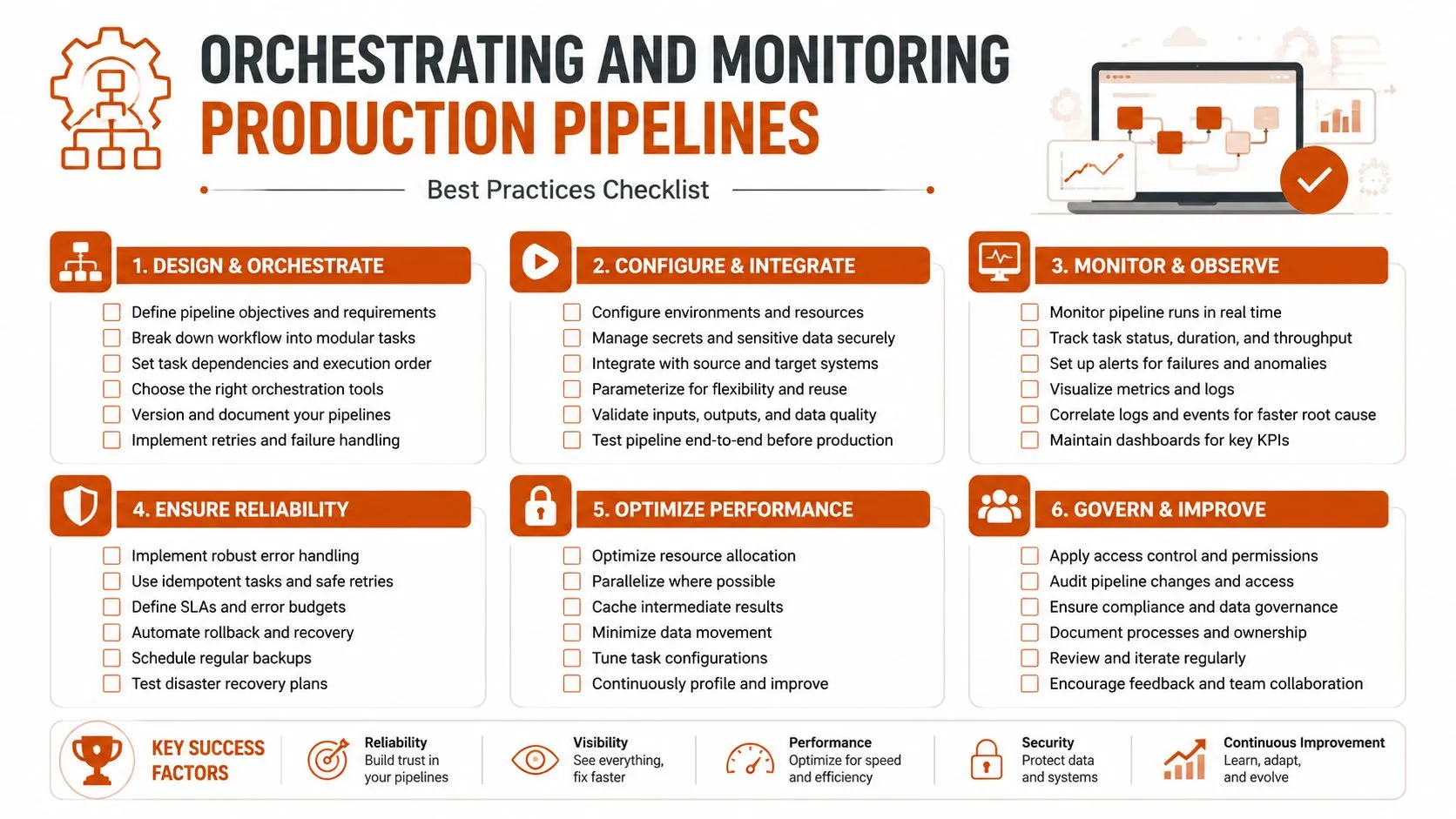
A production scraper needs the same discipline as any other data pipeline. Schedule it predictably, alert on the right failures, retry carefully, and version the schema so downstream users don’t get surprised by a target-site redesign. If those pieces aren’t in place, every successful scrape is just a temporary win.
Keep orchestration boring
Cron works for simple cadences. Airflow or a similar orchestrator makes sense when dependencies, retries, and branch logic start to matter. The point isn’t sophistication for its own sake, it’s making runs visible and recoverable.
A strong monitoring setup separates structural changes from transient noise. If a page returns a temporary error, retry with backoff and proxy rotation. If the selector returns empty rows across a whole page class, flag it as a likely site change and stop pretending it’s a network blip.
Monitor by page class
Search pages, product pages, and compliance reports should be monitored separately because their failure patterns aren’t the same. Ban frequency, response time, and success rate should be tracked per class, then compared against historical baselines. That’s how you catch drift before analysts notice that yesterday’s feed looks thin.
For teams that need a central operational view, an automation dashboard for agencies is useful context because it shows how recurring delivery, status visibility, and task routing can be organized around repeatable work. The same principle applies to scraping operations, the more predictable the reporting layer, the faster you spot failures.
Store outputs in the format your downstream system wants, whether that’s CSV, JSON, webhooks, S3 drops, or a dashboard feed. The best pipeline is the one your analysts and systems can consume without manual cleanup. If you want managed delivery that covers scoping, extraction, monitoring, and re-tuning under one roof, WebscrapingHQ provides custom web scraping services and managed web data operations built around recurring production use, so teams can offload the maintenance burden instead of patching scrapers after every site change.
Want this done for you?
Send us the URLs. We'll quote it in 24 hours.
Paste the URL(s) you want scraped. We'll reply within 24 hours with a feasibility check and a ballpark quote.