Jump to section
- Introduction to AI Powered Ecommerce Data Extraction
- What Web Scraping for Ecommerce Really Means
- From page capture to field extraction
- Why AI changes the job
- Why schema matters more than most teams expect
- Core Ecommerce Use Cases That Drive Value
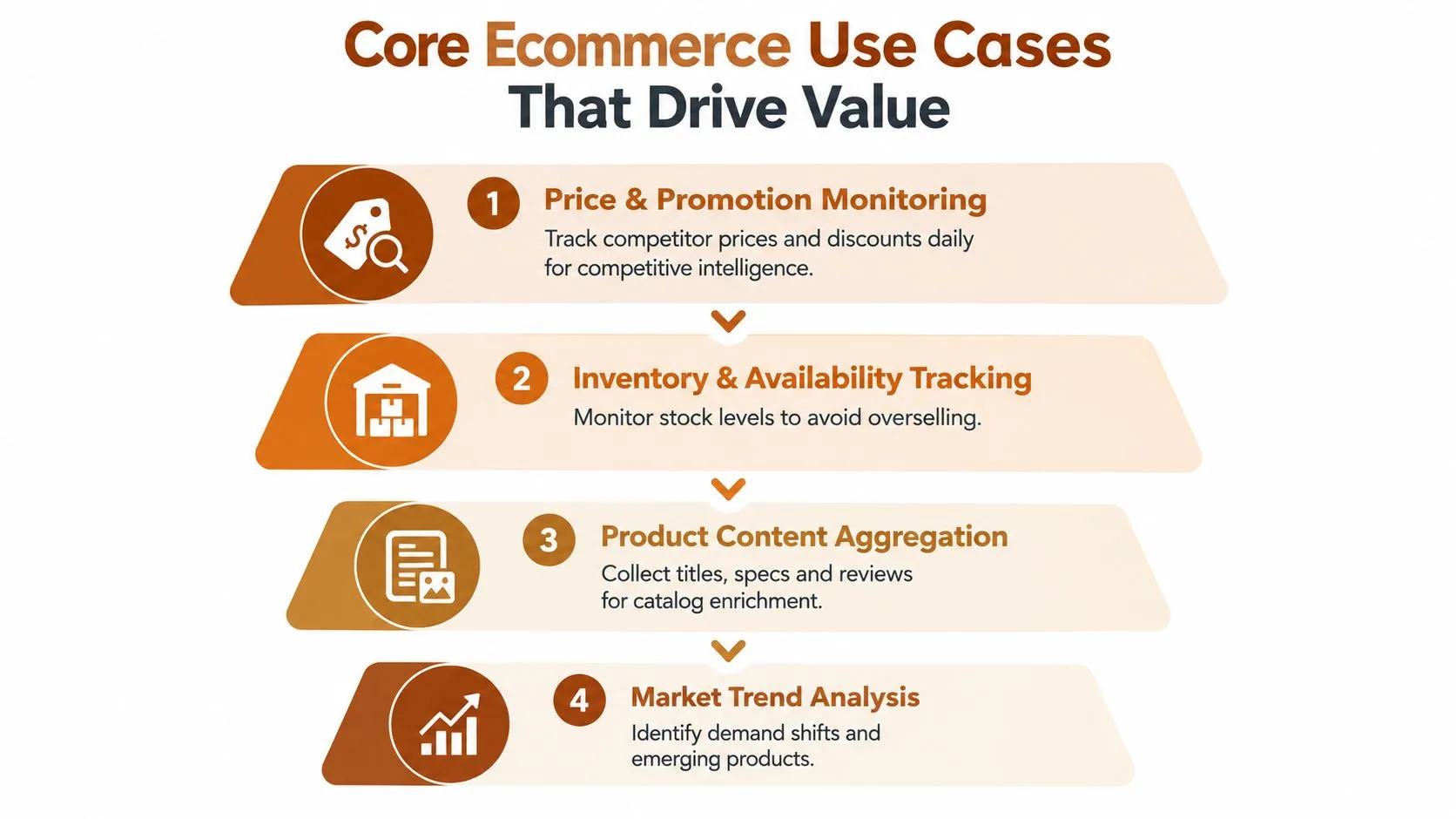
- Price and promotion monitoring
- Inventory and availability tracking
- Product content aggregation
- Review and market signal collection
- How AI Data Extraction Works Behind the Scenes
- Four common approaches
- Comparing Ecommerce Extraction Approaches
- Why accuracy varies so much
- The hidden work most demos skip
- Legal Compliance and Responsible Data Collection
- Compliance starts before the first crawl
- Why validation matters more for messy evidence
- Maintenance and compliance are linked
- Best Practices for Scale Reliability and Maintenance
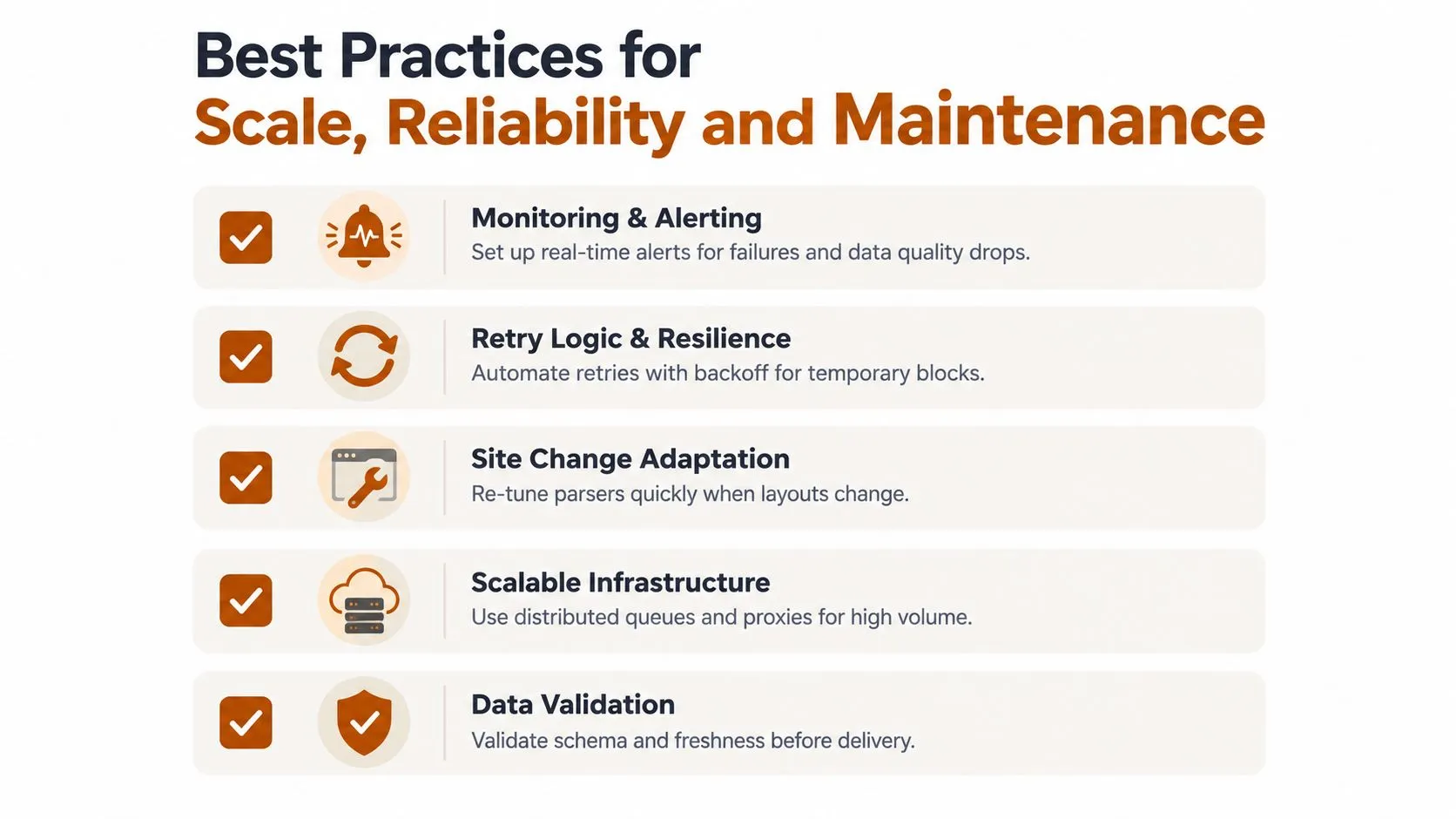
- The five practices that keep feeds usable
- Why schema governance is not optional
- Delivery format is part of reliability
- Choosing and Operationalizing the Right Service
Your team probably started with a spreadsheet.
Someone on ecommerce ops checks three competitor sites every morning. A merchandiser watches stock status on a few marketplaces. A marketplace manager copies titles, sizes, colors, and review counts into a shared sheet before a pricing meeting. It works for a while. Then the catalog expands, the number of sellers grows, and one layout change on a target site breaks the process for a week.
That’s when many teams start searching for AI data extraction services. They think they’re buying a smarter scraper. In practice, they’re taking on a recurring operations function.
The shift matters because ecommerce data work rarely fails on day one. It fails on day thirty, when a site changes its price box, loads stock status through JavaScript, or hides variant details behind image swatches. A pilot can look clean while the production workflow keeps throwing small errors downstream into pricing, catalog, and compliance decisions.
This isn’t a niche corner of software anymore. The AI-driven web scraping market was valued at USD 7.79 billion in 2025 and is projected to reach USD 47.15 billion by 2035, with a 19.82% compound annual growth rate over 2026 to 2035, according to Intel Market Research on the AI information extraction market. The same source notes a separate 2025 estimate of USD 1.45 billion for the AI information extraction market, which tells buyers that structured extraction has already become a real operating category, not a side experiment.
Introduction to AI Powered Ecommerce Data Extraction
A common ecommerce situation looks simple from the outside. You want daily competitor prices, current stock status, seller counts, promotion labels, ratings, and a copy of the product page for proof. The request sounds like a tooling problem. Find a scraper, point it at a list of URLs, and export CSV.
The trouble starts when the page structure shows up. One retailer loads prices only after the page renders. Another uses different labels for in-stock and ready-to-ship. A marketplace changes category attributes depending on brand. Review summaries appear in one format on desktop and another on mobile. The data is on the page, but it isn’t presented in one stable pattern.
That’s why ecommerce teams increasingly treat extraction as infrastructure. Historical milestones show how we got here. In 1993, the World Wide Web Wanderer at MIT was built as one of the first web crawlers, and that same year JumpStation became the first crawler-based web search engine indexing millions of pages. By 2000, Salesforce and eBay had public APIs for structured access. In 2004, BeautifulSoup made HTML parsing much easier for Python users. In 2006, Kapow Software Web Integration Platform 6.0 introduced an early visual scraping approach that let users highlight content and export it into Excel or databases, as summarized in SNS Insider’s overview of data extraction market milestones.
Those milestones explain why modern extraction now looks less like “download some HTML” and more like a managed feed with schema rules, monitoring, and exception handling.
Practical rule: If your ecommerce team needs the same fields on a schedule, you’re not solving a one-time scraping task. You’re operating a data supply chain.
A useful starting point is to think in terms of business decisions, not pages. Are you repricing products? Expanding assortment? Auditing MAP compliance? Enriching marketplace listings? If the answer is yes, then extraction quality has to be measured by whether downstream teams can trust and use the feed. A broader explanation of that shift appears in this guide on why data-driven businesses use AI website scrapers.
What Web Scraping for Ecommerce Really Means
First, picture scraping as collecting text from a page. That picture is incomplete.
For ecommerce, scraping means turning messy, changing storefront pages into a stable structured record. Instead of “all the text on this URL,” you need exact fields such as current price, original price, currency, seller name, shipping status, variant size, pack count, image URLs, ratings, and review snippets. The job isn’t just collection. The job is interpretation.
From page capture to field extraction
Think of a product page like a crowded shelf label in a store. A person can glance at it and separate list price from sale price, identify the selected color, and notice that “out of stock” refers only to one size. A basic scraper sees code. An AI-assisted system tries to reconstruct what the shopper is being shown.
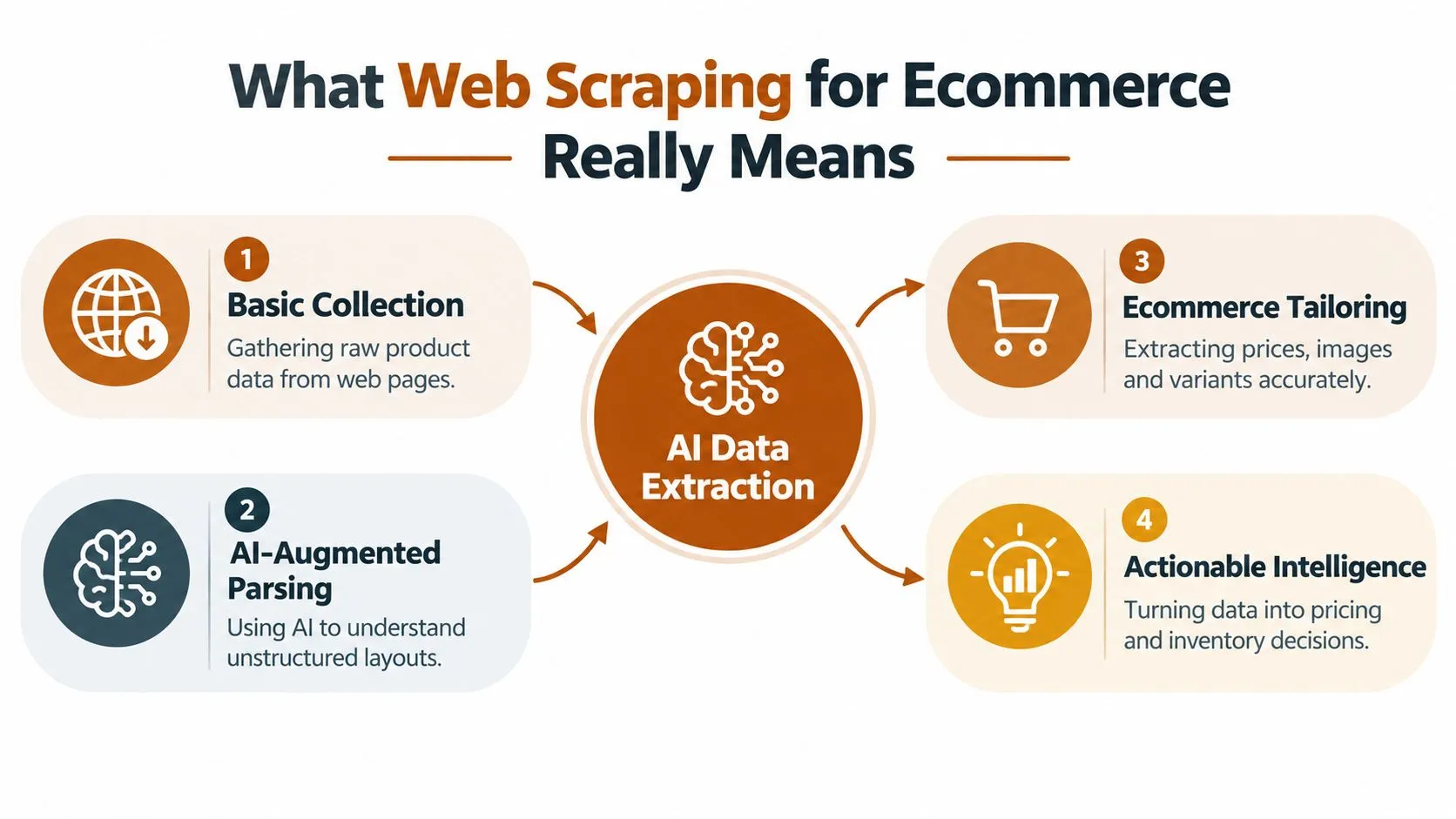
That’s why modern pipelines often combine several layers:
- Page collection that fetches the target content.
- Rendering that loads JavaScript-heavy elements.
- Parsing that identifies relevant content blocks.
- Normalization that maps what was found into a fixed schema.
If any one of those steps is weak, the final dataset becomes unreliable.
Why AI changes the job
AI helps most when the source is semi-structured, visually complex, or inconsistent across pages. Instead of relying only on fixed selectors in HTML, teams can use computer vision and language models to interpret layout and context. That matters when a “price” appears inside a rendered component, a screenshot, or a page design that changes across categories.
Recent industry coverage also points out a blind spot. Many teams focus on text extraction accuracy, but practical enterprise effort often concentrates on semi-structured and visual compliance artifacts, especially when inputs include PDFs, screenshots, and localized documents. Sparkco notes that multilingual OCR and document understanding are active focus areas because the work is shifting from reading characters to understanding layout, exceptions, and image-based evidence, as discussed in its article on multilingual OCR trends and techniques.
If your source is a screenshot, a PDF report, or a dealer compliance document, the hard part isn’t reading letters. It’s deciding which field means what.
Why schema matters more than most teams expect
A schema is the contract your extraction feed has to satisfy. It defines what each field means and how it should look when delivered downstream.
That sounds administrative, but it’s where many ecommerce projects either become useful or become expensive. “Price” by itself is vague. Do you need MSRP, advertised price, cart price, member price, or unit price? “Availability” can mean in stock, preorder, backorder, limited stock, unavailable online, or unavailable in this region.
A workable ecommerce schema usually needs:
- Commercial fields such as price, promo label, discount type, and currency
- Catalog fields like brand, title, pack size, variant, attribute bullets, and category
- Operational fields including timestamp, source URL, seller identity, and capture method
- Validation fields such as confidence notes, page status, and evidence assets
That’s the difference between generic scraping and managed ecommerce extraction. One returns content. The other returns decision-ready records.
Core Ecommerce Use Cases That Drive Value
Ecommerce teams usually don’t buy extraction because they love data plumbing. They buy it because specific operating decisions depend on recurring external visibility.
Price and promotion monitoring
This is the most familiar use case, but it’s also the one teams oversimplify most often. They assume they need “the current price.” In practice, pricing teams often need a richer record: list price, sale price, bundle language, coupon labels, shipping qualifiers, marketplace seller identity, and the exact page snapshot that proves what was displayed at capture time.
When that feed is clean, teams can spot undercutting, monitor promo timing, and compare regional offers without manually opening dozens of pages. For a narrower look at this workflow, this ecommerce price monitoring guide is useful.
Inventory and availability tracking
Availability sounds binary until you try to automate it.
One site says “in stock.” Another says “ships tomorrow.” A marketplace lists ten sellers, but only two can fulfill in the buyer’s region. A variant page may show the parent SKU as available while the selected size is unavailable. Merchandising and marketplace teams need those distinctions because assortment decisions depend on actual purchasability, not a generic stock flag.
A good feed supports questions like these:
- Where are competitors going out of stock?
- Which variants disappear first?
- Which sellers repeatedly show long fulfillment windows?
- When does a category tighten across multiple retailers at once?
Product content aggregation
Catalog operations often need external product content for marketplace listing work, assortment research, or category mapping. Titles, bullet points, dimensions, ingredient lists, compatibility notes, and image sets all matter. So do differences between how brands describe the same item across channels.
This use case becomes more valuable when extraction also normalizes attributes. “Blue,” “navy,” and “midnight” may all need to roll into a common color family in your internal model. Without that normalization layer, content aggregation produces more rows but not much more clarity.
Operational insight: The raw scrape is rarely what the business needs. The business needs a version of the truth that can join to internal product data.
Review and market signal collection
Reviews do more than summarize sentiment. They reveal packaging complaints, recurring sizing issues, feature confusion, and language customers use naturally. Brand teams, product managers, and customer experience teams often need that material in structured form, not just as screenshots.
Some teams also extend extraction into broader market signals. They watch new launches, emerging bundles, changes in assortment breadth, and the appearance of substitute products across marketplaces. This isn’t just about reacting to competitors. It helps teams understand category movement before internal sales data fully catches up.
How AI Data Extraction Works Behind the Scenes
Behind every clean CSV or JSON feed is a set of trade-offs. The right method depends on the site, the fields you need, the tolerance for latency, and how much maintenance your team can absorb.
Four common approaches
Traditional HTML parsing still works well on stable pages with predictable markup. If the product title, price, and brand all appear in accessible page source, selectors can extract them efficiently.
Headless browser rendering becomes necessary when a site builds key elements in the browser through JavaScript. That approach is heavier, but it exposes content that simple requests won’t see.
Computer vision enters when the layout itself carries meaning. A screenshot can show which price is visually dominant, which badge is tied to which seller, or whether a compliance label appeared at all.
LLM-based parsing is most useful for schema mapping and exception handling. It can help interpret irregular structures, classify page sections, and turn semi-structured content into named fields when fixed rules become brittle.
Comparing Ecommerce Extraction Approaches
| Approach | Best For | Strength | Limitation |
|---|---|---|---|
| HTML parsing | Stable product pages with accessible markup | Fast and efficient on clean structures | Breaks when markup changes or content is hidden |
| Headless browser rendering | JavaScript-heavy storefronts and marketplaces | Captures rendered content closer to what users see | More resource-intensive and slower to operate |
| Computer vision inspection | Visual verification, screenshots, badges, compliance evidence | Understands placement and visual context | Requires image pipelines and careful validation |
| LLM-based parsing | Semi-structured pages, schema mapping, exception handling | Flexible on irregular content and field interpretation | Needs guardrails to keep outputs consistent |
Why accuracy varies so much
Many buyers ask for a single accuracy number. That’s understandable, but it hides the operational issue. Performance changes by document or page type.
A comparative benchmark reported Google Document AI at 97.2% OCR accuracy and 95.1% field-extraction precision overall, with stronger results on complex multi-column invoices at 96.1% and handwritten content at 89.3%. The same benchmark showed processing speed differences as well, ranging from 2.1 pages per second for Adobe PDF Extract to 4.2 pages per second for AWS Textract, according to LlamaIndex’s AI document parser benchmark summary. The lesson for ecommerce teams is simple. Evaluate by source class and output requirement, not by one blended score.
A separate published benchmark across 1,497 documents found an AI extractor achieved 98.67% overall accuracy versus 89.42% for the baseline, a +9.25 percentage-point gain, with Cohen’s d = 0.718 and p = 5.34e-89, as reported in RCTK’s OCR benchmark case study. That result is especially relevant when structure recovery matters more than character recognition alone.
The hidden work most demos skip
The hard parts don’t fit neatly into a product demo:
- Anti-bot handling so collection remains stable without constant manual intervention
- Retries and fallbacks when pages partially load or return inconsistent responses
- Schema mapping so a field means the same thing across sites
- Exception routing so unclear cases don’t poison downstream datasets
Teams exploring build-versus-buy decisions often underestimate that maintenance layer. If you want a technical view of how machine learning fits into collection itself, this overview of machine learning in data collection is a useful companion.
A managed service can absorb that operational burden. For example, WebscrapingHQ offers managed web data operations, custom scraper development, visual inspection, LLM-based parsing, monitoring, retries, anti-bot mitigation, and scheduled delivery in formats like CSV, JSON, webhooks, S3 drops, and PDF reports. That’s less about “using AI” and more about owning the full extraction workflow.
Legal Compliance and Responsible Data Collection
Many ecommerce teams still treat scraping as a technical procurement question. Legal teams usually see it differently. They ask what you’re collecting, from where, under which terms, how often, for what downstream use, and what proof you retain if the output is challenged.

Compliance starts before the first crawl
Responsible collection begins with source review. Teams need to assess terms of service, robots.txt considerations, privacy implications, jurisdiction-specific rules, and whether personal data is involved. For ecommerce, that’s especially important when a workflow expands from public product pages into seller details, customer-facing reviews, or marketplace artifacts that may contain identifiers.
The other legal reality is documentation. If a pricing, compliance, or brand protection decision depends on extracted data, your team should preserve provenance. That may include the source URL, capture time, screenshots, and the extraction logic used to produce the structured record.
Why validation matters more for messy evidence
The compliance conversation changes when your source is not a clean webpage. PDF reports, screenshots, product label images, or dealer compliance documents often require both interpretation and auditability.
Recent industry coverage notes that teams often underweight this problem. Semi-structured data creates a large share of enterprise effort and failure risk, and practical validation workflows become essential when legal review is part of the buying decision. That’s one reason many organizations pair automated parsing with human QA.
A simple operating model often works best:
- Automate collection for recurring, low-ambiguity fields
- Flag exceptions when page evidence conflicts with extracted values
- Route edge cases to trained reviewers
- Retain evidence for audit, dispute resolution, or internal approval
Don’t ask only whether a system can extract a field. Ask whether your team can defend that field in a pricing review, partner dispute, or compliance audit.
Maintenance and compliance are linked
There’s also a cost issue hiding inside governance. Buyer guidance increasingly emphasizes that long-run spend is driven less by initial build cost and more by engineering attention, monitoring, retries, schema drift, and legal oversight. It also warns that workflows that function at one scale often become fragile at much larger source counts, as explained in Forage AI’s buyer guide to modern data extraction services in 2026.
That’s why legal review shouldn’t be bolted on later. The extraction method, retention policy, validation workflow, and source mix all affect compliance exposure. Teams that need a practical checklist can use this ecommerce data extraction compliance checklist as a working reference.
Best Practices for Scale Reliability and Maintenance
A pipeline that works on ten pages is a prototype. A pipeline that works across hundreds of changing ecommerce sources on a schedule is an operations system.
That distinction changes how you should evaluate AI data extraction services. Initial parsing quality matters, but it doesn’t determine ROI by itself. Maintenance discipline does.
The five practices that keep feeds usable
-
Monitoring and alerting: Don’t wait for a merchandiser to notice bad data in a dashboard. Track failures, empty fields, freshness gaps, and unexpected schema shifts as they happen.
-
Retry logic and resilience: Some failures are temporary. Rate limits, partial loads, and rendering issues can often be recovered through controlled retries and fallback paths.
-
Fast adaptation to site changes: Retail pages change constantly. Your process needs a clear owner who reviews breakage, updates parsers, and validates fixes before the next scheduled delivery.
-
Scalable infrastructure: Large source sets need queueing, proxy strategy, workload distribution, and controlled execution windows. Without that layer, throughput and reliability become inconsistent.
-
Data validation before delivery: Check required fields, field types, acceptable ranges, duplicate rates, and evidence alignment before the dataset reaches pricing, analytics, or compliance teams.
Why schema governance is not optional
Teams often focus on whether extraction can read a site. A bigger production question is whether the feed still means the same thing after a month of changes.
Schema versioning helps prevent silent breakage. If one source begins returning “member price” in the field that used to hold public price, the issue shouldn’t propagate into your internal systems. Someone needs to detect, document, and approve that change.
A practical governance routine usually includes:
- A canonical schema with field definitions everyone agrees on
- Version control for parser logic and output structure
- Quality review thresholds for newly added sources
- Exception queues for unresolved mapping conflicts
Cheap extraction often becomes expensive when internal teams spend their week reconciling broken fields, rerunning jobs, and answering data trust questions.
Delivery format is part of reliability
The output matters as much as the parsing. Some teams need flat CSV files for analysts. Others need JSON for applications, webhooks for near-real-time workflows, S3 drops for batch processing, or PDF reports for compliance review.
A reliable service doesn’t just “get the data.” It delivers the agreed schema, on the agreed cadence, in the agreed format, with enough metadata for downstream users to trust it. That’s what turns extraction from a clever script into a usable operating feed.
Choosing and Operationalizing the Right Service
The right service isn’t the one with the flashiest demo. It’s the one that matches your source complexity, decision cadence, governance needs, and tolerance for maintenance.
Start with scope. List the target sites, page types, required fields, update frequency, evidence requirements, and output format. Then separate must-have fields from nice-to-have fields. That one step often reveals whether your team needs lightweight structured extraction or a managed workflow with visual validation and exception handling.
Next, evaluate operating fit. Ask who owns retries, who updates parsers when layouts change, how schema changes are approved, how evidence is stored, and how legal review is handled for sensitive sources. These questions usually matter more than a generic promise about AI accuracy.
If you’re comparing in-house work to a managed option, be honest about where your engineering time goes. Building a first parser is rarely the expensive part. Keeping hundreds of recurring jobs healthy is.
A useful buying filter is simple:
- Source complexity: Static pages, dynamic storefronts, marketplaces, PDFs, screenshots
- Decision criticality: Internal research, pricing operations, compliance evidence, customer-facing applications
- Operating model: Internal scripts, hybrid oversight, or fully managed recurring delivery
Teams that need recurring ecommerce feeds often choose managed services because the burden is ongoing upkeep, not first-pass extraction. If you’re weighing that choice directly, this comparison of managed web scraping services versus doing it yourself is a practical starting point.
WebscrapingHQ provides managed web data operations for teams that need recurring ecommerce extraction without owning scraper maintenance internally. If you need structured feeds, compliance-ready reports, visual validation, or scheduled delivery across changing sources, visit WebscrapingHQ to assess scope, source feasibility, and operating fit.
Want this done for you?
Send us the URLs. We'll quote it in 24 hours.
Paste the URL(s) you want scraped. We'll reply within 24 hours with a feasibility check and a ballpark quote.