
Jump to section
- Expired Domain States and How Long Each Lasts
- Record the State, Not Just the Date
- How to Build the Collection Pipeline
- Keep Collection and Decisions Separate
- Scheduling Rechecks Without Getting Blocked
- Make Time and Request Budgets Explicit
- Scoring Candidates for Historical Risk
- Build an Explainable Evidence Record
- Measure Review Quality
- Common Failure Modes and Fixes
- Replay the Evidence Before Shipping
- Set Compliance Limits and Choose Your Build Path
- Ownership Doesn’t Remove Historical Exposure
- Choose Based on Maintenance Capacity
You’ve collected a list of expired domains, filtered it for relevant names, and sent the shortlist to a buyer. Then the registrar rejects the registrations. Some names are still recoverable by their owners; others are auction listings, not public drops. The extraction worked, but the classification didn’t.
A reliable expired domains scraper must distinguish discovery, lifecycle status, commercial availability, and completed acquisition. Missing a candidate is disappointing. Mislabeling an unavailable domain can waste enrichment fees, trigger premature purchase attempts, and make delivery reports untrustworthy.
Expired Domain States and How Long Each Lasts
A scraper that marks a domain free on its expiration date can report a name the previous owner still controls or can recover. Expiration is an event, not permission to register. Your classifier needs evidence of the current lifecycle state.
For generic top-level domains, ICANN’s expiration-policy status report describes a 30-day Redemption Grace Period after registry deletion, followed by five calendar days in Pending Delete if the name isn’t restored. These periods don’t start at the public expiration date.
The earlier commercial window matters just as much: ICANN’s Post-Expiration Domain Name Recovery Issues Report describes an auto-renew period lasting up to 45 days, during which registrars may sell, auction, or transfer names rather than release them.
Record the State, Not Just the Date
Use this reference as a classification model, not a universal countdown. Auction and backorder listings are commercial states that can overlap registry lifecycle states.
| Stage | Typical duration | Owner can restore? | Fields to record |
|---|---|---|---|
| Active until expiry | Until registrar expiry date | Yes, by renewing | Expiry date, registrar, EPP status |
| Auto-renew grace | Registrar-defined window within the auto-renew limit | Generally, through renewal under registrar terms | Renewal attempt state, registrar auction flag |
| Registrar auction or backorder | Registrar’s listing or backorder schedule | Renewal or restoration follows registrar terms; bidding isn’t restoration | Listing ID, close time, seller |
| Redemption grace period | Standard generic-TLD redemption window described above | Yes, through registrar restoration | Redemption status, deletion timestamp |
| Pending delete | Standard pending-delete window described above | No | Pending-delete status, expected purge time |
| Released | After registry purge, until registration | No restoration; open registration may be possible | Observed release time, first new registration |
Don’t apply generic-TLD rules indiscriminately to country-code domains. Maintain a TLD policy configuration with its source, effective date, supported statuses, and deletion rules. An unsupported extension should produce unknown, not a guessed release date.
A missing zone-file entry also isn’t proof of availability. Names can disappear from DNS while remaining unavailable for registration. Historical website evidence, collected through a Wayback Machine scraper, belongs in a separate history record rather than the availability classifier.
Store registry timestamps, registrar expiry, observed status, capture time, registrar behavior, and applicable TLD exceptions separately. Preserve conflicting observations instead of replacing them with whichever source arrived last.
An expiration date is not an availability date.
How to Build the Collection Pipeline
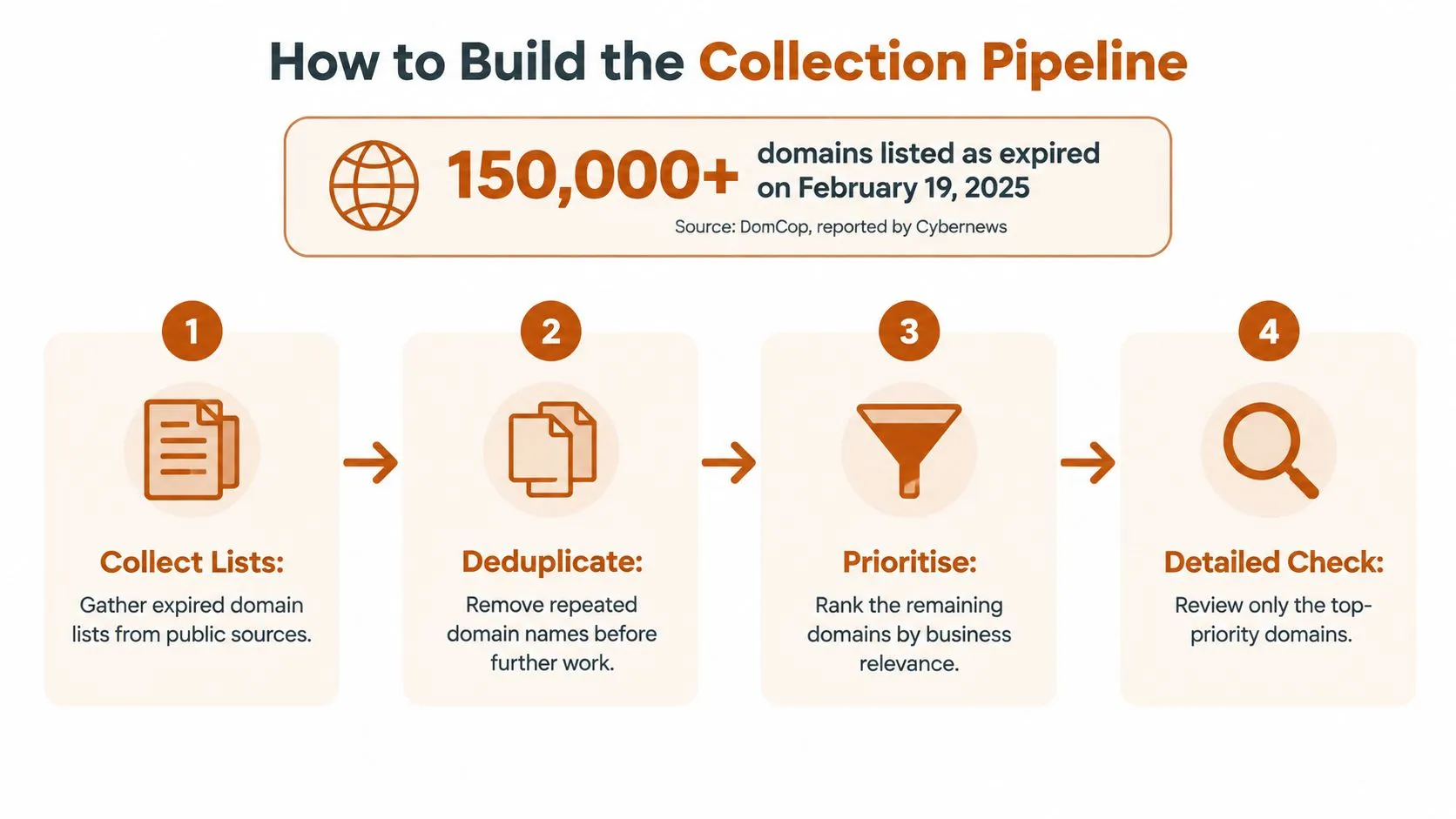
More than 150,000 domains were listed as expired on February 19, 2025, according to DomCop figures reported by Cybernews. That scale makes deduplication and business prioritization necessary before expensive historical checks.
Don’t assume a public listing includes permission for automated collection or offers an official API. Establish the permitted access method for each source before choosing HTTP requests, Scrapy, or Playwright.
Keep Collection and Decisions Separate
-
Ingest approved sources and retain raw evidence. Collect permitted listings, registrar-provided files, and authorized feeds. Store the payload, source identifier, capture timestamp, parser version, and pagination cursor. Loading a feed without capture times makes later freshness checks impossible.
-
Normalize names before enrichment. Lowercase the canonical hostname, convert internationalized names to their ASCII punycode form, and retain the Unicode display form. Extract the registrable domain using a maintained Public Suffix List rather than removing everything before the final labels. Deduplicate canonical names while preserving every source observation. Otherwise, repeated listings consume enrichment budget.
-
Classify from current lifecycle evidence. Parse EPP statuses, registrar expiry, redemption indicators, and pending-delete observations into explicit fields. Attach observation age and confidence to the resulting label. The expensive mistake is classifying from a stale snapshot without recording that it’s stale.
-
Schedule the next meaningful check. Put lifecycle transitions into a durable queue with a next-check timestamp and source-specific request budget. Don’t let the crawler’s page order determine which domain receives attention next.
-
Send qualified candidates for historical review. Apply business relevance filters before archive extraction and link analysis. Keep commercial relevance separate from historical risk, so a strong keyword match can’t cancel a malware warning.
-
Verify acquisition through an accredited registrar. An availability response supports a purchase attempt; it doesn’t prove ownership. Mark a domain acquired only after the registration workflow confirms success. Keep rejected, timed-out, and ambiguous orders out of the acquired dataset.
For pagination, checkpoint only after the page’s records are durably written. Detect repeated cursors and duplicate page fingerprints so a changed listing doesn’t create an endless crawl. Use ordinary HTTP parsing where possible; browser rendering adds operational cost and should solve a demonstrated rendering requirement.
A scalable Scrapy pipeline can separate fetching, parsing, validation, and enrichment. Once those observations enter your database, Streamkap’s guide to building pipelines with change data capture is useful for distributing internal state changes downstream. Change data capture doesn’t discover registry events by itself.
Scheduling Rechecks Without Getting Blocked
Use the following as a hypothetical starting schedule, not a registry requirement or permission to exceed a source’s limits. Tune it against observed transition timing, response freshness, and the request allowance you actually have.
| Lifecycle stage | Recheck interval | Request handling |
|---|---|---|
| Pre-expiry candidates | For example, daily within a selected monitoring horizon | Batch permitted lookups and cache unchanged results |
| Auto-renew grace | For example, every six hours | Respect registrar rate limits |
| Redemption grace period | For example, once daily | Cache last-known status and avoid duplicate lookups |
| Pending delete | For example, hourly, then every five minutes during the final day of an estimated purge window | Use authenticated, permitted checks within request limits |
| Drop day | Continuous acquisition workflow across the expected purge window | Registrar workflow, not continuous HTTP polling |
A single check after expiration misses changes that happen on different schedules: listing closure, registrar transfer, registry deletion, and eventual release. Recheck priority should follow state uncertainty and business value, not merely how recently the crawler encountered the name.
Make Time and Request Budgets Explicit
Store normalized timestamps in UTC and retain the original timestamp, offset, and source field. Convert times for display, not for scheduling arithmetic. When a source supplies a date without a time, record that reduced precision instead of inventing midnight as an authoritative event time.
Apply exponential backoff with jitter when a service returns a rate-limit response, and honor its retry instructions. Cache WHOIS and RDAP observations by domain and source, with expiration rules appropriate to the lifecycle stage. A worker should reuse a fresh observation rather than launch another lookup because a duplicate candidate entered the queue.
Keep concurrency limits per source, not just across the whole application. Proxy rotation is appropriate only where the source’s terms permit it; it isn’t a way to enlarge an account’s request allowance. If a CAPTCHA appears, lower the request rate or suspend that source instead of attempting to evade the challenge.
Practical anti-blocking controls should support permitted access, not disguise prohibited collection.
Operational boundary: Discovery workers can identify a likely release window. They can’t guarantee that a registrar will accept your registration before another buyer’s request.
Reserve low-latency acquisition handling for reviewed candidates. Increasing HTTP polling across the entire inventory creates more load without making your registration workflow competitive.
Scoring Candidates for Historical Risk
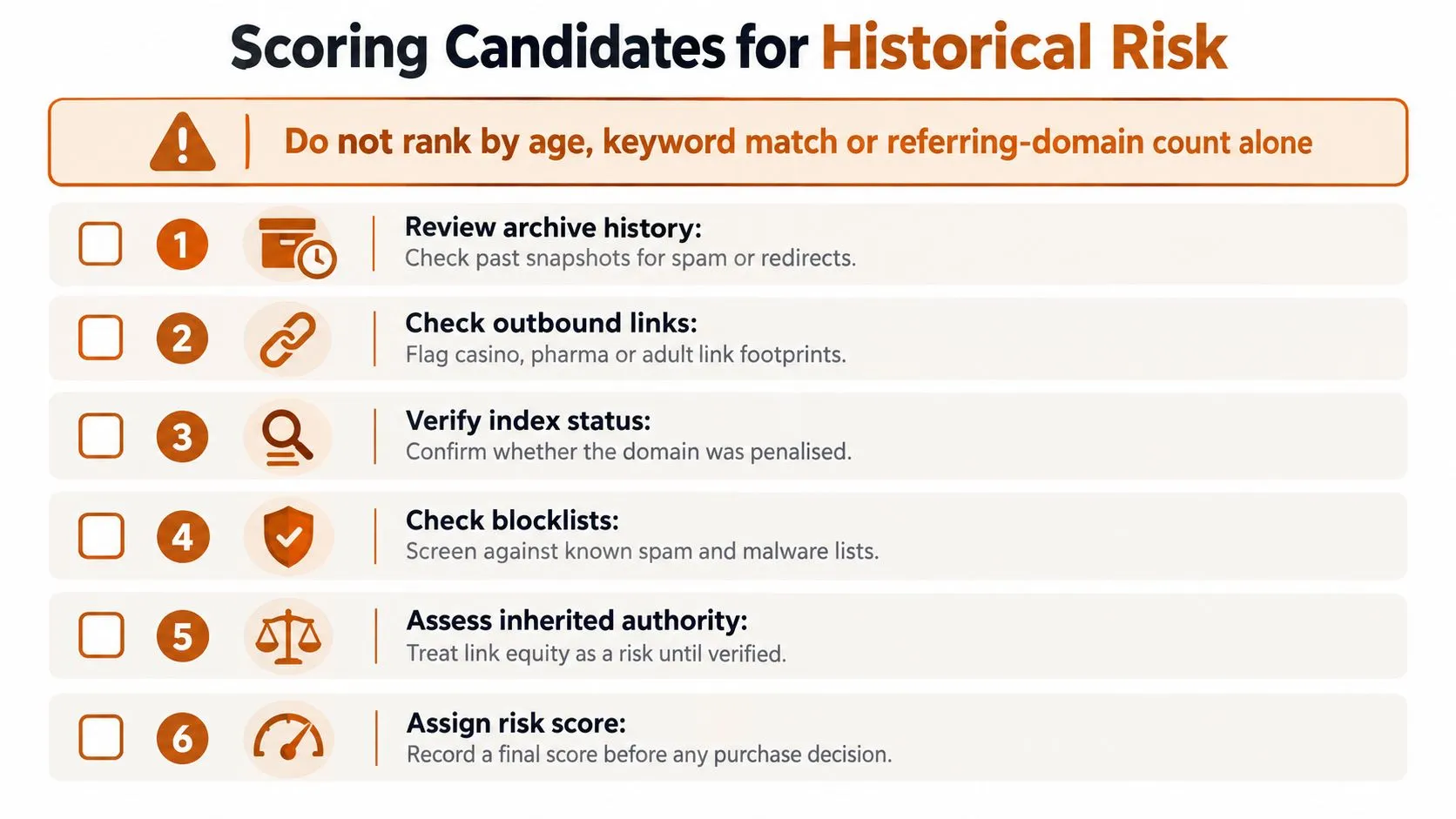
Ranking candidates by age, keyword match, or referring-domain count treats inherited reputation as an asset before anyone has examined it. A relevant name can still carry a history that makes it unsuitable for a brand, publishing project, or email operation.
Google’s spam policies define expired domain abuse around acquiring an expired domain and repurposing it primarily to manipulate search rankings with low-value content. Historical relevance therefore needs evidence, not an authority score.
Build an Explainable Evidence Record
Start with archived pages and redirect chains. Compare titles, visible text, language, and topical entities across captures rather than relying on the earliest and latest snapshots alone. A parked page isn’t meaningful editorial history, and missing captures don’t establish a clean past.
Then examine the signals together:
- Content continuity. Flag abrupt topic changes, doorway-like pages, and thin templated material. Distinguish legitimate multilingual content from unexplained changes in purpose.
- Link patterns. Deduplicate referring domains before counting them. Review concentrated anchors, suspicious outbound destinations, and mass redirects rather than treating every backlink as equivalent.
- Technical history. Inspect current DNS, HTTP responses, TLS, mail records, and nameserver changes. Preserve redirect types so permanent and temporary redirects don’t collapse into the same observation.
- Abuse indicators. Escalate malware, phishing, blocklist matches, and internationalized-name homographs for review. A missing match isn’t proof of safety.
For email-related projects, mailX’s SPF record checker can help inspect current sending-policy records. It doesn’t certify historical sender reputation or establish that an expired domain is safe to use.
Treat the infographic’s index check as an investigation prompt, not a diagnostic guarantee. A scraper can observe index presence; it can’t confirm a search penalty from absence alone.
Measure Review Quality
Assign risk categories with reasons, evidence timestamps, and parser confidence. Keep uncertainty separate from risk: a domain with sparse archives may be insufficiently documented rather than demonstrably harmful. Use data provenance to connect every decision to its underlying capture.
Report precision at the review threshold, the share of shortlisted domains that pass manual brand-safety, legal, and historical-content checks. Report acquisition rate separately. Winning registrations and selecting suitable domains are different outcomes.
Common Failure Modes and Fixes
The most expensive classifier error is a false availability label. A buyer may authorize spending against a name that cannot yet be registered, or mistake an auction purchase opportunity for an ordinary registration.
Use this diagnostic table to make targeted changes. Don’t rewrite the entire pipeline when the defect belongs in a specific classifier rule or schema field.
| Symptom | Likely cause | Fix |
|---|---|---|
| Domain marked free but still restorable | Redemption state not stored | Add an explicit redemption classification that blocks availability until current evidence clears it |
| Drop caught hours late | Mixed local and registry timestamps | Store UTC event times alongside original registry timestamps |
| Acquisition date wrong | Registrar expiry merged with registry deletion | Keep registrar expiry and registry deletion in separate fields |
| Auction counted as release | Auction and drop share one listing type | Classify auction outcomes separately from registry releases |
| Name marked available from DNS | Zone absence treated as availability | Require registry-status evidence and registrar availability confirmation |
Replay the Evidence Before Shipping
Keep a regression dataset containing known redemption records, pending-delete observations, auction closures, and verified releases. Replay the same observations before and after each change so you can attribute the difference to the fix.
For the redemption rule, verify that recoverable names never become free. For timestamp changes, compare normalized ordering against the original source values. For date separation, inspect exports as well as database rows, because reporting transformations can accidentally merge fields again.
Auction fixes need a different test: compare auction-closing records against release records and confirm that the system preserves separate outcomes. DNS-related fixes should include non-resolving names whose registration status remains unavailable.
The AppJet guide to handling errors provides useful context for distinguishing recoverable failures from errors that require intervention. Apply that distinction to your queue: temporary transport failures can be retried, while contradictory lifecycle evidence should trigger review.
A successful request with an empty result is not the same as a failed request. Neither should silently become an availability signal.
Track parser failures, stale observations, unknown states, and acquisition rejections separately. Otherwise, an apparently improving success rate may just mean the pipeline stopped exposing uncertainty.
Set Compliance Limits and Choose Your Build Path
Collect only publicly available data, respect robots.txt where applicable, and read source terms before automating access. Public visibility alone doesn’t establish unrestricted reuse rights. Don’t bypass access controls or solve CAPTCHAs to keep a prohibited collection path running.
Treat exposed registrant contact fields in WHOIS or RDAP as potentially personal data. Exclude fields the workflow doesn’t need, restrict access, and define retention and deletion rules. A practical review of legal risks in web scraping should precede implementation, particularly when sources or buyers span jurisdictions.

Ownership Doesn’t Remove Historical Exposure
The intended use of the purchased domain matters. A clean acquisition transaction doesn’t make manipulative publishing acceptable, settle trademark questions, or erase prior brand associations.
DomainExpiryCheck’s discussion of expired-domain SEO value highlights post-acquisition reputation checks and reports stronger enforcement through 2025, but doesn’t supply an independent Google dataset quantifying that trend. Treat that coverage as context, not a measured enforcement forecast.
Continue the historical-risk checks after acquisition, particularly when publishing begins or redirects change. No pre-purchase score can guarantee future search performance, legal suitability, or audience trust.
Choose Based on Maintenance Capacity
Build in-house if your team already maintains scrapers and can own lifecycle rules, source permissions, scheduling, regression tests, and incident response. The durable expense isn’t writing the initial parser. It’s keeping the observations trustworthy when sources and registrar behavior change.
Choose a managed feed when recurring delivery matters more than owning collection infrastructure. Specify the schema, evidence freshness, unknown-state handling, retry policy, and acceptance tests before agreeing on delivery.
At WebscrapingHQ, we only scrape publicly available data and respect robots.txt where applicable. We focus on recurring web data work rather than one-time projects. An expired-domain engagement therefore needs source-by-source feasibility and scope confirmation before collection begins.
Keep acquisition authority separate from data delivery in either model. A provider can deliver structured observations without making the registration, legal, or publishing decision for you.
WebscrapingHQ provides managed web data operations with custom extraction, monitoring, retries, and recurring structured delivery. Visit WebscrapingHQ to scope your permitted expired-domain sources, lifecycle fields, historical evidence, and delivery cadence before committing to a production pipeline.
Want this done for you?
Send us the URLs. We'll quote it in 24 hours.
Paste the URL(s) you want scraped. We'll reply within 24 hours with a feasibility check and a ballpark quote.