Jump to section
- Pick RSS Before You Touch a Results Page
- Where a Google News scraper should collect
- Reject unnecessary collection work
- How to Collect One Feed per Market
- Build the collection run
- Locale parameters for each feed request
- Canonical URLs and Story Deduplication
- Match exact identity before similarity
- Preserve what a merge cannot recover
- Rate Limits and What You May Keep
- Control traffic without inventing a quota
- Map storage to intended use
- LLM Fields, Schedules and Delivery
- Extract facts deterministically first
- Schedule discovery and bodies independently
- Prove Coverage Instead of Counting Rows
- Validate before declaring coverage
- Coverage signals worth alerting on
- Keep the Pipeline or Hand It Off
- Decide who owns failures
The popular advice to start a Google News scraper with a headless browser solves the wrong problem. If your team needs headlines, sources, publication times, and links, browser automation adds page maintenance before it adds useful data. Start with locale-specific RSS discovery, and treat full article text as a separate collection decision for each publisher.
The harder production question isn’t whether you can extract a headline. It’s whether you can explain which markets you collected, what you missed, why records merged, and what you’re permitted to deliver downstream. Without those controls, increasing collection volume can give you a more detailed record of Google’s ranking preferences, not a representative news dataset.
Pick RSS Before You Touch a Results Page
Use the RSS search feed for recurring discovery metadata. Reserve rendered Google News pages for checking what a person sees, not for establishing your production schema. Choose the collection layer by the information you need, rather than by whichever browser script is easiest to demonstrate.
Where a Google News scraper should collect
| Layer | Use it for | Hard limit | Do not use it when |
|---|---|---|---|
| RSS search feed | Recurring discovery metadata | About 100 items and no page cursor, as observed in the Cloro RSS guide | You need a complete archive from one query |
| Rendered Google News page | One-off visual check of ranking | Infinite scroll and unstable DOM | You need a versioned, replayable feed |
| Publisher RSS or sitemap | Article text the source already publishes, or article discovery | Feed size and update cadence set by the publisher | The source has not been identified yet |
| Full publisher page fetch | Fields missing from feeds, under a source policy | robots.txt, copyright, and per-site change | You only needed headline, URL, publisher, and time |
RSS gives you a structured starting point: title, publisher, publication timestamp, and article URL. It doesn’t make the result set exhaustive. A broad query can saturate the feed, so partition discovery with after: and before: rather than assuming another scroll or request will reveal an archive.
The publisher layer has a different purpose. Once discovery identifies an outlet, inspect its RSS feed or sitemap for direct article references. A sitemap generally supplies discovery information, not article bodies; a publisher feed may expose a summary or full text, but you must inspect what it contains.
Reject unnecessary collection work
A rendered page couples your pipeline to presentation details: containers, loading behavior, and changing selectors. Those details matter for visual ranking checks, but they aren’t a useful contract for a recurring metadata file. The practical distinction in web scraping versus APIs is relevant here: prefer the structured interface when it supplies the fields your application needs.
Transport diagnostics also belong outside the parsing logic. When troubleshooting stale responses or unnecessary repeat fetches, use SiteAlive to investigate caching headers for site reliability. Inspect the response’s cache instructions before deciding that an unchanged payload means your parser failed, and don’t assume every endpoint supports conditional retrieval.
Default architecture: One feed per market and language, metadata only, with bounded time windows instead of browser scrolling.
That boundary keeps the discovery service small. It also prevents a request for brand monitoring from becoming a crawler for every publisher that mentions the brand.
How to Collect One Feed per Market
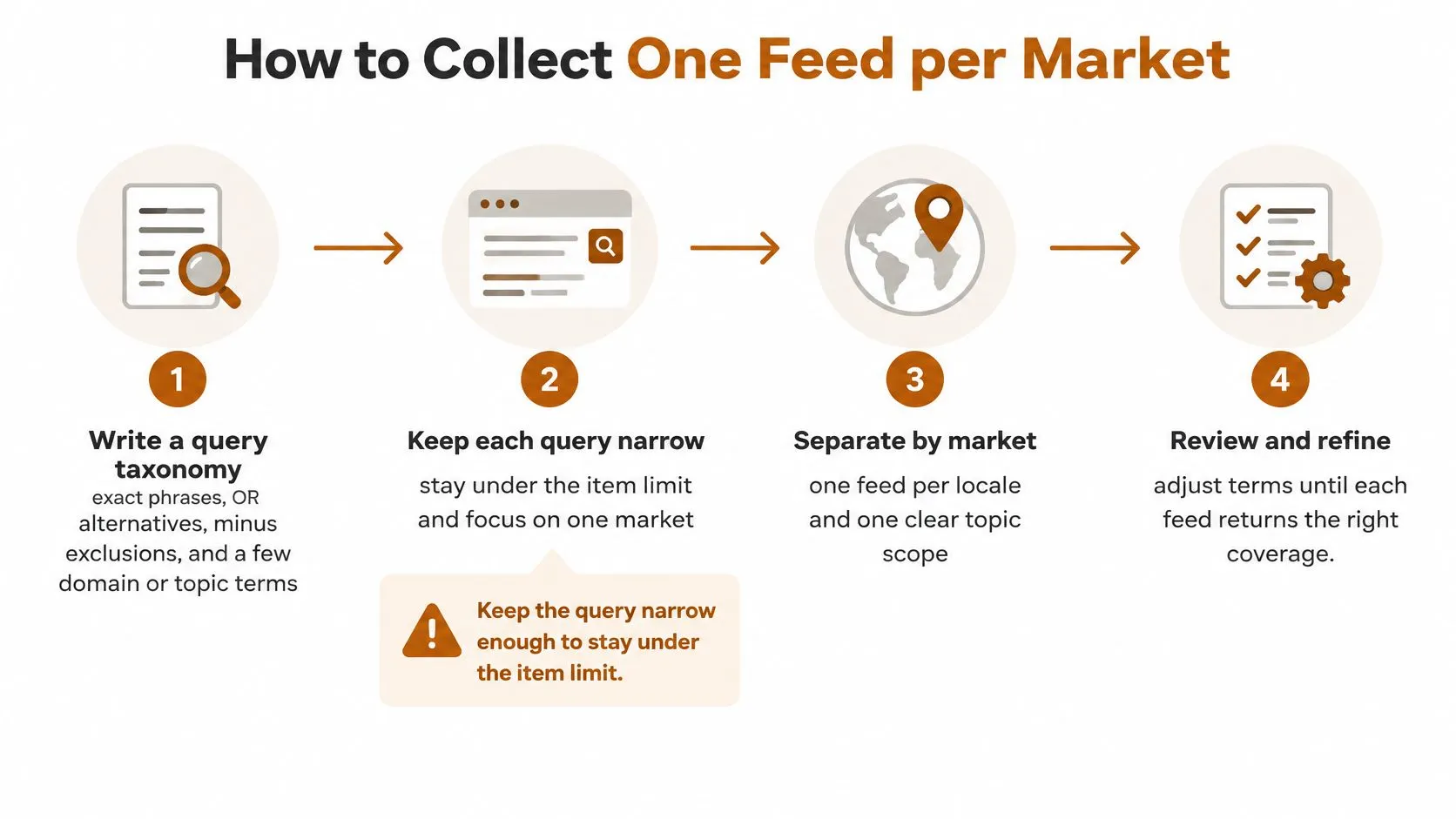
Build requests from a saved query specification, not from strings assembled inside a scheduler. The specification should identify the topic, market, language, exclusions, and collection window so another operator can reproduce the request.
Build the collection run
-
Write a query taxonomy. Separate brand names, product names, and industry topics. Use quoted phrases for exact names,
ORfor alternatives, and minus exclusions for recurring ambiguity. Multi-term searches generally behave as conjunctions, so test whether adding a term excludes useful coverage rather than merely improving relevance. -
Generate a request for each market and language. URL-encode the query with a standard library such as Python’s
urllib.parse.urlencode. Store the exact request URL in the run manifest, together with the readable query specification. -
Partition publication time. Add
after:andbefore:boundaries, then schedule overlapping collection windows. Don’t assume sub-day boundary precision unless you’ve verified the endpoint’s behavior; use explicit date boundaries and apply finer timestamp filtering after parsing. Overlap protects against boundary interpretation and delayed discovery, but it isn’t evidence of complete retrieval. -
Fetch and parse XML. Use an HTTP client such as
httpxand an XML parser such asdefusedxml. Map feed fields into a schema containingtitle,publisher,published_at,google_news_url, andretrieved_at. Preserve missing values rather than inventing an author or publication time. -
Normalize time and retain the input. Convert valid timestamps to UTC while keeping the original timestamp string. Store the raw XML as a run artifact and reference it from parsed sightings, rather than copying the entire payload into every row.
-
Write the run manifest. Record query, locale, retrieval time, parser version, schema version, response status, item count, and raw-artifact location. Distinguish a valid empty feed from a failed request or malformed XML response.
Locale parameters for each feed request
| Parameter | Controls | Setting rule |
|---|---|---|
q | Terms and operators | Exact phrases, OR alternatives, and minus exclusions from the taxonomy |
hl | Interface language | Set per locale, for example en-US |
gl | Geographic edition | Country code matching the target market |
ceid | Country-language edition | One pair per market and language, stored with the run |
For a hypothetical brand called Northstar Bikes, configure an English-language US feed and an English-language UK feed. Use hl=en-US, gl=US, and ceid=US:en for the US request; use the corresponding UK settings for the other request. Locale settings guide collection, but they don’t replace language validation.
Suppose your scheduler evaluates two overlapping six-hour slices. Fetch the applicable date-bounded feeds, then filter parsed publication timestamps into those slices locally. Keep sightings returned in both runs: tomorrow’s response is a newly ranked result set, not a continuation page, and the duplicate sightings are useful evidence for the matching stage.
Canonical URLs and Story Deduplication
Every extracted row starts as a sighting, not a unique article. A sighting records that a particular query and edition returned a headline at a particular retrieval time. Article identity and story identity belong in separate records.
That distinction prevents an aggressive deduplication job from deleting the evidence needed to explain regional visibility. An article can appear in several feeds, while several independently written articles can describe the same event.
Match exact identity before similarity
Resolve the stored article reference through an approved URL-resolution process. Remove known tracking parameters, preserve parameters that identify content, and follow redirects with a bounded redirect policy. When publisher-page access is in scope, prefer a valid article canonical URL, but reject a canonical that unexpectedly points to a homepage or unrelated domain.
Use canonical URL plus normalized publisher identity for exact article matching. Keep both the original Google News URL and the resolved publisher URL: the former documents discovery, while the latter identifies the destination.
Title similarity should come later. Lowercase titles, normalize whitespace, and remove punctuation for comparison, but retain the original text. The implementation details in normalizing scraped data with Python are useful for keeping those transformations consistent and testable.
- Exact article match: Attach a new sighting to the existing article record.
- Likely syndication: Compare title similarity alongside publisher family, wire attribution where available, and publication-time proximity.
- Related coverage: Assign a shared story cluster without merging independently authored articles.
- Uncertain match: Preserve separate records and queue the pair for review.
Preserve what a merge cannot recover
A changed headline isn’t sufficient reason to create a new article or discard an old sighting. Update the article’s current headline and retain prior headlines in history. Similarly, don’t replace the original publication time with a later update time unless your schema distinguishes them.
Handle non-article destinations explicitly. Homepages, topic pages, PDFs, and error pages need classification rather than silent deletion. A wire story with a locally written introduction may belong in the same story cluster while remaining a distinct publisher article.
Merge article identity when the evidence supports it. Preserve coverage identity even after the merge.
Keep locale, query_id, retrieved_at, original_title, and the original URL on every sighting. Store the match method and matching-rule version as well, so an operator can reverse a bad merge without recollecting the news.
Rate Limits and What You May Keep
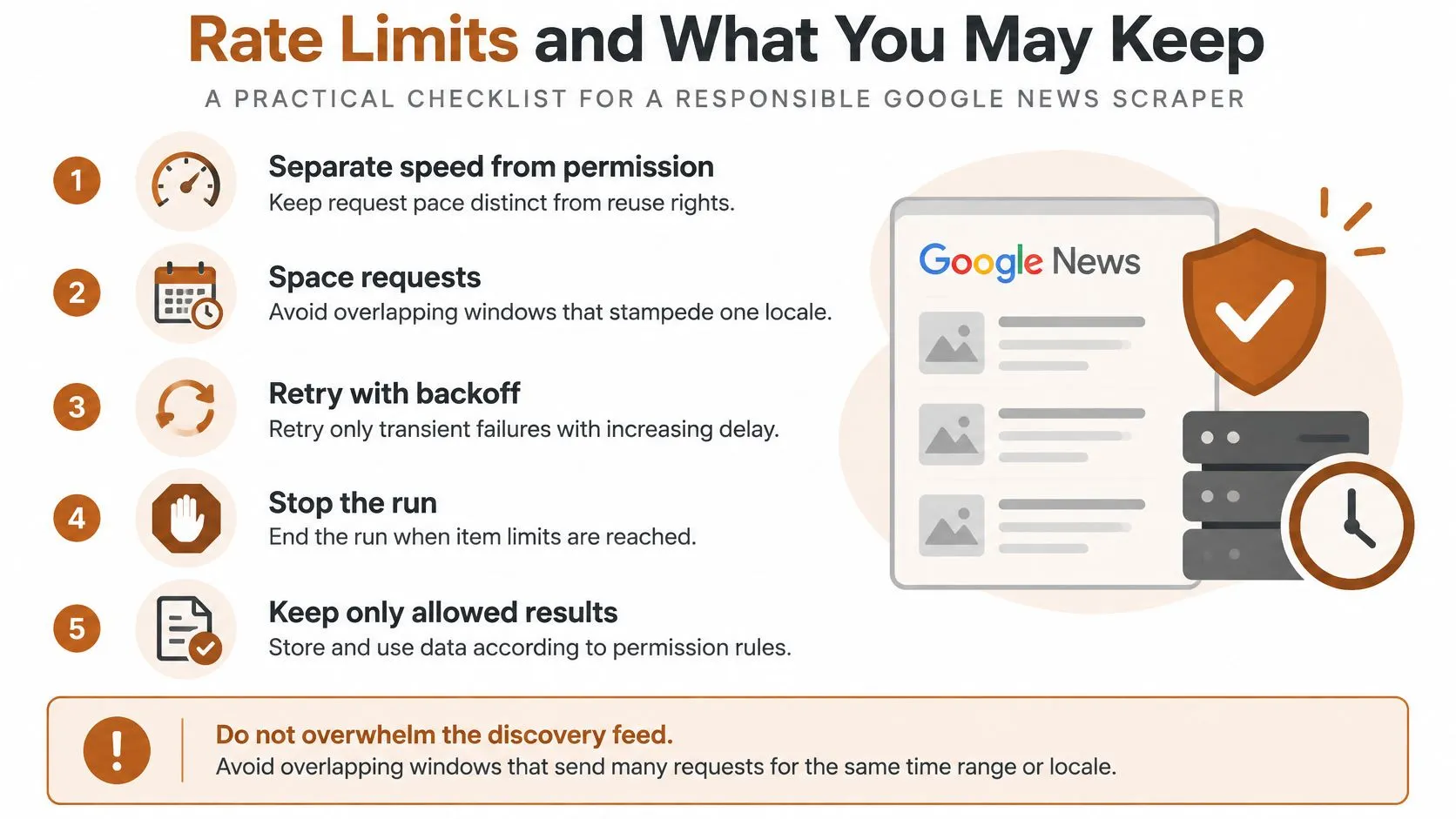
Request speed and reuse permission are separate controls. A successful response doesn’t authorize republication, and a slow request schedule doesn’t establish a lawful basis for storing article bodies.
Google’s publisher guidance on scraped content describes automated copying of substantial material, including reproduction through synonym replacement, and addresses copies that take all or nearly all of a work without clear added value. Treat that as a warning against substitute articles, not as a complete legal test for every jurisdiction or use.
Control traffic without inventing a quota
Space feed requests so overlapping jobs don’t launch against the same locale simultaneously. Retry transient network and server failures with increasing delay, honor retry instructions when present, and cap retries. Don’t turn authorization failures or persistent blocking into an escalation loop.
For queue design and backoff patterns, the guidance to manage API requests with Scrappey provides useful operational context. Apply those patterns to scheduling, not as permission to evade access restrictions.
Pause a locale’s run when its item count collapses unexpectedly and inspect the response. A saturated result window calls for narrower collection scope, not repeated identical requests.
Map storage to intended use
| Intended use | Narrow starting payload | Required decision |
|---|---|---|
| Internal monitoring | Query, locale, title, publisher, URL, publication and retrieval times | Establish applicable terms, lawful basis, and retention |
| Redistribution to clients | Approved metadata with attribution | Verify redistribution rights and contractual restrictions |
| Public snippet display | Only approved excerpts and source references | Review display rights, attribution, and jurisdiction |
| Model training | Only content approved for that purpose | Review source permissions, licensing, privacy, and downstream use |
This is a review matrix, not a blanket allowance. Feed availability isn’t a license to copy linked articles. Following a discovery link into a publisher site creates a separate collection operation subject to that site’s applicable terms, robots rules, and content rights.
Set retention for parsed rows, raw XML, caches, and backups. Don’t delete the visible table while retaining the same restricted content indefinitely in object storage. For article-body projects, ethical article scraping practices provide a useful framework for documenting source-specific decisions.
The easiest browser scrape is often the least durable design because it combines discovery, presentation parsing, and content reuse without clear boundaries.
LLM Fields, Schedules and Delivery
LLM parsing belongs downstream of an approved publisher-text collection step. A model should never expand a Google News snippet into a replacement article or infer an author, timestamp, or quotation that the source page does not explicitly provide.
Define the output contract before processing pages. A useful article schema includes canonical_url, headline, dek, author, published_at, language, and either body or an approved short extract, together with schema_version and parser_version. Keep field-level provenance so downstream reviewers can separate publisher-authored text from model-derived labels.
Extract facts deterministically first
Read URLs, structured metadata, and explicit timestamps with deterministic parsers before asking a model to interpret template-dependent fields. BeautifulSoup or lxml can isolate the main article container; the model can then identify a dek or distinguish article text from an embedded promotion.
Constrain the task, permit null values, and treat page content as untrusted input rather than instructions. Validate every response against a JSON Schema before storage.
- Reject unresolved destinations: Mark the article fetch as failed without deleting its discovery sighting.
- Quarantine language mismatches: Compare detected article language with the collection policy and document multilingual exceptions.
- Separate extraction from enrichment: Keep topics, entities, and sentiment outside fields presented as publisher-authored facts.
- Version contract changes: Require an explicit migration when adding a required field or changing timestamp semantics.
A syntactically valid model response is still capable of returning navigation text, subscription prompts, or unrelated recommendations as article content. Check the extracted body against the publisher container before accepting the record.
Schedule discovery and bodies independently
Discovery jobs should refresh independently of article-body jobs. Queue body work by stable article identity so repeated RSS sightings do not trigger repeated downloads, then pace requests separately for each approved source.
Publisher ingestion freshness does not establish the polling rate for search RSS. It also does not guarantee that a query will surface every newly published article. Set discovery frequency from observed feed behavior, collection windows, and the acceptable lag for each locale.
Deliver changes rather than repeatedly exporting all history. Inserts-only delivery suits immutable sightings, while article updates need an operation type or a diff tied to a stable article identifier. CSV and JSON Lines feeds can run daily, weekly, or hourly with a versioned schema; diffs and inserts-only formats keep recurring deliveries smaller and easier to reconcile.
For CSV, define escaping, null representation, and timestamp formatting. For JSON Lines, validate each record independently and include a delivery manifest. Object-storage drops should use immutable batch names, while signed webhooks need retries and idempotency keys.
Each downstream batch needs a schema version, collection window, and explicit completion status. A failed body extraction should remain visible as a status on the related article record rather than making the discovery event disappear.
Prove Coverage Instead of Counting Rows
An item-count dashboard can stay green while your dataset becomes less useful. A parser can successfully extract irrelevant results, repeatedly collect syndicated copies, or overrepresent an outlet favored in a particular edition.
An academic Google News collection across 81 region-language combinations produced 1,482 validated records after a 56% noise reduction, while reporting temporal instability, a roughly 100-result query cap, false positives, irrelevant PDFs, and inappropriate SEO-driven inclusions. Those findings support treating Google News as a discovery signal, not a complete news corpus.
Validate before declaring coverage
Collect comparison locales within the same operational window to reduce ranking drift. Filter publication dates and language, then apply deterministic topical rules before sending ambiguous records to an ML classifier or LLM adjudicator. Confirm that destinations are actual articles, apply article and story matching, and manually inspect borderline decisions.
Track precision, duplicate rate, empty-feed rate, timestamp lag, and yield per locale. Define each denominator: precision requires a reviewed sample, while duplicate rate should distinguish repeated sightings from redundant articles. Add publisher concentration so a seemingly healthy locale cannot conceal dependence on a narrow source set.
Coverage signals worth alerting on
| Signal | Reference point | Alert when |
|---|---|---|
| Items per query window | Observed query ceiling and recent comparable runs | Far below baseline or pinned at capacity for a broad query |
| Noise after validation | The collection study’s substantial filtering requirement | Irrelevant, PDF, or non-article share jumps |
| Empty feeds | A locale that recently returned rows | A market goes to zero while others stay healthy |
| Duplicate rate | Syndicated copies and repeated article identities | The same canonical URL floods a window |
| Timestamp lag | Publication time versus retrieval time | Lag widens against the trailing baseline |
| Publisher concentration | Share of rows from leading sources | One publisher dominates a locale beyond its accepted baseline |
Set operational thresholds from your own reviewed baseline, not from the study’s filtering rate. Page an operator on invalid required fields or broken XML parsing; investigate distribution changes against comparable query, locale, and schedule histories. During a major event, an item-count jump may be genuine, so preserve the response before changing filters.
Use data quality monitoring tools to connect alerts to affected runs and artifacts. An alert without the query, locale, parser version, and raw response leaves the operator guessing.
More requests can measure a ranking system more precisely without making the resulting news sample more representative.
Compare reviewed samples against publisher feeds or an independent news index. Document known gaps and source concentration before using the dataset for high-stakes research or cross-market comparisons.
Keep the Pipeline or Hand It Off
Keep the pipeline in-house when the query list is short, the output is metadata only, and someone owns empty-feed alerts and schema failures. A team tracking a brand in English-language US and UK editions with a weekly review can reasonably maintain a small script.
Consider a different hypothetical workload: forty markets, multiple languages, approved body text due hourly, and separate policies for each publisher. At that point, the decision to outsource web scraping is about operational ownership, not whether your engineers can write an XML parser.
Decide who owns failures
- Keep it: A named engineer can review coverage, maintain matching rules, and repair failed deliveries without displacing core work.
- Hand it off: Source-policy tracking, language validation, and parser repairs have become a recurring on-call responsibility.
- Define the boundary: Public availability doesn’t remove the need for access-policy checks or legal review.
At WebscrapingHQ, we only scrape publicly available data, respect robots.txt where applicable, and advise clients up front when additional legal review is needed. We provide recurring CSV/JSONLines feeds with versioned schemas on daily, weekly, or hourly schedules, with diffs and inserts-only formats available.
Write a brief containing the query list, locales, fields, source permissions, retention rules, delivery schedule, and alert thresholds. Assign an owner to each failure condition, then either implement that brief internally or use it to scope a managed operation.
WebscrapingHQ builds and runs managed news-data pipelines with recurring structured delivery, so your team doesn’t have to own every feed failure and publisher-template change. Visit WebscrapingHQ with your queries, target locales, required fields, and delivery schedule to scope a Google News discovery pipeline and any separately approved article-text collection.
Want this done for you?
Send us the URLs. We'll quote it in 24 hours.
Paste the URL(s) you want scraped. We'll reply within 24 hours with a feasibility check and a ballpark quote.