Jump to section
- 1. WebscrapingHQ
- Best suited to recurring, specialized outputs
- 2. Bright Data
- Strong infrastructure, more catalog complexity
- 3. Oxylabs
- A good fit for control and experimentation
- 4. Zyte
- Predictable pilots, less public detail for managed work
- 5. Grepsr
- Accessible for pilots, still scope-dependent
- 6. PromptCloud
- Strong fit for zero-maintenance programs
- 7. ScrapeHero
- Useful separation between pilots and bespoke work
- Top 7 Financial Data Scraping Services Comparison
- Turn the Shortlist Into a Defensible Purchase
The right financial data scraping service isn’t the one with the largest proxy network. That popular advice confuses infrastructure with an operating model. A finance team needs recurring source coverage, clear ownership of maintenance, reliable schemas, quality controls, integrated delivery, compliance review, and a realistic view of total operating effort. Proxy capacity matters only after those requirements are defined.
That distinction matters because finance is already one of the largest demand centers for structured extraction. Banking, financial services, and insurance represented 29.40% of the web scraping market in 2025, according to Mordor Intelligence’s web scraping market analysis. The market is also moving quickly, with 67% of U.S. investment advisers’ alternative-data programs supported by web scraping, a figure that rose by 20 percentage points during 2024, according to the same source.
This comparison evaluates seven providers against source coverage, scale, reliability, anti-bot strategy, output formats, compliance considerations, use-case fit, and engagement model. It includes WebscrapingHQ alongside API-led products and managed-service alternatives. Prices, certifications, and capabilities should still be verified during procurement because target difficulty, geography, frequency, and output requirements can materially change the final offer. For broader context on how financial language patterns can reveal market signals, see this discussion of market signals from language patterns.
1. WebscrapingHQ
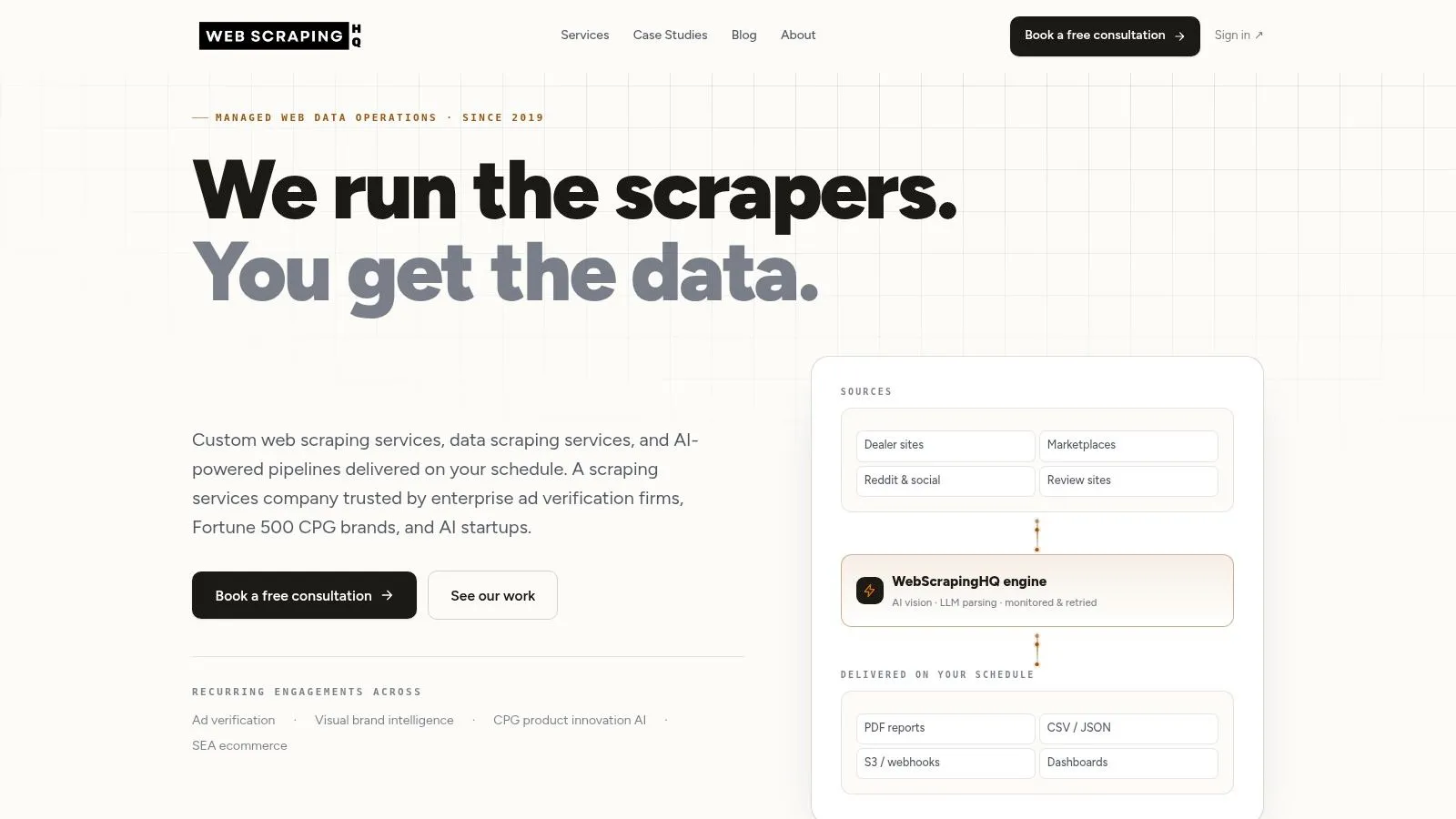
WebscrapingHQ fits buyers procuring a managed financial data operation rather than another component for an internal engineering backlog. Established in 2019, the provider designs, builds, runs, and maintains custom pipelines for enterprise and growth-stage teams. Its documented scope includes handling site changes, CAPTCHA challenges, proxy management, retries, parsing, normalization, monitoring, and scheduled delivery.
The buying distinction is operational ownership. A self-serve API gives engineers tools to retrieve pages. WebscrapingHQ manages the work of converting difficult sources into a repeatable feed or reporting workflow. Its stack combines computer vision, LLM-based parsing, proxy and anti-bot management, and schema versioning. Those capabilities suit financial material published in inconsistent layouts, PDFs, screenshots, investor-relations pages, and image-heavy documents.
Best suited to recurring, specialized outputs
Relevant applications include stock-market workflows and extraction from Yahoo Finance, Bloomberg, Finviz, PitchBook, Morningstar, and Seeking Alpha. Delivery options include CSV and JSON feeds, webhooks, S3 drops, dashboards, and AI-audited PDF reports. That range lets procurement teams connect collection with analytics, machine learning, compliance, or human review systems.
WebscrapingHQ cites Fortune 500 retail and ad-verification work, including approximately 1,680 dealer compliance reports per month for a U.S. verification bureau, according to its publisher information. Supplied company data also describes multi-geo and multi-language pipelines across 20+ geographies. Recurring engagements start at roughly USD 500 per month. Custom scopes require intake and feasibility review before quotation.
Procurement implication: Choose WebscrapingHQ when internal maintenance, schema drift, document review, and exception handling matter more than letting developers operate each request.
The trade-off is engagement overhead. Buyers seeking immediate, self-directed experimentation may prefer an API-led provider, although WebscrapingHQ offers free Apify actors for lighter use cases. Custom work requires scoping and setup, and its site does not list third-party awards or certifications. Request current security documentation, SLA definitions, permitted-use guidance, sample outputs, and incident procedures. Its GDPR-compliant web scraping guide provides practical compliance guidance.
2. Bright Data
Bright Data operates across both sides of the buying decision. Its Managed Data Acquisition service provides scoping, scraper development, maintenance, validation, and delivery, while its broader catalog includes scraper APIs, datasets, Scraper Studio, and a dataset marketplace. That breadth makes it attractive to financial teams that may begin with an existing dataset and later require a custom recurring pipeline.
For finance, likely applications include monitoring rates and fees, lending and card offers, investor-relations pages, earnings calendars, financial news, broker promotions, exchange venues, and alternative-data sources. The managed model is useful when a buyer wants a project team to translate business requirements into collection logic, validate the result, and deliver data through an agreed integration rather than asking internal engineers to assemble those pieces.
Strong infrastructure, more catalog complexity
Bright Data’s published product structure supports custom pipelines, APIs, datasets, multiple delivery formats, webhooks, and enterprise-oriented documentation. Its large global IP infrastructure and anti-bot capabilities are relevant when sources vary by geography or resist repeated automated access. The company also publishes trust and security materials, including SOC-related documentation, which can shorten early compliance conversations.
The operating-model trade-off is complexity. A buyer may need to choose among an off-the-shelf dataset, a scraper API, Scraper Studio, or Managed Data Acquisition. Those options aren’t interchangeable. A dataset can accelerate a pilot, while a bespoke pipeline may be necessary for unusual fields, historical snapshots, or strict schema requirements. Scope expansion can also increase costs, so the statement of work should define source lists, page types, refresh schedules, retries, enrichment, validation, and storage responsibilities.
Bright Data publishes managed-service pricing tiers, which can help with initial budgeting. Still, published tiers don’t eliminate the need for a target-specific assessment. A difficult exchange page and a straightforward investor-relations page can create very different operational requirements. Buyers should ask which costs are driven by requests, bandwidth, browser rendering, managed engineering, or data volume, and how failed or repeated attempts are billed. Its managed web scraping approach offers a useful comparison point for teams deciding whether to outsource maintenance entirely.
3. Oxylabs
Oxylabs is primarily an API-led scraping platform with enterprise programs, not a conventional end-to-end data operations partner. Its Web Scraper API combines automatic unblocking, proxy rotation, CAPTCHA handling, JavaScript rendering, and structured JSON outputs. The provider also presents a financial-data pathway that can help teams validate finance sources without designing every browser and proxy component themselves.
This model fits engineering-led organizations collecting prices, market signals, broker information, and alternative data across anti-bot-heavy pages. Residential, ISP, and datacenter proxy options give developers control over how they approach different target classes. Headless browser support matters when a page’s useful content appears only after scripts execute, while structured parsing reduces the need to build a separate extraction layer for common page types.
A good fit for control and experimentation
Oxylabs publishes API pricing and enterprise tiers, and its developer tooling, examples, and trials make target validation more accessible than a fully custom managed engagement. That makes it practical for a team that already owns orchestration, storage, monitoring, schema validation, and downstream quality checks. The provider’s strongest buying case is therefore not just scale. It’s engineering control with infrastructure support.
The cost is operational responsibility. A pay-as-you-go request model can become difficult to govern on targets that trigger repeated retries, browser rendering, or frequent unblocking attempts. The procurement team should model successful and unsuccessful requests separately, then test how costs behave when a source changes. It should also clarify whether bespoke extraction, normalization, historical backfills, and ongoing maintenance are included or require a partner or custom arrangement.
Oxylabs is less suitable when the finance team wants a finished feed with minimal internal ownership. It can supply the collection layer, but buyers may still need to build field-level quality controls, anomaly alerts, delivery guarantees, and change-management processes. Before selecting an API-led approach, compare its responsibilities with the difference between web scraping and an API, especially when the required information is narrative, visual, or embedded in irregular documents.
4. Zyte
Zyte uses a hybrid model that combines managed data delivery through Zyte Data with a request-based Zyte API. The API handles automatic proxying, browser rendering, and AI-assisted extraction, while the managed service can support persistent feeds where the customer doesn’t want to operate each crawler directly. Scrapy Cloud and Zyte’s developer ecosystem add another path for teams that want to build some workflows internally and outsource others.
That flexibility makes Zyte relevant to alternative-data programs covering investor-relations pages, jobs and careers signals, product intelligence, pricing, business listings, and other public sources. AI-assisted extraction can help when the same entity appears across different page layouts, although financial buyers should validate field accuracy against representative documents rather than assuming that a common entity model will fit every source.
Predictable pilots, less public detail for managed work
Zyte’s request-based pricing is organized by site and tiered request complexity, with a visible pricing calculator. That is useful for low-volume pilots because the buyer can estimate an initial collection pattern before negotiating a larger managed program. It also supports a pay-for-success style of evaluation, where the team can test whether the target produces usable records before committing to a broad custom build.
The limitation is the split in transparency. API pricing is easier to inspect, while Zyte Data’s availability, scope, and commercial details are sales-scoped. Heavy browser targets may also become more expensive under request-based pricing than under a model based primarily on bandwidth or infrastructure consumption. The right comparison requires a sample run that includes rendering, extraction, failed requests, retries, and the final delivery format.
For a finance team, Zyte is strongest when the roadmap includes both developer experimentation and eventual managed delivery. It is less compelling if the buyer wants a fully bespoke schema, document-specific quality review, and a single accountable operator from day one without a separate scoping process. A broader comparison of online web scraping services can help frame that managed-versus-API decision.
5. Grepsr
Grepsr combines a concierge managed service with an account-facing platform. The provider handles extraction, recurring maintenance, dynamic pages, CAPTCHA and anti-bot issues, delivery, and support, while customers receive visibility into project and delivery status. This is a middle position between a fully outsourced pipeline and a purely self-serve API.
The model can suit financial and alternative-data teams tracking public-company prices, marketplace signals, branch and location information, or sector-specific datasets. Its value is strongest where the source list is broad enough to require maintenance, but the buyer still wants an accessible operational view rather than a black-box feed.
Grepsr supports CSV, JSON, Parquet, and XML outputs, along with downstream delivery options. Those formats matter in procurement because a source that looks inexpensive at collection time can create avoidable transformation work later. Parquet may fit analytical warehouses, JSON may suit application integrations, and CSV or XML may remain necessary for legacy review and exchange processes.
Accessible for pilots, still scope-dependent
The company publishes starter pricing, which can make initial pilot planning easier than fully quoted managed providers. Its plan emphasizes recurring jobs, responsiveness, and reliability, supported by account management and higher-touch enterprise options. Buyers should still test the actual target set because public starter prices don’t establish the cost of high-frequency collection from protected financial pages.
Grepsr’s weakness is product specificity. Compared with providers that market financial-data APIs or domain accelerators, it offers fewer publicly described finance-specific shortcuts. That isn’t necessarily a technical limitation, but it means the buyer must establish feasibility through samples and ask detailed questions about source coverage, field normalization, historical data, and anti-bot escalation.
A sensible Grepsr evaluation would include one stable investor-relations source, one JavaScript-heavy page, and one source with changing layouts. Review not only whether records arrive, but whether missing fields are labeled, schema changes are announced, anomalies are surfaced, and failed collections are replayed. That test reveals whether the platform is a genuine operating layer or just a convenient delivery dashboard around a custom project.
6. PromptCloud
PromptCloud is built for buyers who want a fully managed enterprise pipeline with explicit program management. Its engagement model covers scoping, crawler development, anti-bot handling, ongoing maintenance, schema design, quality assurance, anomaly detection, and delivery to customer endpoints. The provider explicitly positions finance and investment use cases around risk and event monitoring, pricing intelligence, and revenue intelligence.
That outcome-oriented model changes the procurement conversation. The buyer doesn’t need to compare proxy features in isolation. Instead, it can define the business output, such as a monitored event feed or normalized pricing dataset, then evaluate whether PromptCloud can meet the required schema, freshness, validation, and escalation terms.
Strong fit for zero-maintenance programs
PromptCloud provides pilot or sample delivery before full activation, which is important for financial data because a technically complete extraction can still be analytically unusable. A sample should show how the provider handles missing values, duplicate records, amended documents, date formats, currency fields, and changes to page structure. Anomaly detection is particularly relevant when a sudden empty result may indicate a broken scraper rather than a genuine market event.
The provider describes ISO 27001 and GDPR-aligned practices, which can help with compliance discussions, but buyers should request the current documentation and determine whether it applies to the specific service, location, subprocessors, and data flows in scope. Compliance-friendly positioning isn’t a substitute for reviewing permitted collection, retention, access controls, and downstream use.
PromptCloud doesn’t publish a fixed price table. Every project is quoted after scoping, so procurement needs a precise requirements document before comparing proposals. Include target domains, fields, geography, collection frequency, historical requirements, output destination, retention, quality thresholds, and incident response. PromptCloud is a strong candidate when the internal team wants to avoid scraper maintenance entirely. It is a weaker fit for developers seeking a low-friction API with granular, usage-based control.
7. ScrapeHero
ScrapeHero combines managed crawling, custom APIs, and productized Cloud scrapers. That combination is useful when a finance or market-intelligence team needs to move quickly on common sources but expects more specialized pipelines for protected, dynamic, or unusual targets. A Cloud scraper can support a pilot, while a managed engagement can handle infrastructure, proxies, monitoring, and quality assurance for recurring work.
Potential applications include competitive price tracking, branch and ATM intelligence, marketplace signals, and scheduled alternative-data collection. The provider’s public pricing across on-demand, business, and enterprise plans gives buyers a clearer starting point for budgeting than a fully bespoke service. It also supports enterprise procurement and compliance workflows, though the details still need to be confirmed for the selected project.
Useful separation between pilots and bespoke work
ScrapeHero’s main advantage is the ability to combine ready-made scrapers with custom delivery. That can shorten the path from question to sample for familiar domains. It also gives stakeholders something tangible to review before funding a larger managed pipeline.
The trade-off is pricing geometry. Page-based pricing may be easy to understand for straightforward sources, but it may not represent the true cost of highly dynamic financial pages that require browser rendering, repeated retries, or specialized post-processing. High-frequency or heavily protected jobs may move into enterprise brackets, so the initial public price should be treated as a budgeting reference rather than a final estimate.
Buyer test: Ask for the price and delivery behavior of the same difficult target under both a Cloud scraper and a managed custom scope. The difference will show whether speed, control, or maintenance ownership matters more for your use case.
ScrapeHero is a sensible choice for teams that value transparent entry points and a blended rollout. It may be less suitable when every record requires a specialized schema, visual interpretation, compliance artifact, or tightly governed change process. For a wider view of managed providers, compare the selection principles in this guide to top-rated web scraping services.
Top 7 Financial Data Scraping Services Comparison
| Vendor | Implementation complexity | Resource requirements | Expected outcomes | Ideal use cases | Key advantages |
|---|---|---|---|---|---|
| WebscrapingHQ | Low for buyer (fully managed); short scoping/setup | Recurring paid engagements (starts ~USD 500/mo); vendor handles proxies/CAPTCHA | Schema-versioned structured feeds, AI-audited PDFs, image intelligence, SLA-backed deliveries | Enterprise e‑commerce/product intelligence, compliance reporting, multi-geo pipelines | AI + computer-vision extraction, handles site changes/CAPTCHA, flexible delivery formats |
| Bright Data (Managed Data Acquisition) | Medium–high: managed option but broad catalog requires scoping | Published managed tiers; large IP pool and anti-bot infra; costs can grow with scope | SLA-backed, validated data pipelines and off-the-shelf datasets/APIs | Recurring financial data pipelines, alt-data programs, large-scale acquisition | Extensive proxy network, enterprise compliance docs, dataset marketplace |
| Oxylabs | Medium: API-first developer integration; partner-managed for bespoke work | Pay-as-you-go API, broad proxy choices (residential/ISP/datacenter), headless browser support | Structured JSON outputs with automatic unblocking; reliable at scale for monitoring | Price monitoring, market/alt-data, anti-bot-heavy exchange/broker pages | Transparent API pricing, strong proxy network, developer tooling & examples |
| Zyte | Medium: hybrid managed Zyte Data + request-based API; per-site setup | Per-site tiered pricing with calculator; browser rendering and AI-assisted extraction | Persistent feeds or request-based results with predictable per-site cost | Persistent finance feeds, IR/job signals, low-volume pilots | Granular per-site pricing, Scrapy Cloud ecosystem, AI-assisted extraction |
| Grepsr | Low–medium: concierge managed service plus self-serve platform | Starter pricing available; vendor handles dynamic sites, proxies, CAPTCHA; 24/7 support | Recurring deliveries, delivery monitoring dashboard, multiple output formats | Product/price tracking, marketplace signals, location/POI datasets | Managed service with delivery monitoring and responsive support |
| PromptCloud | Low for buyer: fully managed, outcome-based engagements | Sales-scoped pricing; ISO 27001 / GDPR-aligned practices; pilot/sample available | SLA schedules, anomaly detection, outcome-focused deliveries | Finance & investment monitoring, risk/event detection, stakeholders needing zero maintenance | Outcome-driven pipelines, compliance certifications, SLA-backed operations |
| ScrapeHero | Low–medium: mix of full managed crawling and ready-made Cloud scrapers | Transparent pricing tiers for on-demand and recurring; handles infra/proxies/QA | Scheduled/periodic feeds and one-off exports; faster pilots via Cloud scrapers | Competitive price tracking, branch/ATM/POI intelligence, scheduled analytics feeds | Transparent pricing, hybrid managed + off-the-shelf scrapers for rapid pilots |
Turn the Shortlist Into a Defensible Purchase
A defensible purchase starts with a source inventory, not a vendor demo. List every domain and page type, the fields required, the relevant geographies, the update frequency, the freshness target, acceptable failure behavior, retention period, and delivery destination. Separate structured market data from narrative material, PDFs, screenshots, investor-relations pages, news, and alternative signals. Those categories may require different rendering, parsing, validation, and legal treatment.
Ask each shortlisted provider for a representative sample using the actual sources that matter. Include difficult pages, not only clean examples. Test JavaScript rendering, pagination, document parsing, regional variants, missing fields, duplicate records, amended disclosures, and layout changes. A sample should also show timestamps, source identifiers, schema behavior, and how the provider communicates uncertainty.
Practical rule: Compare the cost of usable data, not the cost of an individual request.
The total cost includes retries, proxy or browser consumption, normalization, quality assurance, enrichment, storage, alerting, incident response, and internal maintenance. An API can look inexpensive until engineers must rebuild parsers after a redesign. A managed service can carry a higher quoted fee while reducing the operational burden. A hybrid model may offer the best balance when common sources support a fast pilot and bespoke pipelines handle specialized outputs.
The market context supports taking this evaluation seriously. The global web scraping market was valued at USD 1.34 billion in 2025 and is estimated to reach USD 1.56 billion in 2026, with a projection of USD 3.49 billion by 2031 at a 17.39% CAGR, according to Mordor Intelligence. A separate data extraction market report values the broader market at USD 5.287 billion in 2024 and projects USD 28.48 billion by 2035, while identifying financial services as the largest segment in its cited period. The implication is practical: finance buyers are choosing an operating capability, not a temporary scraping experiment.
Before signing, document permitted collection, contracts, privacy controls, retention, access rights, downstream use, and responsibility for source-specific restrictions. Then ask every vendor:
- SLA measurement: Is success measured by delivery punctuality, field completeness, source availability, or another agreed metric?
- Schema versioning: How are field changes documented, tested, announced, and rolled back?
- Anomaly alerts: Will the system flag empty pages, abnormal record counts, unexpected formats, and sudden value changes?
- Anti-bot escalation: What happens when proxies, browser rendering, retries, or CAPTCHA handling stop working?
- Output formats: Can the provider deliver the required CSV, JSON, Parquet, XML, PDF, webhook, S3, API, or dashboard output?
- Incident response: Who is notified, what is the response process, and how are missed deliveries recovered?
- Exit terms: Can you export schemas, historical data, configurations, and documentation if you migrate?
Choose managed delivery when reliability and maintenance ownership matter most. Choose API-led tooling when engineering control and rapid experimentation dominate. Choose a hybrid model when productized sources can accelerate validation while managed pipelines produce the specialized, governed outputs your finance workflow needs.
WebscrapingHQ provides managed financial data scraping services that turn difficult public sources, dynamic pages, PDFs, and visual documents into structured feeds and scheduled reports. If your team needs schema controls, anti-bot handling, multi-geo collection, and delivery through CSV, JSON, webhooks, S3, or dashboards without maintaining the scraping infrastructure, visit WebscrapingHQ to discuss a representative scope.
Want this done for you?
Send us the URLs. We'll quote it in 24 hours.
Paste the URL(s) you want scraped. We'll reply within 24 hours with a feasibility check and a ballpark quote.