
Jump to section
- Table of Contents
- Why UAE Businesses Are Scaling Automated Data Collection
- Manual monitoring breaks down fast
- What a good pipeline actually delivers
- Key Data Fields and Metadata for UAE Commerce Intelligence
- Core fields that actually drive decisions
- Metadata is where hyperlocal intelligence starts
- Schema discipline prevents downstream friction
- Comparing Data Collection Methods for UAE Platforms
- Side-by-side trade-offs
- Where each method falls short
- How to choose without overbuilding
- Technical and Legal Challenges in UAE Web Scraping
- Anti-bot controls that cause trouble
- Legal boundaries are narrower than many teams assume
- Production teams separate access from usage
- Building Reliable Scheduled Extraction Pipelines
- Cadence has to match volatility
- Validation catches drift before the business does
- Operational controls keep feeds usable
- The Case for Managed Web Data Operations
- Evaluating and Engaging a UAE Scraping Service Provider
- What to check before signing
- How to structure a pilot
If you’re running retail, marketplace, or quick-commerce analytics in the UAE, you already know the routine. Someone on the team opens Noon, Amazon.ae, Carrefour, Talabat, Instashop, or Lulu, checks a handful of products, captures delivery notes by hand, and then discovers the price changed again before the spreadsheet was even shared. That gap between what’s live on the screen and what your team can act on is exactly where web scraping services UAE become operationally useful.
For UAE businesses, the issue is rarely access to data in the abstract. The issue is keeping hyperlocal commerce feeds fresh enough to support pricing, promotion, and fulfillment decisions without building a small army of manual checkers. The most durable setup turns unstable public pages into structured feeds that can be refreshed on schedule, matched across platforms, and handed off to analysts or systems without constant cleanup.
Table of Contents
Open Table of Contents
- Why UAE Businesses Are Scaling Automated Data Collection
- Key Data Fields and Metadata for UAE Commerce Intelligence
- Comparing Data Collection Methods for UAE Platforms
- Technical and Legal Challenges in UAE Web Scraping
- Building Reliable Scheduled Extraction Pipelines
- The Case for Managed Web Data Operations
- Evaluating and Engaging a UAE Scraping Service Provider
Why UAE Businesses Are Scaling Automated Data Collection
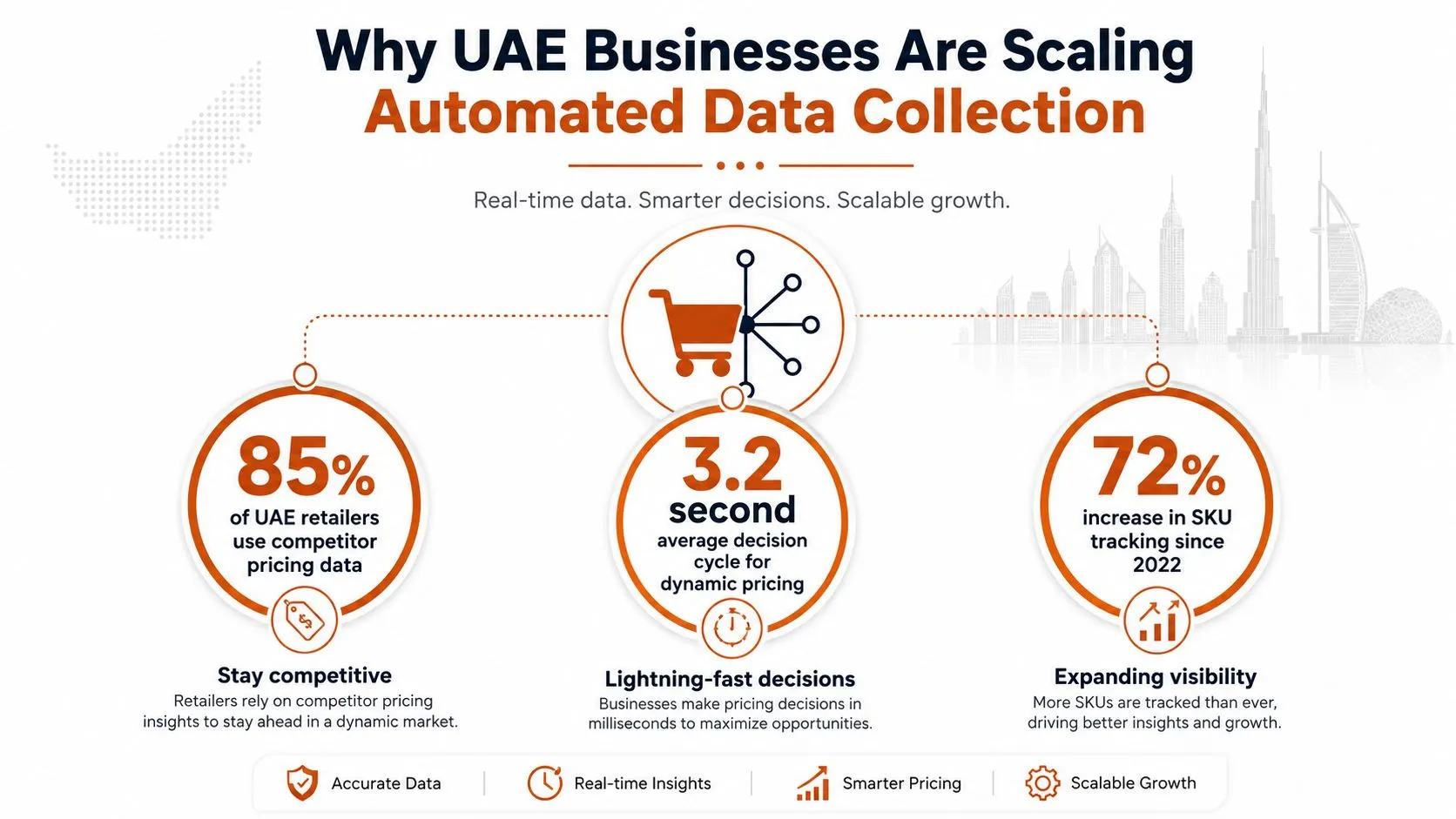
A pricing analyst in Dubai can get through one category review manually, maybe two. Then the day starts to slip. A promotion disappears from one retailer, a bundle changes on another, and a delivery ETA shifts by neighborhood, so the analyst is left reconciling screenshots instead of making a decision. That’s the reason automated data collection keeps replacing spreadsheet work in the UAE.
The broader market backdrop matters. One 2026 industry guide places the UAE e-commerce market at about US$12.28 billion, and it frames scraping as a practical way to collect thousands of pages in minutes for pricing, business intelligence, and lead generation, while also drawing a clear line between public business data and personal data without consent for compliance-sensitive use cases. The same guide notes that scraping publicly available business data is legal in the UAE, which is why teams use it for retail monitoring, travel intelligence, and lead enrichment rather than treating it as a workaround for the law. For a practical overview of the business case, Smart Classic Business Hub’s 2026 guide is a useful companion read.
Manual monitoring breaks down fast
Manual checks fail for a simple reason, the UAE market is concentrated enough that competitors’ moves show up quickly, but broad enough that those moves have to be tracked across multiple platforms. A team can’t reliably watch every SKU, every promo flag, every stock indicator, and every neighborhood-specific delivery condition by hand. That’s why structured monitoring approaches matter more than one-off pulls.
Practical rule: If a data point changes often enough to affect price, stock, or fulfillment, it should be collected on a cadence, not during ad hoc spot checks.
The 2025 UAE-focused market report reinforces that this isn’t a passing experiment. It says the market is expected to grow at over 15% CAGR through 2025, and its examples show competitor-price monitoring expanding from 20,000 scraped price points in 2020 to 100,000 in 2025, with revenue growth moving from 5% to 15% over the same period. Another example shows products monitored increasing from 50,000 to 200,000, while conversion growth rises from 4% to 16%. Taken together, those figures show how automated collection becomes an operating layer, not a reporting luxury.
What a good pipeline actually delivers
A proper pipeline doesn’t just dump page text into a file. It gives the commercial team structured fields, clean timestamps, and stable history that can support decision-making across categories. In practice, that means the analyst stops spending the morning copying data and starts reviewing the exceptions that need human judgment.
The best outcome is boring in the right way. Prices arrive consistently, promotions are normalized, and the business can compare what changed yesterday with what’s live today without re-reading the source site every hour. For UAE teams dealing with frequent assortment changes, that’s the difference between reactive tracking and usable intelligence.
Key Data Fields and Metadata for UAE Commerce Intelligence
Not all scraped data is equally useful. A product title alone doesn’t tell you whether a competitor is winning on price, whether stock is available in a specific area, or whether a delivery promise changed after a campaign launch. For UAE commerce intelligence, the value sits in the field structure, not in the raw page count.
Core fields that actually drive decisions
The first layer is obvious, but it has to be captured cleanly. Teams need product titles, SKUs, variant attributes, listed price, discounted price, and image references. In retail and marketplace work, those fields anchor everything else, from catalog matching to price parity checks. In quick commerce, the same base set becomes more useful when it is paired with seller or store identifiers so the same item can be tracked across locations.
A useful schema also includes inventory signals when they’re available, because out-of-stock and limited-availability states change how pricing should be interpreted. Scraping services that support e-commerce monitoring often extract product names, SKUs, prices, stock levels, product variants, ratings, and shipping costs by region, which aligns closely with what commerce teams act on. For a price-monitoring view of that field logic, this guide on ecommerce price monitoring is a strong reference point.
Useful filter: If a field won’t change a pricing, merchandising, or fulfillment decision, it probably doesn’t deserve a slot in the core schema.
Metadata is where hyperlocal intelligence starts
For UAE quick-commerce use cases, the important layer is contextual metadata. That includes delivery SLAs, basket-level fees, promotion flags, store or ZIP-code tags, and the timestamp attached to each record. The practical reason is simple, a price without time and location can be misleading, especially when delivery windows and fees vary by area and time of day.
The current service pages for UAE quick commerce emphasize basket pricing, delivery ETAs, location-specific comparisons, and event-based campaigns such as Ramadan and White Friday. That points to a shift from static product feeds toward city- and neighborhood-level operational data. In other words, the feed has to say not just what the item costs, but where it costs that amount, when it was seen, and what service promise came with it.
Schema discipline prevents downstream friction
Good teams also track schema versioning. When a retailer changes a field label, a delivery widget is rendered differently, or a promo badge disappears, downstream systems need a consistent contract. Without that, the data lands in analytics but breaks joins, dashboards, or training pipelines.
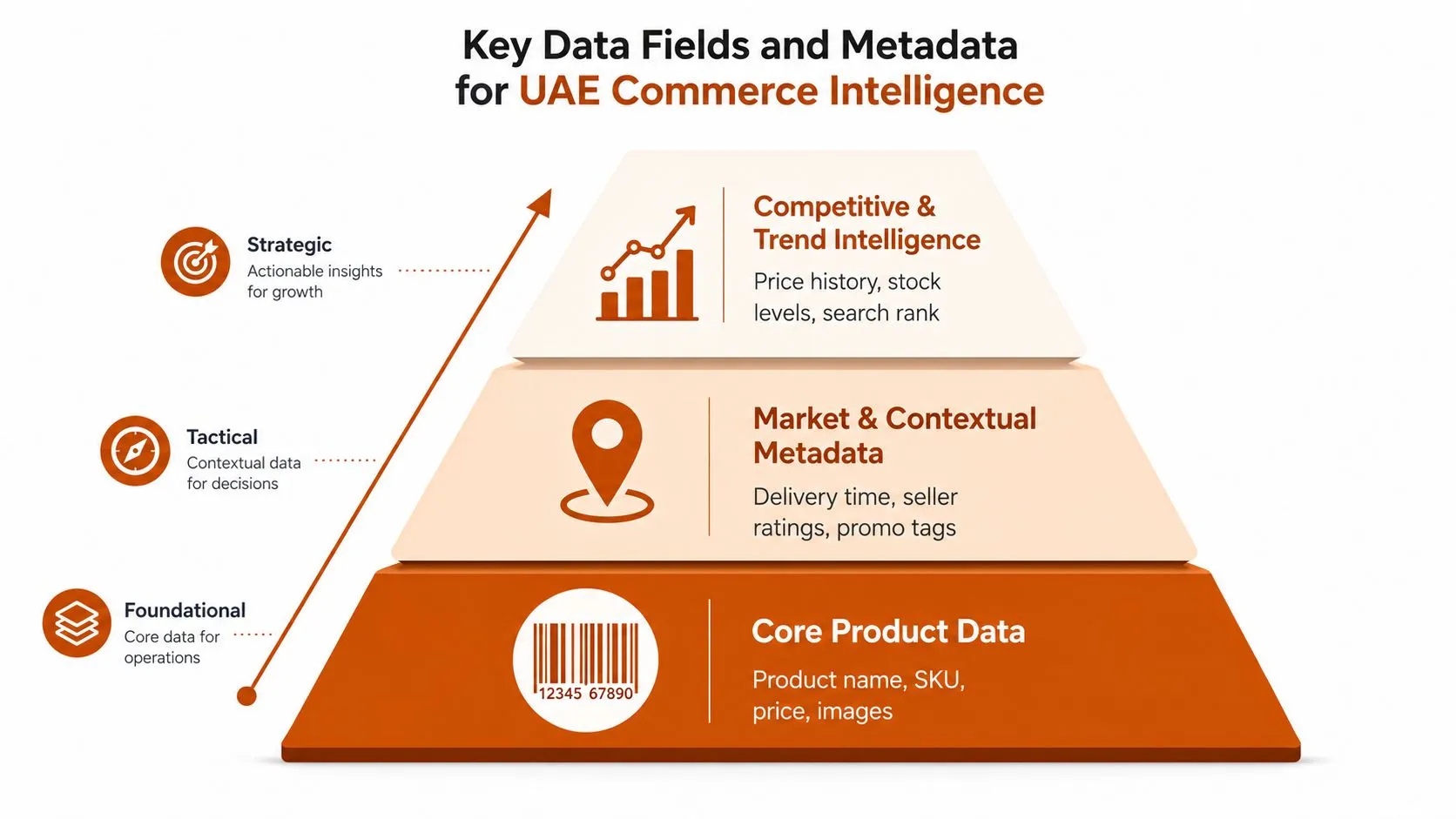
A pyramid view helps here:
- Core product data at the base.
- Market and contextual metadata in the middle.
- Competitive and trend intelligence at the top.
That hierarchy keeps the team from overvaluing vanity signals and underweighting the fields that support recurring decisions. The result is a schema that can survive both commercial change and site change.
Comparing Data Collection Methods for UAE Platforms
Teams usually consider three paths: official APIs, data marketplaces, and custom web scraping. The right answer depends on how much coverage you need, how fresh the data must be, and how much maintenance your team can tolerate once the first extraction is live.
Side-by-side trade-offs
| Method | Coverage | Freshness | Cost | Maintenance |
|---|---|---|---|---|
| Official APIs | Usually narrow and controlled | Often limited by provider rules | Often predictable but constrained | Lower at first, then limited by missing fields |
| Data marketplaces | Broader than one API, but still packaged | Often not tuned for live neighborhood-level change | Can be efficient for standard use cases | Lower operational burden, but less flexible |
| Custom web scraping | Can reach the exact pages and fields you need | Best when scheduled tightly | Higher setup effort, especially for complex sites | Higher without managed operations, lower with a strong provider |
Official APIs are attractive because they feel clean and supported, but they rarely expose the messy operational fields that matter in UAE retail and quick commerce. If the platform does not publish the exact basket fee, promo badge, store-specific ETA, or location-specific offer you need, the API can be technically correct and commercially useless. For a practical comparison of those constraints, this API versus scraping guide is worth reading.
Where each method falls short
Data marketplaces help when the question is broad market visibility. They struggle when you need hyperlocal freshness or a custom schema aligned to your own pricing engine. A marketplace feed can tell you a lot, but it won’t always tell you what changed in a particular neighborhood after a promotion went live.
Custom scraping becomes the only workable path when the business needs source-specific detail. That’s especially true for retailers and quick-commerce operators who want continuous feeds across platforms with different layouts, anti-bot controls, and delivery logic. The cost is higher at the start, but the coverage and granularity are harder to match any other way.
How to choose without overbuilding
Choose the simplest source that still returns the fields you need at the cadence you need. If a platform’s API covers 80 percent of the use case but misses location and time-sensitive fields, that missing 20 percent often carries most of the business value. If the target is a competitor basket feed across multiple UAE marketplaces, the extra flexibility of custom extraction usually pays for itself in fewer manual corrections.
The decision is less about ideology and more about fit. Teams that need stable, recurring, geo-specific commerce data usually end up with a scraping layer, then wrap it with validation and monitoring so the output stays usable.
Technical and Legal Challenges in UAE Web Scraping
The hardest part of UAE scraping is rarely the first page load. The problem starts after the pipeline is live and the platform shifts a layout, adds a CAPTCHA, or begins treating repeat traffic as suspicious. In production, breakage tends to show up without warning, then spread across the feed fast.
Anti-bot controls that cause trouble
UAE-targeted platforms can rely on rate limiting, session-based blocking, IP fingerprinting, and CAPTCHA walls. Static requests often fail on JavaScript-heavy product pages, baskets, and delivery widgets, which is why a hybrid pipeline is usually the practical design for retail and quick-commerce targets. The usual setup is to capture static HTML with conventional crawlers, render dynamic pages with a headless browser layer such as Playwright or Selenium, then normalize the output into a structured feed. That is the approach described in the UAE retail scraping guidance from Kanhasoft.
In practice, teams usually respond with a few controls.
- Proxy rotation to reduce repeat-source blocking.
- Browser fingerprint randomization to make automation look less uniform.
- Request pacing so traffic doesn’t resemble a burst attack.
- Session handling for carts, logins, and delivery widgets that depend on cookies.
A scraper that works on Tuesday and dies on Thursday usually failed because the site changed its expectations, not because the data disappeared.
Legal boundaries are narrower than many teams assume
The legal distinction in the UAE matters. The 2026 business guide cited earlier says scraping publicly available business data is legal in the UAE, while scraping personal data without consent is not. That means the compliance question is not whether scraping exists, but whether the target data belongs to a lawful business-intelligence use case or crosses into personal information.
For founders and operators who need a broader privacy lens, Founder Connects explains UAE PDPL in a way that helps frame the practical risk. For a closer look at the legal side, see this guide on 5 legal risks in web scraping and how to mitigate them. The point is simple, legal review should happen before scaling extraction, not after the first feed goes live.
The same logic applies to terms of service and site-specific restrictions. A team can technically extract data and still create unnecessary risk if it ignores consent boundaries, over-collects, or stores personal data it doesn’t need. The safer architecture collects only what the business can justify, keeps the schema tight, and avoids mixing public commerce data with personal records.
Production teams separate access from usage
Strong teams treat scraping as an access layer, not as permission to use everything they can see. They log what was collected, why it was collected, and where the output will be used. That discipline keeps legal, operations, and analytics aligned, and it reduces the chance that a useful feed turns into a compliance problem later.
Building Reliable Scheduled Extraction Pipelines
One-off scraping is useful for a proof of concept. It’s not enough for a commerce feed that has to survive promotions, layout changes, and constant price movement. The move to production happens when the team stops asking, “Can we get the data?” and starts asking, “Can we keep getting it on the right cadence?”
Cadence has to match volatility
For UAE marketplaces and grocery platforms, scheduled extraction plus deduplication matters more than one-off pulls. The reason is straightforward, fast-changing price, stock, and promotion data loses value quickly if it isn’t refreshed and cleaned on a predictable cadence. Providers targeting these platforms describe hourly, daily, or weekly pulls, and that cadence is usually driven by how often the underlying source changes.
The extraction schedule should follow the business question, not the engineering convenience. A competitor price feed may need tighter checks than a catalog enrichment job. A location-specific delivery ETA feed may need a different refresh pattern from a weekly assortment audit.
Validation catches drift before the business does
Reliable pipelines don’t wait for a dashboard to fail before they react. They validate field presence, type consistency, and record shape before delivery. That matters because a site can change a class name, move a promo badge, or alter its pagination logic without changing the product page in a way a human would immediately notice.
Cross-platform deduplication is part of the same job. If the same SKU appears under slightly different naming patterns across platforms, the feed has to match records before analysts can compare them. Without that step, the output looks complete but gives misleading comparisons.
Operational controls keep feeds usable
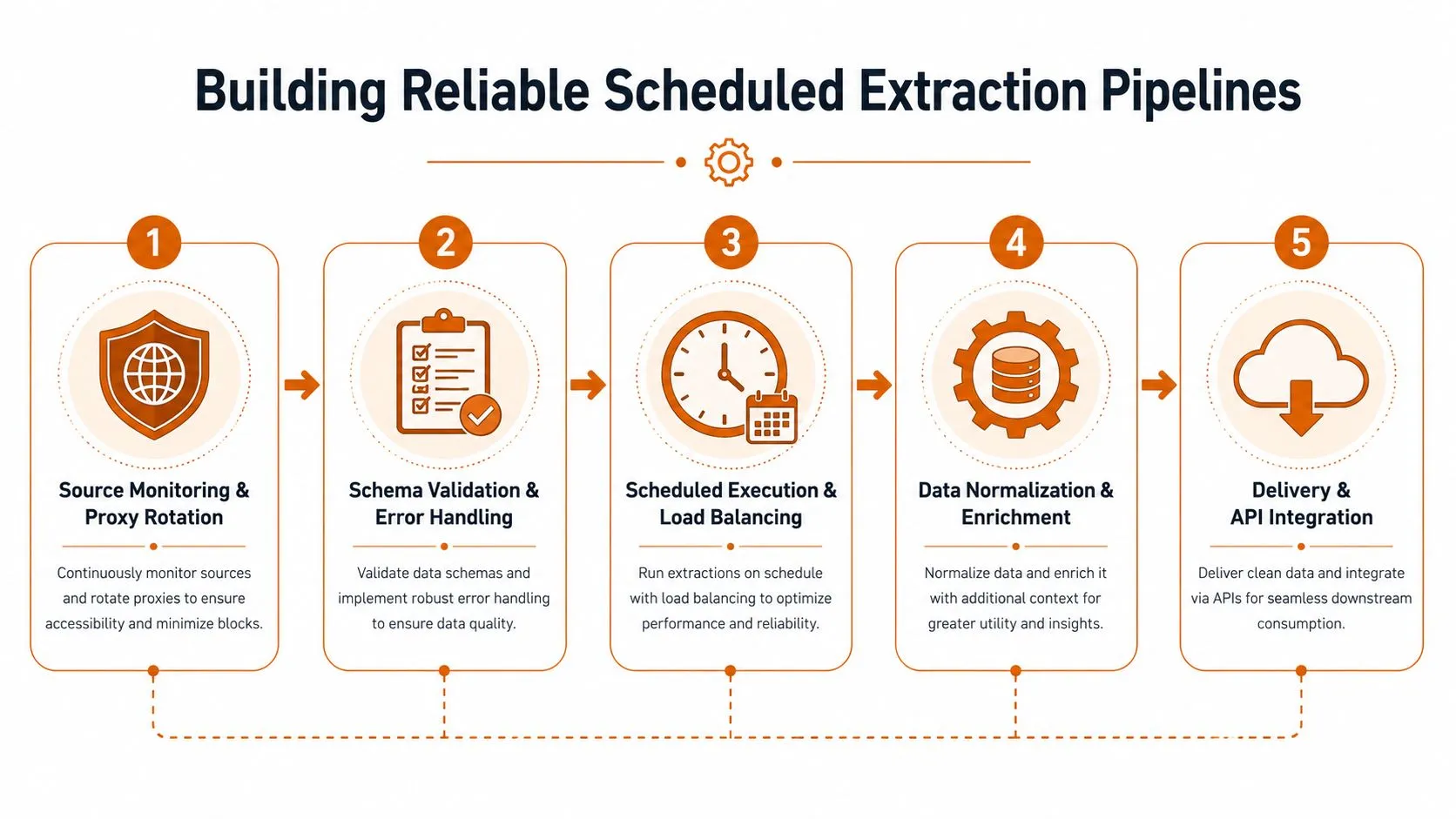
A stable pipeline usually includes source monitoring, schema validation, scheduled execution, normalization, and delivery integration. For deeper implementation detail, this guide on building scalable data pipelines with Scrapy lines up well with production practice.
Operational test: If your team can’t explain how the pipeline detects change, retries failures, and confirms delivery, it’s not a pipeline yet. It’s a script with optimistic branding.
The end state is a feed that lands in the analyst’s system already cleaned, matched, and timed. That’s the difference between an extraction job and an operational data layer.
The Case for Managed Web Data Operations
Teams often start by building scraping in-house because the first use case looks manageable. Then the maintenance starts. Proxies need tuning, CAPTCHAs appear, selectors drift, and someone on the engineering team gets pulled away from product work to keep a price feed alive.
That hidden load is why managed operations make sense for many UAE programs. A service team absorbs the infrastructure work, monitors failures, retries jobs, and adjusts to site changes so internal teams can focus on using the data. In enterprise settings, that matters even more when the workflow extends beyond retail into compliance, ad verification, or multi-geo collection where the output has to be consistent enough for recurring review.
WebscrapingHQ is one option in that managed model, since it runs extraction pipelines and structured delivery on fixed schedules, but the broader point is operational. If a team needs recurring CSV, JSON, PDF, webhook, or S3 delivery, plus maintenance around site changes and anti-bot defenses, a managed provider often reduces the amount of internal engineering tied up in upkeep. That’s especially relevant when a feed has to support multiple countries, multiple languages, or frequent refreshes.
The main trade-off is control versus focus. DIY gives direct control, but it also pulls your developers into scraper triage. Managed operations shift that burden outward, which is often a better use of time when the extraction layer is not your core product. If data freshness, reliability, and delivery consistency matter more than owning every line of scraper code, the managed model usually wins on total effort.
Evaluating and Engaging a UAE Scraping Service Provider
A good provider is not the one with the slickest pitch. It’s the one that can tell you, before launch, which sources are feasible, which fields will need browser rendering, and what the failure points are likely to be. If they can’t do that, they probably haven’t operated enough pipelines in production.
What to check before signing
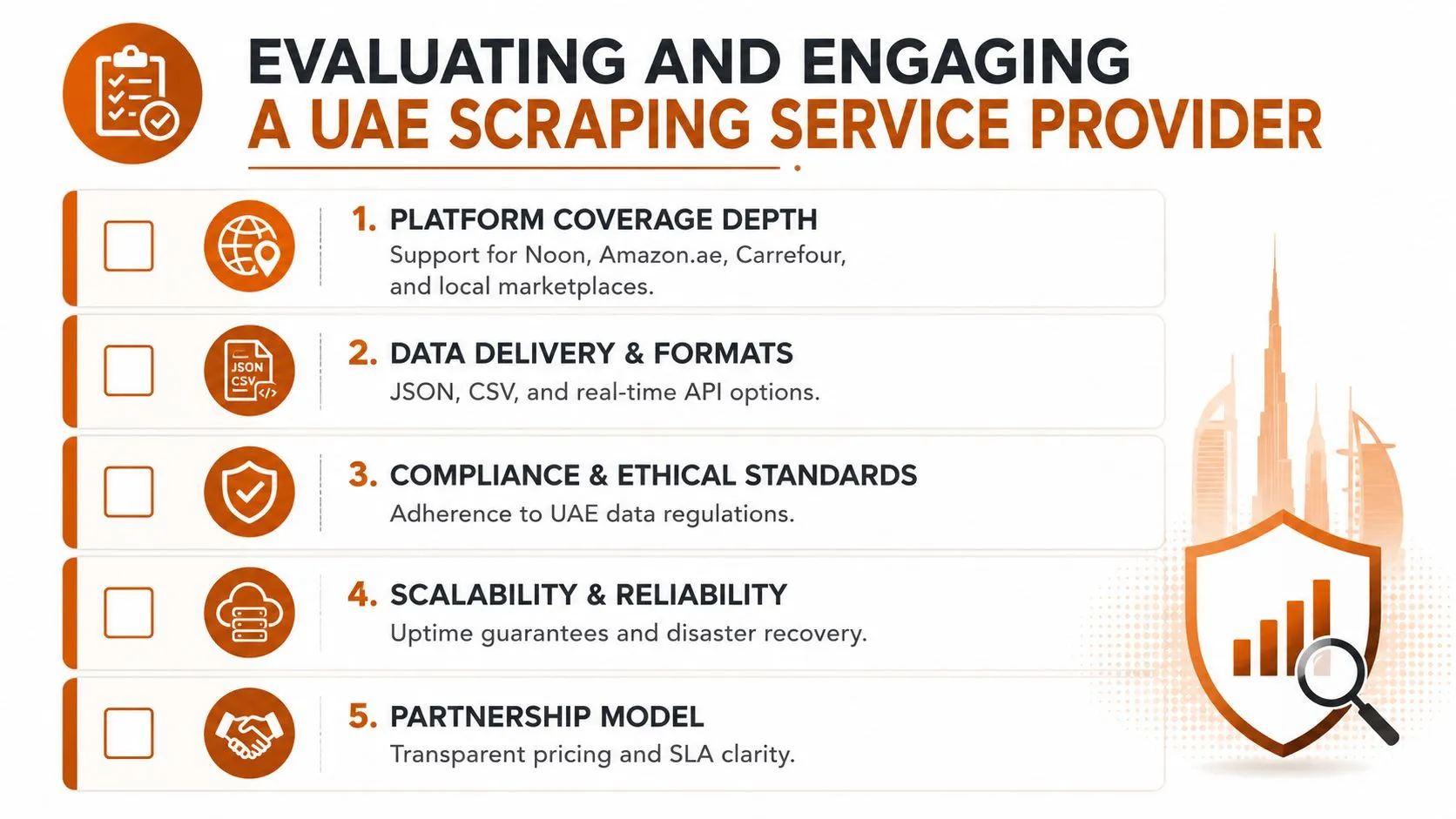
The first filter is platform coverage depth. A provider should be able to show whether they can reach Noon, Amazon.ae, Carrefour, and other local marketplaces, and what they do when those pages shift structure. The second is delivery flexibility, because some teams need JSON feeds while others need CSV, PDF, or real-time integration.
Other criteria matter just as much:
- Compliance and ethical standards, especially around UAE data rules and personal information boundaries.
- Scalability and reliability, including how they handle retries, monitoring, and disaster recovery.
- Partnership model, meaning pricing clarity, SLA clarity, and whether the provider aligns to quality rather than just raw volume.
For a practical reference point on infrastructure location and market context, Khazna Data Center Abu Dhabi is useful background for teams thinking about regional data handling and hosting choices.
How to structure a pilot
A pilot should test the messy part of the work, not the easy part. Give the provider a source with dynamic elements, a realistic refresh cadence, and a schema that includes the fields your business uses. Then confirm how they handle schema versioning, duplicates, and the inevitable edge case where a field moves or disappears.
The best engagement models are usually campaign-based for short-term monitoring and monthly recurring deliveries for ongoing intelligence. Contract terms should reward data quality, not just throughput. That keeps everyone focused on feeds that remain usable after launch, not just on getting the first export out the door.
Commercial truth: The cheapest quote can become the most expensive option once your analysts have to repair every feed by hand.
The teams that get the most value from web scraping services UAE are the ones that treat provider selection like an operations decision, not a procurement formality. They ask about coverage, cadence, governance, and resilience, then choose the partner that can keep the feed dependable after the first month.
If you need commerce feeds that stay fresh after the launch week, WebscrapingHQ can scope, build, and run managed extraction pipelines for UAE retail and quick-commerce targets with structured delivery on a fixed schedule. Visit WebscrapingHQ to review the service model, then map your sources, refresh cadence, and downstream format requirements to a pilot that fits your workflow.
Want this done for you?
Send us the URLs. We'll quote it in 24 hours.
Paste the URL(s) you want scraped. We'll reply within 24 hours with a feasibility check and a ballpark quote.