Jump to section
- What AI-Augmented Jewelry Data Scraping Actually Means
- A production definition
- Why Jewelry Catalogs Break Conventional Scrapers
- The taxonomy problem
- The Architecture of an AI-Augmented Jewelry Pipeline
- Layer one, access and rendering
- Layer two, extraction and visual interpretation
- Layer three, constrained normalization and review
- Comparing Traditional and AI-Driven Extraction Approaches
- Accuracy isn’t one number
- From Raw Listings to AI-Ready Jewelry Schemas
- The record-building sequence
- Anomaly detection before delivery
- Compliance, Surveillance, and Image Intelligence Use Cases
- Evidence changes the workflow
- Responsible collection boundaries
- Trade-Offs, Failure Modes, and When to Build or Buy
- Audit the failure modes
- A practical build-or-buy decision
Online jewelry retailers sold $5.63 billion in 2022, and the category’s Top 1000 online retailers reached $6.25 billion in sales in 2023, when their share of total jewelry retail sales rose to 29.2%. During that same period, median monthly unique users more than doubled, from 333,017 to 688,934, while the median ticket price moved from $326 to $337. These figures, reported by Digital Commerce 360’s jewelry e-commerce analysis, explain why jewelry data scraping is no longer just a price-monitoring exercise. A small change in assortment, product attributes, or ticket size can affect decisions across merchandising, search, compliance, and competitive intelligence.
The difficult part isn’t collecting a product URL, SKU, or displayed price. It’s turning inconsistent, multilingual, visually encoded information about gemstones, cuts, carats, metal finishes, clasps, and sustainability claims into records that an AI system can use without filling gaps with guesses. Production-grade jewelry data scraping combines deterministic extraction with browser rendering, OCR, computer vision, language models, validation rules, and human review.
What AI-Augmented Jewelry Data Scraping Actually Means
AI-augmented jewelry data scraping is a collection pipeline in which conventional parsers handle predictable fields and AI models interpret the parts of a product page that aren’t reliably represented in HTML. A browser renderer may first load a JavaScript-heavy product detail page, expand variant controls, and capture lazy-loaded images. A parser then extracts the obvious values, such as product name, currency, price, SKU, availability, and visible description.
The messy attributes follow a different path. A ring’s gemstone color may appear only in a swatch image. Its cut grade may be present in image alt text, while its metal purity sits inside a downloadable PDF. A clasp type might be visible in a zoomed photograph but absent from the product description. Research on e-commerce attribute extraction notes that sellers often omit or mislabel fields such as color and size, which forces systems to combine text and image signals rather than depend on catalog labels alone. The research paper on multimodal product attribute extraction documents this broader technical problem.
A production definition
A useful pipeline separates responsibilities:
- Render the page so dynamic content, variant selectors, accordions, and gallery images become available.
- Parse deterministic fields with DOM selectors, JSON-LD extraction, regular expressions, and platform-specific rules.
- Read visual evidence with OCR and image models when the page encodes meaning in photographs, labels, swatches, or certificates.
- Normalize attributes into a controlled schema rather than preserving every merchant’s naming convention.
- Validate and review uncertain records before they reach pricing systems, search indexes, or machine-learning datasets.
The language model isn’t a magical replacement for every parser. It works best as a constrained merger that reconciles evidence already collected from the page. A model can compare “18k yellow gold” in a description with “AU750” in a specification and map both to a standard representation. It shouldn’t invent a karat value when neither source supports one.
Practical rule: Use models for ambiguity, not for fields that a reliable parser can extract directly.
This approach also supports adjacent workflows, such as designing or visualizing a new piece with an AI jewelry design tool, where consistent material and gemstone terminology helps teams move between creative concepts and structured product data. For broader context on why teams are combining browser automation with AI parsing, see this explanation of why data-driven businesses need an AI website scraper.
Why Jewelry Catalogs Break Conventional Scrapers
Jewelry storefronts expose a difficult combination of dynamic presentation and nuanced product semantics. Many luxury and direct-to-consumer sites render product information client-side, lazy-load gallery images, and hide specifications behind expandable panels. The visible page may show a product name and price while the meaningful details sit in SVG icons, image metadata, variant controls, or a document loaded after the initial request.
A conventional DOM scraper can find a price reliably until a retailer changes its theme. It may also treat every variation as the same parent SKU, even when metal color, ring size, or stone selection changes the commercial offer. A finish option might appear only in a thumbnail, and a ring-size guide may use an image rather than selectable text. These aren’t edge cases for jewelry. They’re common ways merchants present information to shoppers.
The taxonomy problem
Even when two merchants expose the same concept, they may use incompatible names. One feed might use stone_type, another material_category, and a third might describe the stone only in prose. “White gold,” “white-gold tone,” and “platinum” can also look similar in product photography while representing different materials.
| Attribute | Merchant A, DOM text | Merchant B, image-only | Merchant C, PDF spec |
|---|---|---|---|
| Gemstone | “Sapphire” in product description | Blue stone visible in gallery image | Stone name in certificate |
| Metal finish | “Yellow gold” in variant selector | Warm metallic tone in photograph | Purity and finish in specification sheet |
| Clasp | Written as “lobster clasp” | Clasp visible only in close-up image | Hardware detail in downloadable document |
| Ring size | Selectable text option | Size guide rendered as an image | Measurement table in PDF |
Anti-bot systems add another layer of uncertainty. Rotating fingerprints, CAPTCHAs, IP restrictions, and JavaScript challenges can prevent a fetch service from reaching the page at all. A resilient system therefore needs source-aware fetching, retry logic, browser automation, and an explicit compliance policy. It shouldn’t treat a blocked request as an empty product record.
Visual extraction deserves its own operating model. Teams collecting gallery data need to preserve image URLs, dimensions, alt text, and capture timestamps, then pass relevant assets to OCR or vision models. The practical considerations behind that workflow are covered in this guide to web scraping images. The key point is simple: a text-only scraper can collect a jewelry catalog while still missing much of what makes each item distinct.
The Architecture of an AI-Augmented Jewelry Pipeline
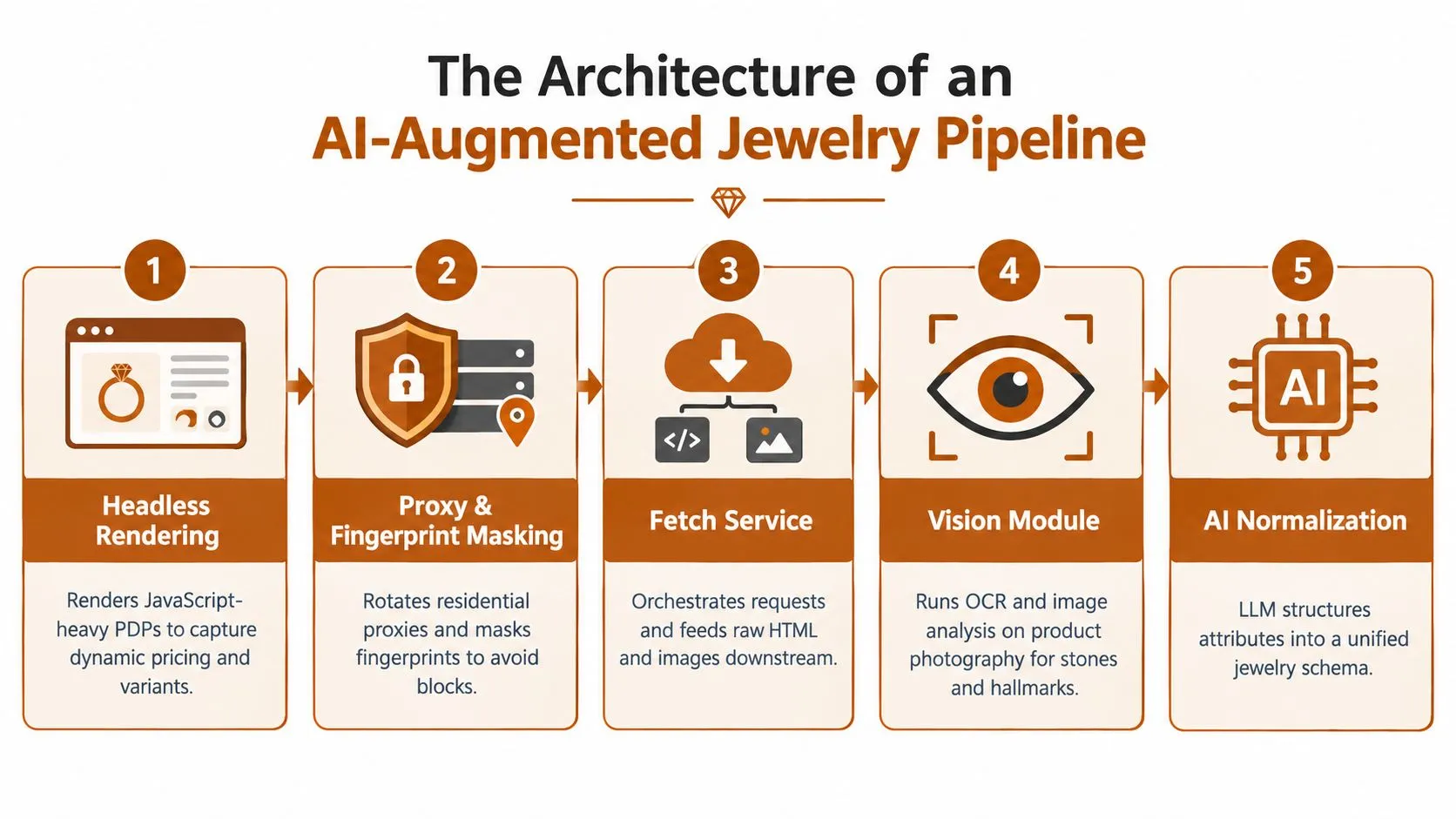
A reliable system is layered. Each layer has a narrow job, produces observable outputs, and can fail without corrupting the entire dataset.
Layer one, access and rendering
The fetch service begins with a URL queue, source rules, and a browser strategy. Static pages may need only an HTTP request, while interactive product detail pages require headless rendering to execute JavaScript, click variant controls, and load gallery assets. Proxy rotation and request fingerprint management can help with access reliability, but they must sit inside a responsible collection policy that respects applicable rules, rate limits, and site restrictions.
The output shouldn’t be only final JSON. Store the raw HTML, rendered page state, response metadata, image references, and capture time where permitted. Those artifacts make debugging possible when a merchant changes its layout or a reviewer challenges a value.
Layer two, extraction and visual interpretation
A deterministic parser handles price, currency, SKU, canonical URL, breadcrumbs, and structured data when those fields are present. OCR reads rendered labels, hallmark text, size charts, and specification images. A vision encoder can classify visual cues such as gemstone hue, setting style, or the presence of a particular clasp, but it should return evidence and confidence rather than an unexplained conclusion.
Research on product understanding describes systems that combine product text, OCR tokens, and visual objects, while newer approaches use image extraction and language-model merging to normalize noisy attributes. This product understanding research supports the architectural choice to combine modalities instead of forcing every attribute through one model.
For example, a ring description may contain AU750, while the photograph has a warm yellow tone. The merger can map the textual hallmark to 18k gold, retain the image-derived tone as supporting evidence, and mark the visual classification as lower confidence than the explicit text. It shouldn’t infer that the ring is solid gold merely because the image looks warm.
A marketplace-specific connector can also reduce custom work for recurring sources. For instance, an Etsy scraping API may provide a structured starting point for marketplace listings, after which a normalization layer still needs to reconcile Etsy fields with the rest of the organization’s jewelry schema.
Layer three, constrained normalization and review
The LLM receives extracted text, OCR tokens, image labels, and source metadata. Instead of asking for free-form prose, the system supplies a strict schema containing fields such as:
- Materials: metal, karat, plating, finish
- Stone details: type, cut, color, clarity, carat
- Construction: setting, clasp, chain style, dimensions
- Commercial fields: SKU, variant, price, availability, source URL
Constrained decoding prevents the model from creating unsupported fields or inconsistent enum values. Confidence thresholds route ambiguous records to a reviewer. Validated examples can later improve lightweight classifiers, while deterministic rules continue to protect high-value fields from model drift. The computer-vision considerations behind this pattern are explored in computer vision feature extraction.
Comparing Traditional and AI-Driven Extraction Approaches
Traditional extraction remains valuable because jewelry pages still contain many predictable fields. CSS selectors, XPath, JSON-LD parsing, and regular expressions are fast, inexpensive to operate, and easy to test when a page template is stable. They’re usually the right first choice for product names, prices, currencies, SKUs, canonical URLs, and clearly labeled availability.
The weakness appears when the merchant expresses meaning outside stable text nodes. A selector can retrieve the img element, but it can’t reliably determine whether a photograph shows rose-gold plating, solid rose gold, or warm studio lighting. A regular expression can find a carat value, but it won’t know whether the value describes the center stone, a total diamond weight, or a comparison product mentioned in nearby copy.
| Dimension | Traditional DOM/XPath | AI-Driven Multimodal |
|---|---|---|
| Price and SKU | Strong when markup is stable | Useful as a fallback, but unnecessary for clean fields |
| Gemstone and cut | Weak when values are visual or inconsistently labeled | Can combine text, OCR, and images, subject to confidence limits |
| Metal purity | Strong when explicitly written | Can reconcile hallmarks, PDFs, and descriptions |
| Dimensions and sizes | Good for labeled text, fragile for image charts | OCR can read charts, but units and context require validation |
| Template changes | Selectors need maintenance | Semantic extraction can tolerate some layout drift, but still needs monitoring |
| Numerical claims | Regex preserves source text | Language models may hallucinate unsupported carat or size values |
| Operating cost | Lower per record | Higher because browser, vision, and model inference add expense |
| Auditability | Clear source node when captured | Requires evidence links, crops, OCR output, and model traceability |
Accuracy isn’t one number
Teams often ask which approach is “more accurate,” but accuracy depends on the field. A DOM parser may outperform a language model on a plainly labeled price. A vision model may recover a clasp type that no text parser can see. An LLM may normalize “14KT,” “14k,” and “585 gold” correctly, but it may also turn an ambiguous phrase into a confident numerical carat value.
The right evaluation is field-level. Create a labeled sample across merchants, languages, product types, and image conditions. Measure exact matches for prices and SKUs, enum agreement for metal and stone fields, unit correctness for dimensions, and unsupported-value rates for model-generated attributes. Track review volume and maintenance work alongside technical quality.
A model that extracts more fields isn’t automatically better. It’s better only when the additional fields are supported, normalized, and useful downstream.
Traditional systems also fail differently. A Shopify theme update can break selectors overnight. A multimodal system may continue returning records while misreading a new size-chart design. Production monitoring must therefore test both missing values and plausible-looking wrong values. The latter are more dangerous because they can pass basic completeness checks.
From Raw Listings to AI-Ready Jewelry Schemas
Consider a multi-merchant jewelry feed arriving as raw product pages, gallery images, variant data, and specification documents. The first record may describe “14KT gold,” the second may say “14k,” and the third may use “585 gold.” A useful pipeline preserves the original wording, then maps each supported expression to a controlled metal enum without losing provenance.
The record-building sequence
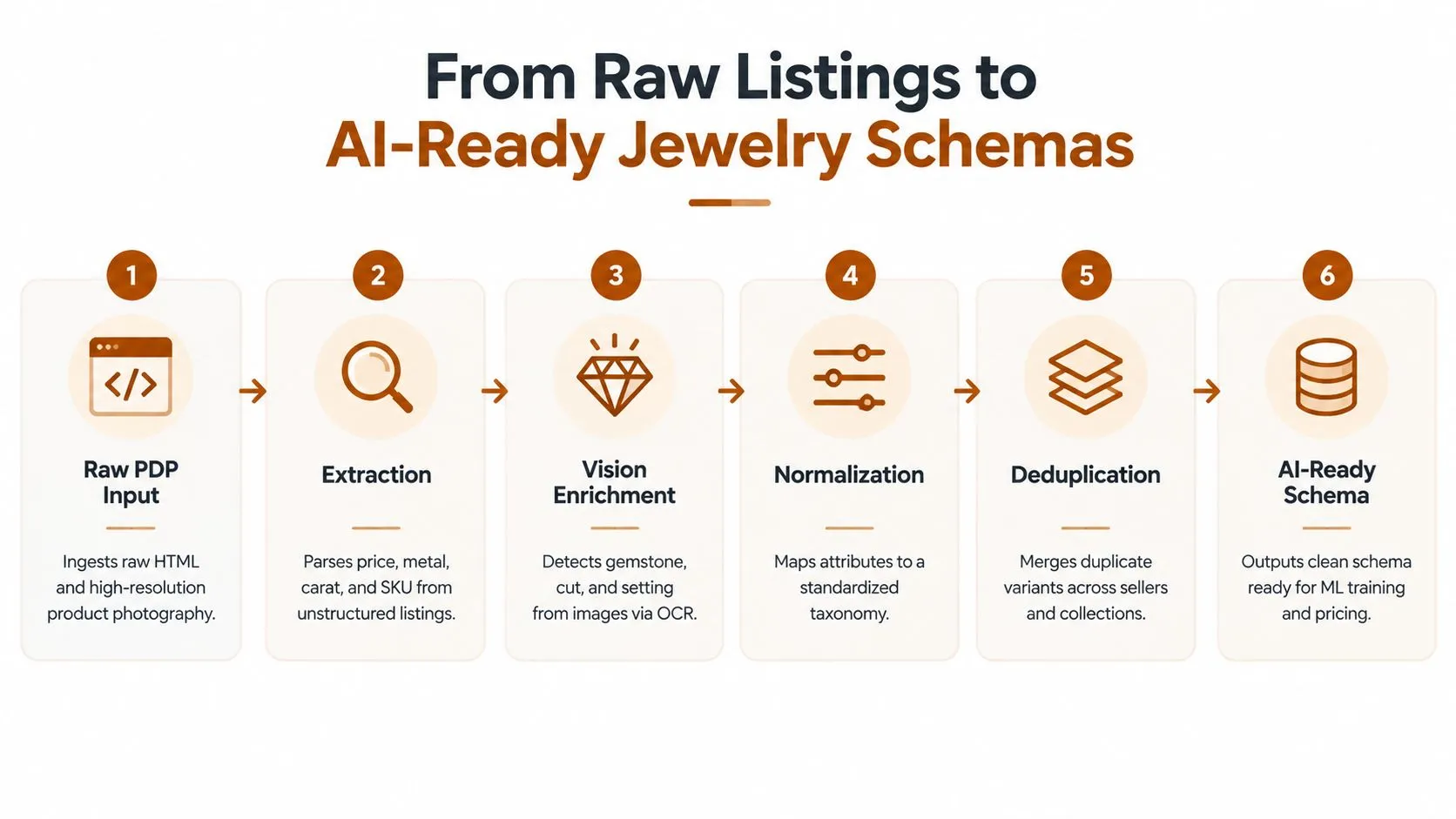
Raw input comes first. Store the rendered HTML, structured data, product images, PDFs, source language, and merchant identifier. Preserve the original evidence because normalized values without provenance are difficult to audit.
Field extraction follows. Parsers collect direct text values, while OCR and vision modules inspect relevant assets. The system should distinguish explicit evidence, such as a written hallmark, from inferred evidence, such as a color classification based on a photograph.
Normalization creates consistency. Map variants into controlled values for metal, karat, stone, cut, clasp, finish, dimensions, and ring size. Convert units only when the source unit is known, and retain both normalized and source representations. A millimeter measurement shouldn’t be treated as a carat value, and a ring-size convention shouldn’t be compared across regions without an explicit conversion rule.
Visual embeddings add retrieval value. Image embeddings can support visual similarity search, duplicate detection, and catalog clustering. They don’t replace attribute extraction. Two pieces may look similar while using different stones, settings, or metal treatments, so visual similarity should remain a signal rather than a definitive identity match.
Deduplication resolves commercial identity. Compare canonical URLs, merchant IDs, SKU and variant fields, normalized titles, dimensions, and image similarity. A parent product with multiple metal or size options should remain connected to its variants, not flattened into one misleading row.
Schema versioning protects downstream users. If a merchant introduces a new finish taxonomy, publish a schema revision and map old records deliberately. Downstream search, recommendation, pricing, and training systems need to know whether a field changed meaning or merely received a new label. The mechanics of turning raw content into structured records are described in this guide to data parsing.
Anomaly detection before delivery
Validation rules should flag suspicious records rather than attempting to repair them. A diamond listing with an unusual combination of stated dimensions and carat information may need review. A hallmark extracted from a low-resolution image should carry lower trust than a matching value in a specification document. Conflicting evidence, abrupt price changes, duplicate photography, and impossible unit combinations can all enter a review queue.
The final schema might include source_value, normalized_value, evidence_type, confidence, source_url, image_reference, schema_version, and review_status. That structure gives an analyst enough context to decide whether an attribute is ready for publication or needs human confirmation.
Compliance, Surveillance, and Image Intelligence Use Cases
Price monitoring is only one application of jewelry data scraping. Brand owners, marketplaces, and compliance teams also need to determine whether dealers are authorized, whether resellers are presenting products accurately, and whether suspected counterfeit or gray-market listings use copied imagery.
Text matching struggles when a seller changes a product name, translates the description, or omits the brand. Image intelligence can compare listing photographs against an authorized catalog, identify reused campaign imagery, and cluster visually similar products for review. The system doesn’t make a legal determination. It gives investigators a prioritized set of listings with supporting evidence.
Evidence changes the workflow
A surveillance pipeline should produce more than a dashboard row. It can retain:
- Timestamped captures showing how the listing appeared at collection time
- Source URLs and merchant identifiers for traceability
- Image hashes and similarity references to connect suspect images with catalog assets
- Extracted JSON records containing price, seller, variants, availability, and attributes
- Field-level confidence and review notes so an analyst can explain why a listing was flagged
These artifacts help a brand protection team prepare a takedown request or internal compliance report. They also reduce the risk of presenting an AI inference as established fact. A visual match is an investigative lead, not proof of counterfeit status.
Evidence standard: Keep the original page, the extracted value, the image used for inference, and the reason for the flag together.
Responsible collection boundaries
Compliance work needs clear limits. Teams should review robots.txt and site terms, use reasonable request rates, avoid collecting unnecessary personal data, and apply relevant privacy and data-protection requirements. A dealer audit should focus on public business information and product evidence, not unrelated customer details.
Image-first collection also creates governance questions. Store only the assets needed for the stated purpose, define retention rules, and limit access to screenshots and seller information. If a model identifies a likely unauthorized listing, route it to a trained reviewer before contacting the seller or taking legal action. That combination of automation and human accountability is more defensible than an opaque alerting system.
Trade-Offs, Failure Modes, and When to Build or Buy
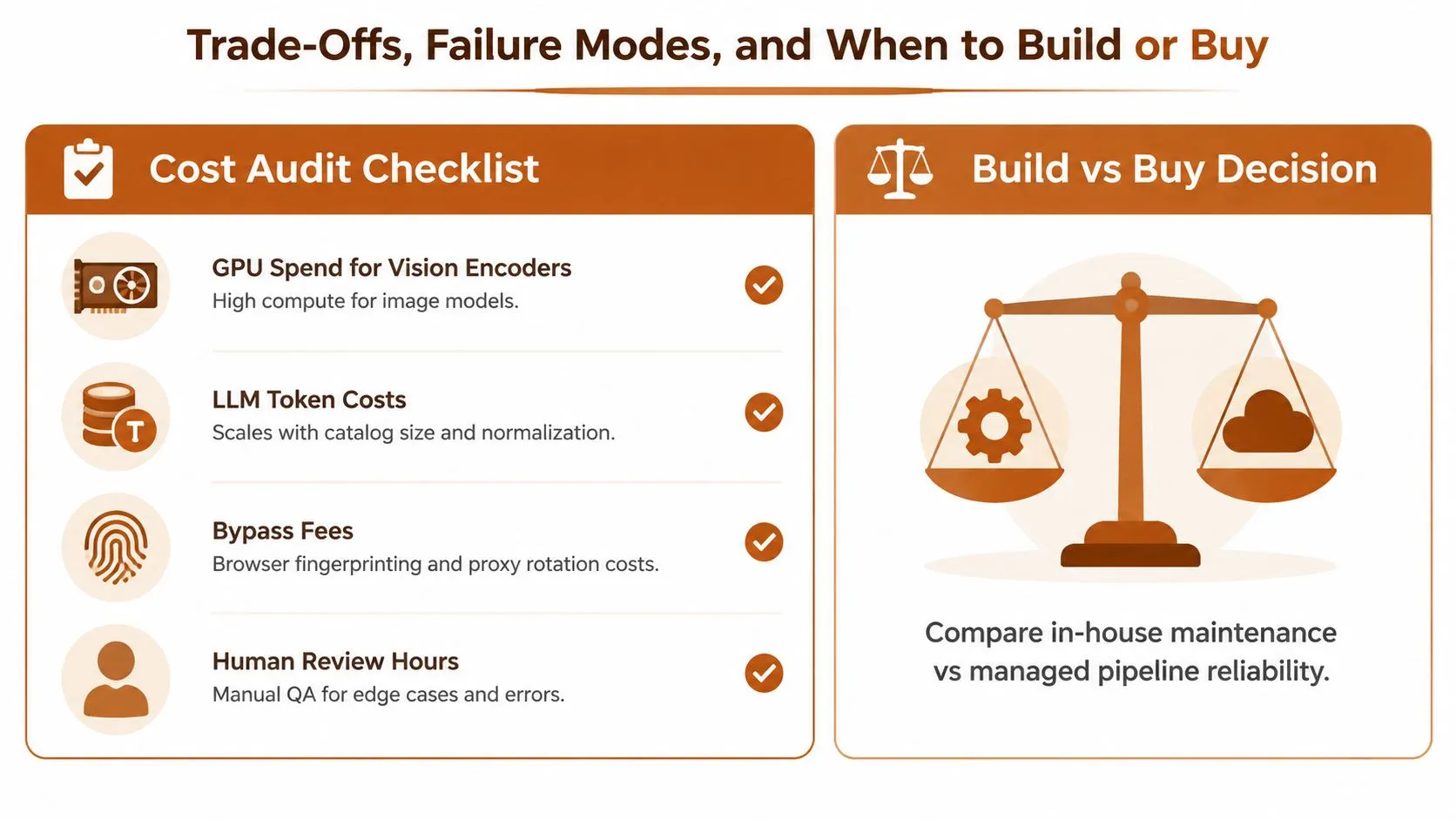
An AI-augmented pipeline carries real operating costs. Vision encoders consume compute, language-model normalization adds token usage, browser rendering requires infrastructure, access controls can add proxy or fingerprint-management expense, and difficult records still need human review. The business case depends less on whether AI is fashionable than on how much attribute depth, source variation, and evidence retention the workflow requires.
Audit the failure modes
Anti-bot defenses can stop collection before extraction begins. Use compliant access methods, source-specific throttling, retries, and monitoring rather than assuming a single browser configuration will work everywhere.
Layout drift can alter selectors, image positions, variant controls, or downloadable documents. Keep parser tests and visual regression samples so the system detects changes instead of returning empty or misleading values.
Visual ambiguity affects gemstone color, metal tone, plating, and setting style. Studio lighting, reflections, filters, and low-resolution thumbnails can cause a vision model to overstate confidence.
Language-model hallucination is especially risky for carat weights, dimensions, purity, and availability. Require source evidence, constrain output values, and reject unsupported numerical fields.
A practical build-or-buy decision
Buy or outsource when the catalog has shallow attribute requirements, the source list is manageable, and the team doesn’t want to maintain browsers, proxies, monitoring, model evaluation, and reviewer workflows. Build when the organization needs a custom multilingual taxonomy, deep visual attributes, proprietary matching logic, or evidence artifacts integrated with compliance systems.
Use these questions before choosing:
- Catalog scope: How many merchants and product variants must the system cover?
- Update cadence: How often do prices, availability, and imagery change?
- Attribute depth: Are SKU and price enough, or do you need stone, cut, clasp, finish, and sustainability fields?
- Risk profile: Will incorrect records affect legal review, dealer status, customer-facing search, or model training?
- Evidence requirements: Must every value include screenshots, image references, and review history?
- Internal capability: Can the team operate browser infrastructure, model evaluation, schema versioning, and human QA?
A managed provider can be appropriate when the workload needs recurring collection, source monitoring, custom schemas, and scheduled delivery without building every operational component internally. For teams comparing that route with internal ownership, this overview of web-scraping services versus self-management lays out the underlying trade-off.
WebscrapingHQ offers managed extraction pipelines that combine browser-based collection, custom schemas, computer vision, and LLM-assisted parsing for recurring web data work. If your jewelry catalog requires normalized gemstone and metal attributes, multilingual coverage, or image-backed compliance records, visit WebscrapingHQ to discuss the sources, fields, evidence, and delivery format you need.
Want this done for you?
Send us the URLs. We'll quote it in 24 hours.
Paste the URL(s) you want scraped. We'll reply within 24 hours with a feasibility check and a ballpark quote.